
Transforming Enterprise Intelligence Through Autonomous AI
Enterprise AI is becoming an agentic operating model, requiring data readiness, sovereignty, composable architecture, and governance.
Key Takeaways
- Enterprise AI is shifting from pilot tools to agentic operations, with global AI investment projected to reach $2.5 trillion in 2026, up 44% year over year, though many companies still struggle to turn spending into revenue.
- The core barrier is structural fragmentation: AI capabilities arrive faster than organizations can integrate them, and siloed functions prevent context from flowing across sales, support, marketing, finance, and governance.
- The agentic shift requires a new operating model, not just better models: companies must redesign processes first and connect people, workflows, and data in real time with strong governance.
- Future-ready enterprise architecture depends on AI-ready data infrastructure, composable technology stacks, and sovereign control over where models run and where data resides.
- The next test is whether process-first design, composable infrastructure, and sovereign data control can make AI operational across functions without creating new silos and can deliver sustained business value.
Meta description: MIT Technology Review Insights tracks enterprise AI from tools to agentic operations, data readiness, sovereignty, and 2026 spending of $2.5 trillion.
Tags: Enterprise AI, MIT Technology Review, Agentic Shift, Data Sovereignty, AI Governance

According to material produced by Insights, MIT Technology Review's custom content arm, not its editorial staff, Enterprise AI has crossed from pilot-stage ambition into everyday operation. Model capabilities are advancing faster than many organizations can absorb them, while the price of achieving performance keeps falling. Globally, AI investment is set to reach $2.5 trillion in 2026, up 44% from the previous year. That spending is reshaping how companies connect sales, support, marketing, finance, and governance, but many enterprises still cannot turn AI budgets into revenue or a redesigned operating model.
Background: AI Moves From Tool Layer to Operational Pressure
Earlier programs treated AI as a tool attached to existing workflows. The report describes a different expectation: intelligence must operate across functions in real time. The pressure is organizational as much as technical. Sales agents may still miss open support tickets. Marketing systems may personalize content without seeing what finance already knows about a customer. Each department can look productive on its own, yet the enterprise learns little and has less information to act upon because context does not travel between systems.
This fragmentation explains why more spending does not automatically create more value. The problem is structural: capabilities arrive faster than organizations can integrate them, and performance is becoming cheaper while the operating model remains rigid.
Development: From Model Access to Operating Model Change
The central transition is the agentic shift: AI as an operating model rather than a tool. The report says this change requires more than better models or faster infrastructure. It requires connecting people, processes, and data in real time, with governance and control that allow organizations to act on intelligence reliably.
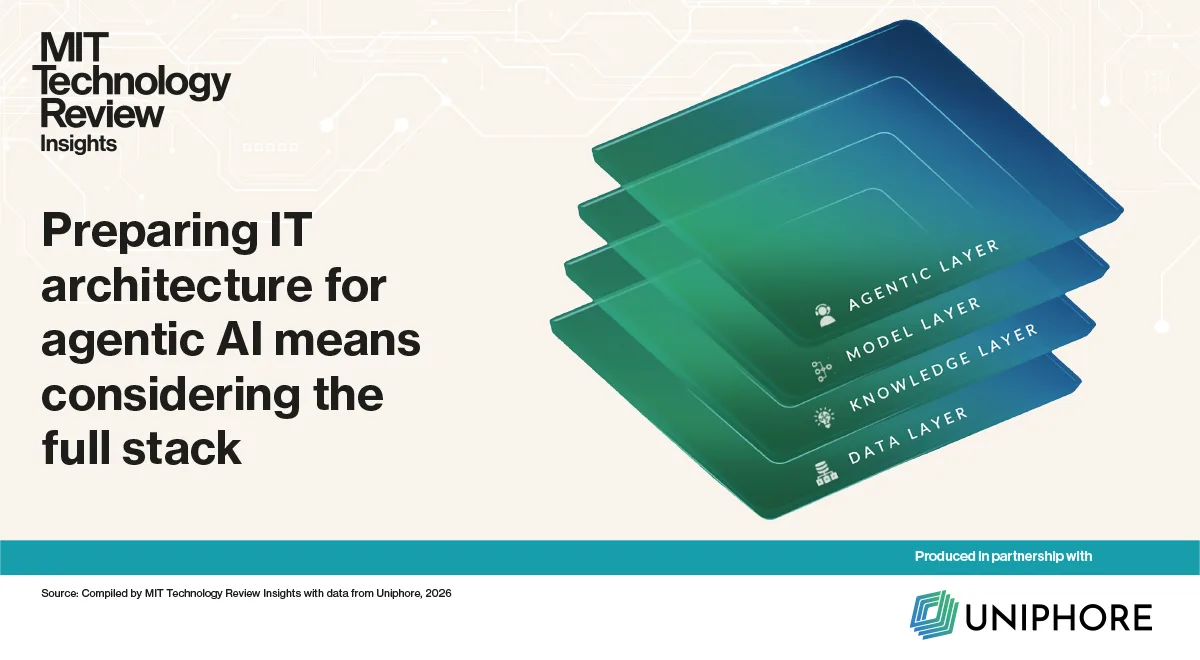
Three architecture changes follow. First, data infrastructure must be rebuilt for accessibility rather than volume. The question is not whether an enterprise has data, but whether data can be reached, understood, and used by AI agents where it already lives. Second, fixed technology stacks are giving way to composable architectures. Composable means components can be replaced or rearranged as models and tools change, instead of locking a company into one stack for years.
Third, AI sovereignty becomes an operational question. Companies need to decide where intelligence runs, who controls it, and how it operates across organizational and jurisdictional boundaries. Data residency laws, multicloud environments, and structural complexity make centralization increasingly impractical. A sovereign, composable foundation can query and prepare data where it resides, without migration or centralization, converting raw data estates into intelligence AI agents can act upon. Sovereign control over where models run and data lives keeps that adaptability intact.
Latest Progress: Process-First Enterprises Pull Ahead
The report finds that Enterprise AI's scaling problem is structural. Global AI spending is rising sharply, and model capabilities are advancing faster than most organizations can integrate them. Yet the majority of enterprises are still not growing revenue through AI or fundamentally rethinking how they operate.
The companies generating sustained returns share a discipline. They treat process redesign as the work that precedes model selection. Rather than deploying a model and then retrofitting roles and workflows after deployment, they build for how the technology will evolve. For them, the agentic shift begins with the operating model.
Data readiness is the second dividing line. Having data and having AI-ready data are different. Data that can be queried, governed, and prepared near its source allows AI to compound: each new system can use the same operational context without creating another silo.
Current Stage: Agentic Operations Move Into Enterprise Architecture
The current stage is not simply more powerful models. It is an attempt to align architecture, process, and control. Enterprises are being pushed to connect functions, prepare data for agents, and set boundaries for where models run and how they are supervised. The $2.5 trillion 2026 investment figure shows the scale of that shift, while the 44% increase from the previous year shows how fast capital is moving into it.
What to watch next is whether spending converts into revenue. The next test will be whether process-first designs, composable infrastructure, and sovereign data control can make AI operational across sales, support, marketing, and finance without creating new silos.
Comments
No comments yet. Be the first to comment.