
MiniMax M3.1 Flash suggests that China's AI price competition has no bottom in sight
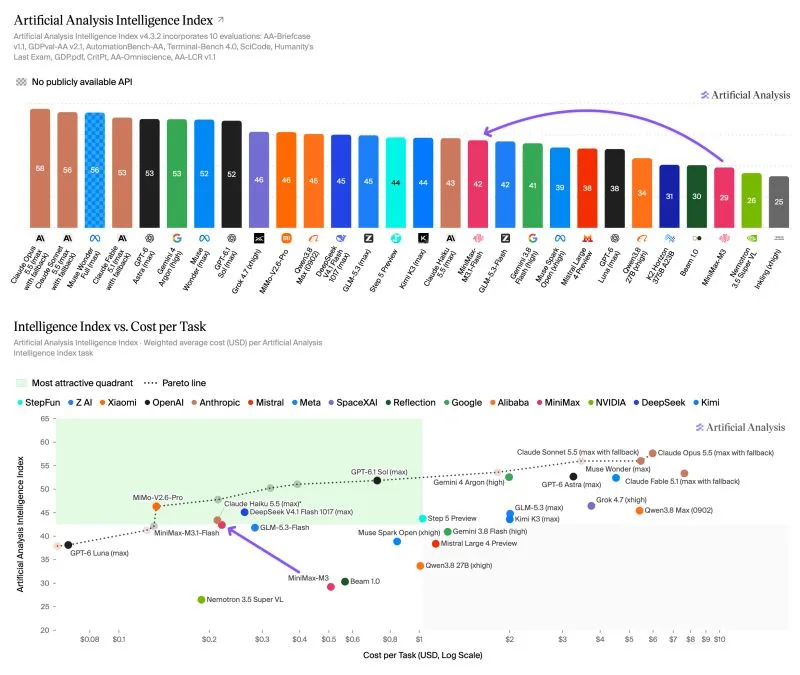
MiniMax M3.1 Flash scores 42, cuts task cost to $0.22, plans open weights on October 23, but has a 93 percent hallucination rate.
Key Takeaways
- MiniMax M3.1 Flash scores 42 on the Artificial Analysis Intelligence Index, up from 29 for M3, while reducing cost per task to about $0.22 and running roughly three times faster.
- The model intensifies China’s AI price competition by combining strong reasoning performance with low token usage, offering $0.15 per million input tokens and $0.60 per million output tokens, plus 1 million-token context and multimodal input.
- Compared with Deepseek V4.1 Flash 1017, MiniMax trails on the overall Intelligence Index and research-level physics reasoning, but leads on “Humanity’s Last Exam,” factual accuracy on AA-Omniscience, and cost per task.
- A major weakness is its high hallucination rate, reported at 93%, because the model tends to answer every question rather than declining when uncertain.
- MiniMax plans to release open weights on October 23, giving developers a chance to test its efficiency, reasoning quality, and hallucination behavior beyond benchmark reports.
Meta description: MiniMax M3.1 Flash reaches 42 on the Artificial Analysis Intelligence Index, cuts task cost to $0.22, and plans open weights on October 23 for developers.
Tags: MiniMax M3.1 Flash, Artificial Analysis Intelligence Index, Deepseek V4.1 Flash 1017, AI reasoning models, open weights

MiniMax M3.1 Flash has arrived as a reasoning model that changes the math of cheap AI output: it scores 42 points on the Artificial Analysis Intelligence Index, up from 29 points for M3, making it 13 points higher than its predecessor while costing less than half as much per task. The result places MiniMax in a direct price-and-benchmark contest with Deepseek V4.1 Flash 1017, GLM-5.3-Flash, and Gemini 3.8 Flash, with the practical question becoming how much reasoning quality a user can buy for about $0.22 per task.
Background: The Cost Race Behind MiniMax M3.1 Flash
The model’s release sits inside China's latest pricing battle among AI output providers. MiniMax says M3.1 Flash ties GLM-5.3-Flash on the Intelligence Index, edges past Gemini 3.8 Flash at 41 points, and trails Deepseek V4.1 Flash 1017 at 45 points. The larger story is not just the score, but the cost curve: the new model reaches 42 points while keeping the cost per task under half of M3’s, and MiniMax says it runs three times faster than M3.
That cost comes partly from token efficiency. MiniMax says the model uses far fewer output tokens than its rivals, bringing the cost per task down to about $0.22. API pricing is set at $0.15 per million input tokens, $0.60 per million output tokens, and $0.015 for cached inputs. The model handles up to one million tokens of context and accepts both text and images. It is live at platform.minimax.io, and MiniMax also offers a desktop app called MiniMax Code.
Development Process: Benchmark Gains, Hallucinations, and Pricing
Complex reasoning saw the biggest improvement. On "Humanity's Last Exam," M3.1 Flash hits 48 percent, beating both Deepseek and GLM. On CritPt, a benchmark that tests research-level physics reasoning across 71 complex problems, it scores 22 percent, putting it ahead of GLM-5.3-Flash at 15 percent and Gemini 3.8 Flash at 18 percent, while sitting just behind Deepseek at 24 percent. For factual accuracy on the AA-Omniscience test, M3.1 Flash answers 56 percent of questions correctly, well above GLM-5.3-Flash at 28 percent and Deepseek at 43 percent.
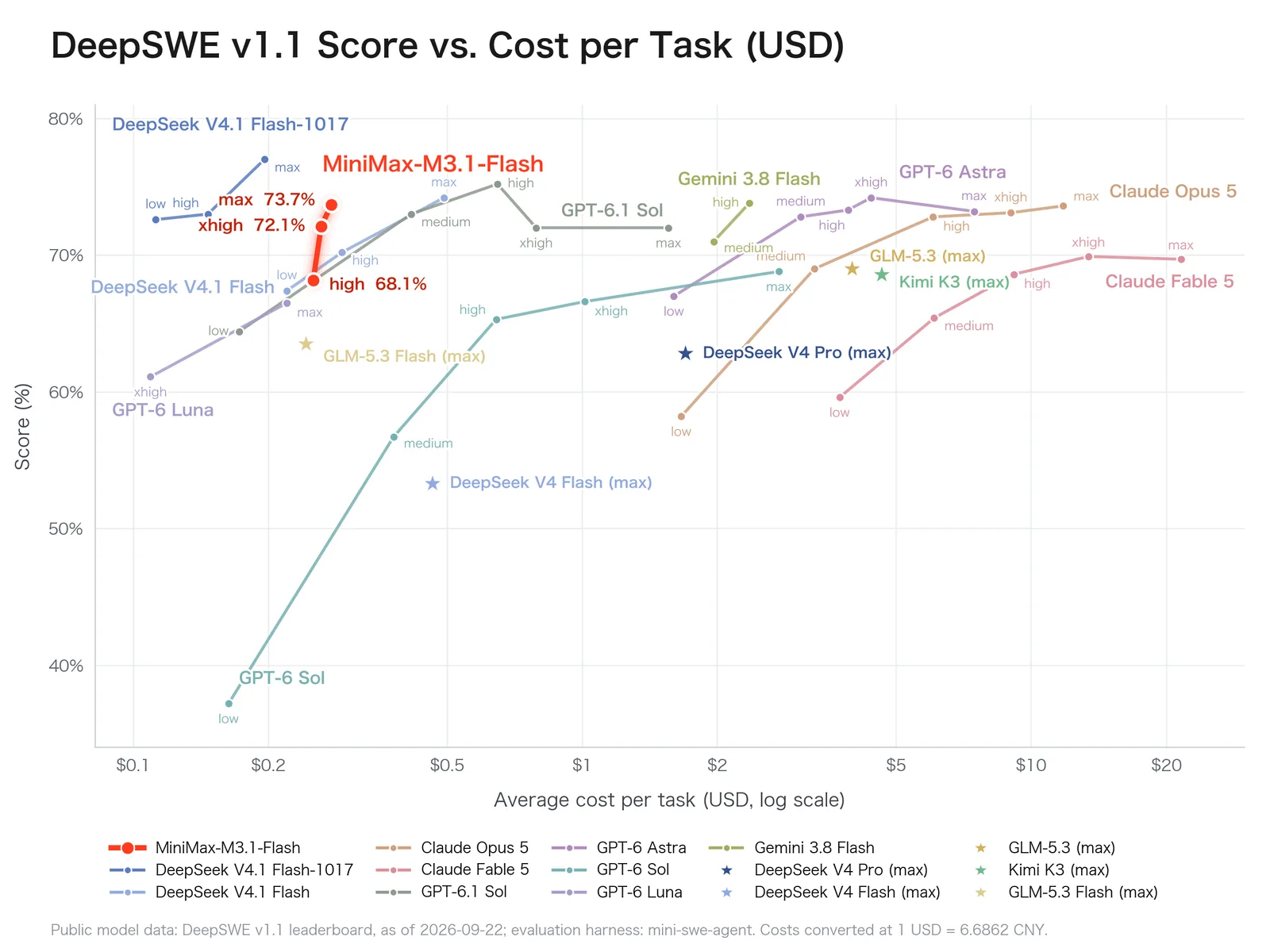
The gains come with a clear weakness. Artificial Analysis reports a 93 percent hallucination rate, because the model tries to answer every test question instead of declining when uncertain. MiniMax also reports coding-related results: on DeepSWE v1.1, MiniMax-M3.1-Flash scores up to 73.7 percent at under $0.30 per task. The model’s open-weight release is planned for October 23.
Latest Progress: Direct Comparison with Deepseek V4.1 Flash 1017
Compared head-to-head with the recently released Deepseek V4.1 Flash 1017, neither model wins across the board. Deepseek leads on the Artificial Analysis Intelligence Index with 45 points versus MiniMax’s 42 points and has a slight edge on CritPt at 24 percent versus 22 percent.
MiniMax pulls ahead on other tests. It hits 48 percent on "Humanity's Last Exam," while Deepseek manages 43 percent. For factual accuracy on AA-Omniscience, MiniMax answers 56 percent of questions correctly versus Deepseek’s 43 percent. MiniMax is also slightly cheaper per task at $0.22 compared with Deepseek’s $0.26, because it needs fewer output tokens across the benchmark: about 189 million versus 224 million for Deepseek.
Current Stage: Open Weights and What to Watch Next
Both models are getting open-weight releases. Deepseek is already on Hugging Face, and MiniMax will follow on October 23. The event now stands at a split point in China's latest pricing battle: Deepseek keeps the higher Intelligence Index score and a small CritPt advantage, while MiniMax delivers stronger "Humanity's Last Exam," AA-Omniscience, and lower cost per task. The next measurable milestone is the October 23 open-weight release, which will let users compare M3.1 Flash’s efficiency and hallucination behavior outside the benchmark reports.
Comments
No comments yet. Be the first to comment.