
SPLATIFY helps you reproduce, discover, and innovate by turning papers and ideas into trainable 3D Gaussian Splatting code.
SPLATIFY converts 3D Gaussian Splatting papers into trainable code, cuts implementation time, diagnoses weaknesses, and tests 30 papers.
Key Takeaways
- SPLATIFY is a multi-agent framework from Hugging Face community authors that converts 3D Gaussian Splatting research papers into trainable gsplat code, helping reduce the manual effort of reproducing methods when public implementations are missing.
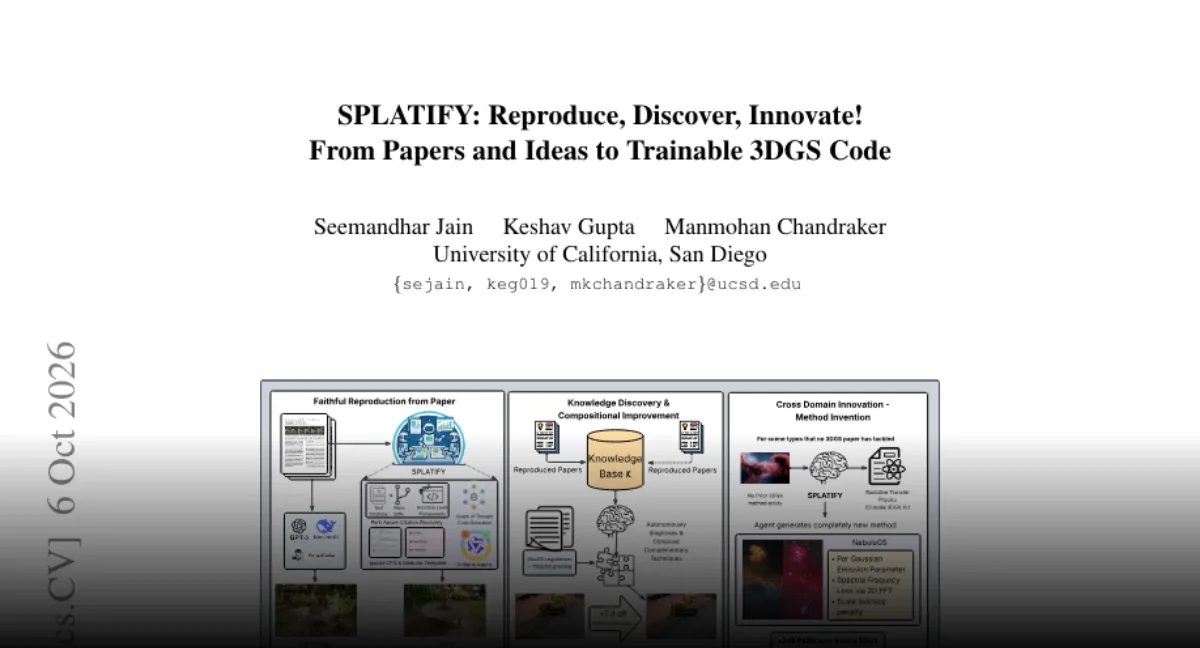
- The framework supports three connected stages: reproducing papers as runnable code, diagnosing and combining techniques from different papers, and innovating beyond 3D Gaussian Splatting by applying physical priors to new visual tasks.
- Reported results include reproduction quality comparable to expert-written code with much faster implementation, and up to +2.4 dB PSNR improvement over reproduction-only baselines when methods are analyzed and combined.
- SPLATIFY’s technical pipeline includes grammar-constrained code generation, fork-aware dependency recovery, and closed-loop visual feedback to make generated code more faithful to the intended research behavior.
- The project introduces SPLATIFY-Bench, a 30-paper benchmark for evaluating both code reproduction and preservation of each paper’s technical contributions, and is currently open to community feedback.
Meta description: SPLATIFY, a multi-agent framework from Hugging Face community authors, turns 3D Gaussian Splatting papers into trainable code and tests 30 papers.
Tags: SPLATIFY, 3D Gaussian Splatting, multi-agent framework, code reproduction, SPLATIFY-Bench
Featured image: abstract 3D point cloud and neural code graph in blue and orange, no people, no logos, no text
SPLATIFY is presented by one of its authors in a Hugging Face community post as a multi-agent framework that converts 3D Gaussian Splatting research papers into trainable code. The post also frames the work as going beyond paper reproduction. Its relevance lies in a familiar research workflow: published methods describe approaches, but turning them into runnable implementations can take substantial manual effort, especially when public code is absent.
Background: From Papers to Runnable Research
The announcement identifies a gap between research papers and executable code. SPLATIFY is positioned as a response to that gap in the 3D Gaussian Splatting area. The post identifies the work as arXiv-related and introduces it to the Hugging Face community as a system that can create trainable gsplat implementations from papers. The author notes that some target methods do not have publicly available code, which makes manual reproduction slower and more dependent on individual implementation choices.
Development Process: Reproduce, Discover, and Innovate
The post organizes SPLATIFY into three connected stages. The first stage, reproduction, is meant to convert a paper into code that can be trained. The authors report that, in their experiments, the generated implementations were comparable to expert-written references while reducing implementation time from weeks to minutes.
The second stage moves from reproduction to analysis. SPLATIFY is described as diagnosing weaknesses in methods and combining complementary techniques from different papers. The reported result is an improvement of up to +2.4 dB in peak signal-to-noise ratio over reproduction-only baselines in evaluated settings. The framework’s internal mechanisms are summarized as grammar-constrained code generation, fork-aware dependency recovery, and closed-loop visual feedback. Together, these components suggest a pipeline that not only writes code, but checks it against the paper’s intended behavior and tracks dependencies across diverging research directions.
The third stage is innovation. The post says SPLATIFY retrieves physical priors from beyond the 3D Gaussian Splatting literature to synthesize methods for new applications. The demonstrations given are volumetric nebula rendering and thin-film bubble iridescence. These examples show the framework being tested on visual problems that extend past the original research domain.
Latest Progress: Benchmarks and Community Feedback
The announcement also introduces SPLATIFY-Bench, a benchmark covering 30 papers. The benchmark is described as evaluating both reproduction and the preservation of technical contributions. This adds a measurable layer to the project: instead of relying only on qualitative examples, the authors present a set of 30 paper-based tasks for checking whether code generation remains faithful to the source research.
The post ends with a request for feedback from the Hugging Face community, asking readers to engage with SPLATIFY as a framework for turning papers into trainable code and extending them. At this point, the project appears to be in a public research-sharing stage: the authors have described the framework, reported selected performance figures, introduced a 30-paper benchmark, and opened the work to community input.
Comments
No comments yet. Be the first to comment.