
Cheaper AI tokens are creating greater demand, which is the best outcome for Jensen Huang.
Cheaper AI tokens raise usage, while H100 GPU rental prices stay firm. Demand volume decides if AI compute stays tight or market pressure shifts.
Key Takeaways
- AI is exhibiting a Jevons paradox: falling token prices can increase total token consumption instead of reducing overall compute demand.
- H100 GPU rental prices remain steady or rise even as AI outputs become cheaper, showing a split between software pricing and hardware pricing.
- Agentic AI and automation may be major token-consumption drivers, potentially inflating compute demand far beyond modest human usage growth.
- The dynamic depends on continued rapid AI usage growth; if demand flattens, pressure could shift from hardware scarcity to weaker demand across the AI stack.
Meta description: Data from Ornn, Silicon Data and Bloomberg through August 2026 show a16z's Jevons paradox in AI: falling token prices and rising H100 GPU rental costs.
Tags: Jevons paradox, a16z, H100 GPU, AI tokens, OpenAI
Featured image: abstract AI infrastructure visual with token streams and GPU server outlines, no logos, no real people, no text
Background: a cheaper input that keeps hardware expensive
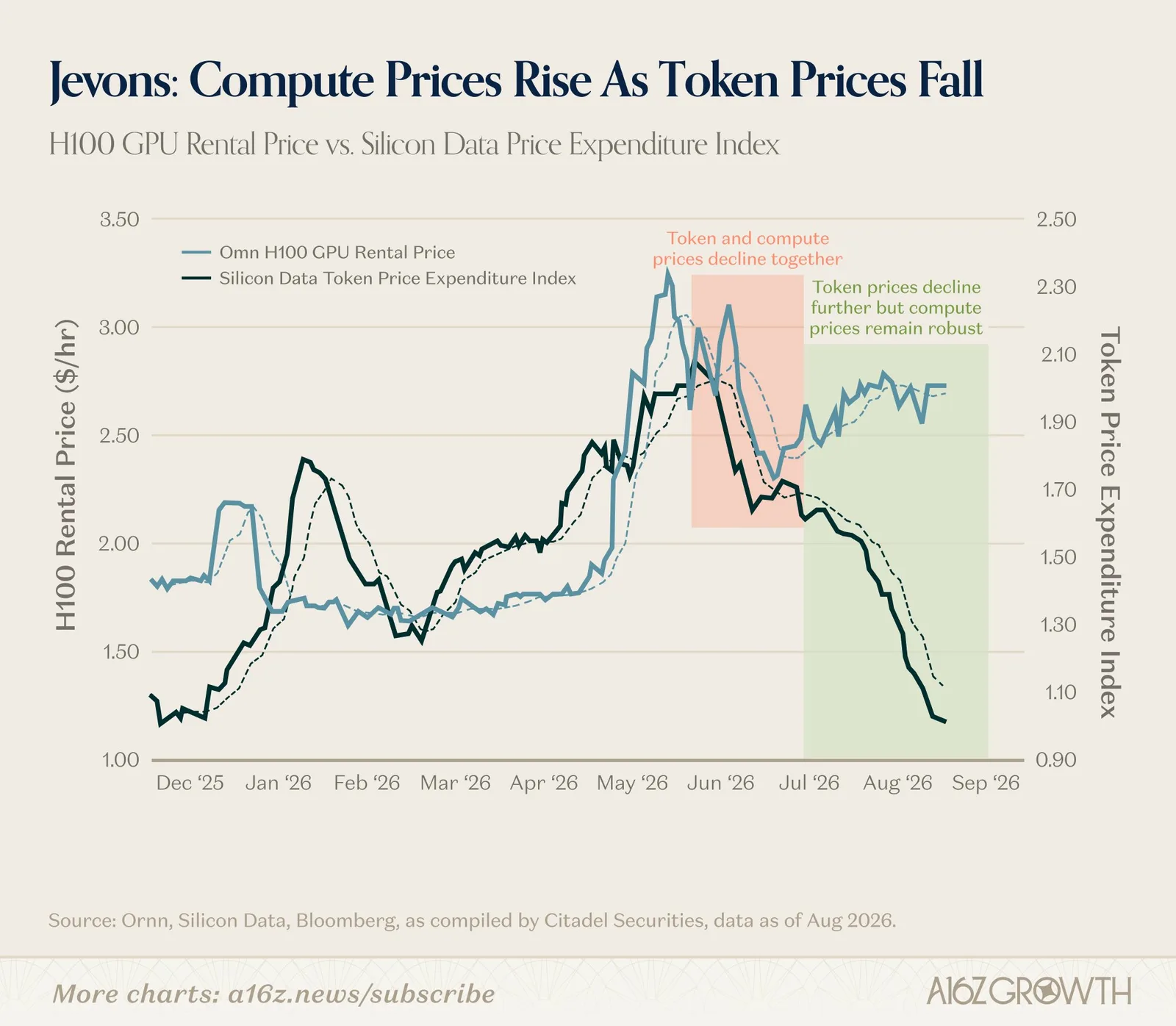
Jevons' paradox describes a situation where a lower cost for a resource leads to higher total use, not to a matching drop in overall spending. In the AI market, the framing “Jevons' paradox is Jensen's best friend” points to that dynamic. Data from Ornn, Silicon Data, and Bloomberg as of August 2026 show what a16z calls a textbook Jevons paradox. Token prices keep falling, but rental prices for H100 GPU capacity hold steady or climb. The market can therefore produce cheaper AI outputs without making the physical compute layer cheap.
Development: lower token prices expand usage faster than costs fall
The mechanism begins with price. When tokens become cheaper, AI agents, automation workflows, and new applications can run more tasks for the same budget. That can push total token volume higher than the per-unit price decline. The referenced chart compares H100 GPU rental prices with a token price index through August 2026, and it is credited via X. The key uncertainty is where the demand comes from. It is not clear how much usage is driven by human users and how much by AI systems themselves. Agentic AI can burn through tokens at a staggering rate, so compute demand could be artificially inflated; even modest human usage growth may create outsized hardware needs.
Latest: August 2026 data reveal a fragile assumption
The whole arrangement rests on one condition: AI usage must grow fast enough to offset falling token prices. While that condition holds, hardware can remain scarce and expensive. If demand flattens, the strain could move through the chain from chip makers and memory suppliers to energy providers and cloud companies, and markets could spiral from there. Market sensitivity is already visible. US stocks dropped on reports that OpenAI's annualized revenue might be lower than previously reported, suggesting investors are watching AI demand signals closely.
Current stage: volume is the swing factor
The August 2026 picture is not simply a story of cheaper AI. It is a story of volume deciding whether cheaper AI inputs create more infrastructure demand or less pressure on hardware. For readers, the practical signal is that token prices and GPU rental prices are moving on different clocks. a16z's label of a textbook Jevons paradox captures that split. What matters next is whether token consumption keeps expanding or starts plateauing. If expansion continues, H100 GPU rental prices may stay firm. If usage growth slows, the pricing split could narrow, and the pressure may shift from hardware scarcity to weaker demand across the AI stack.
Comments
No comments yet. Be the first to comment.