
Anthropic has almost ceased hiring entry-level staff because AI agents now work six times as many hours.
Anthropic's study links junior hiring drop to Claude AI agents logging more hours than humans, boosting productivity but risking expertise.
Key Takeaways
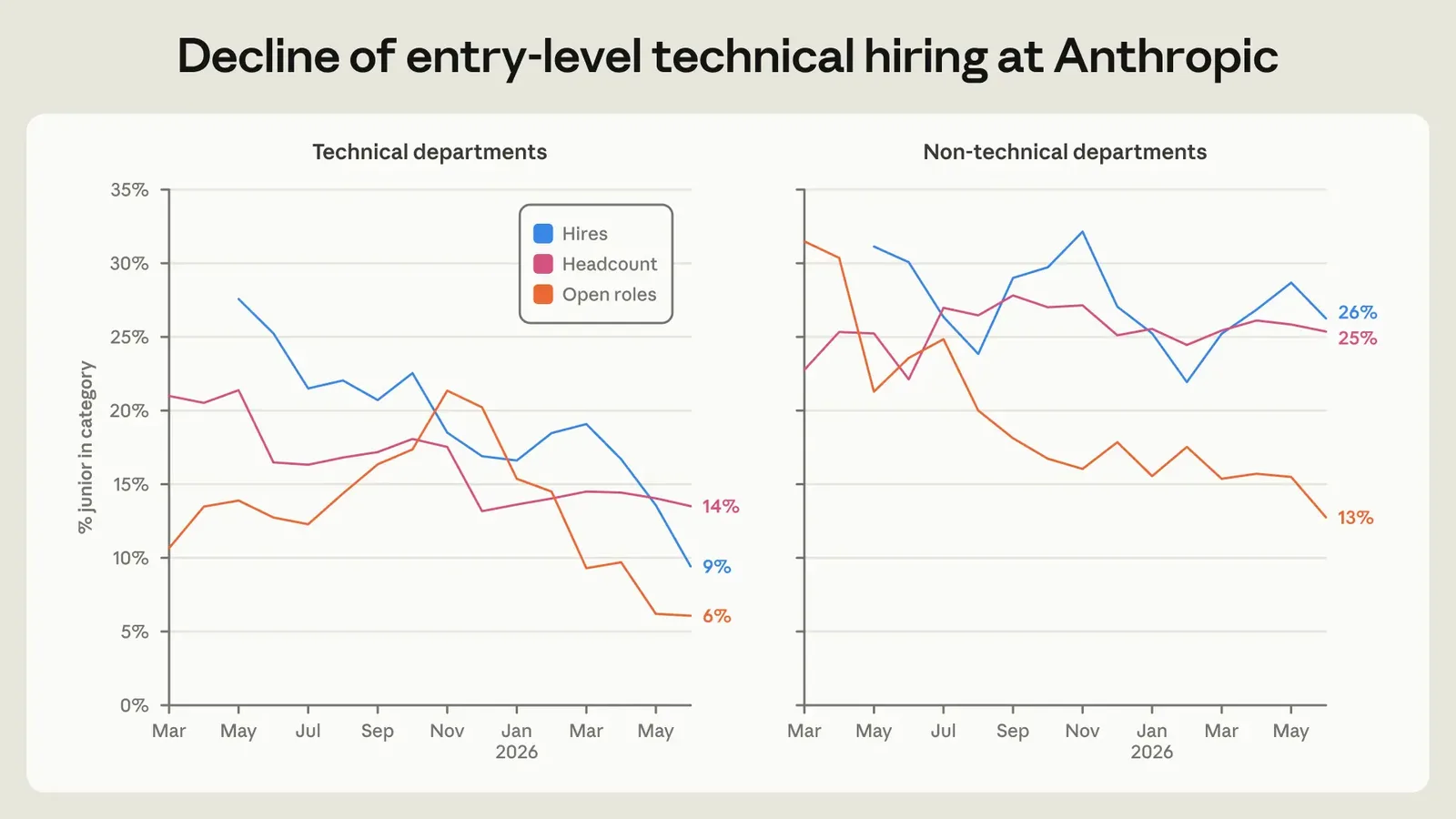
- Anthropic’s internal study shows junior technical hiring collapsed since early 2025, with junior new-hire share falling from 27% to 9% and open junior roles dropping to 6%.
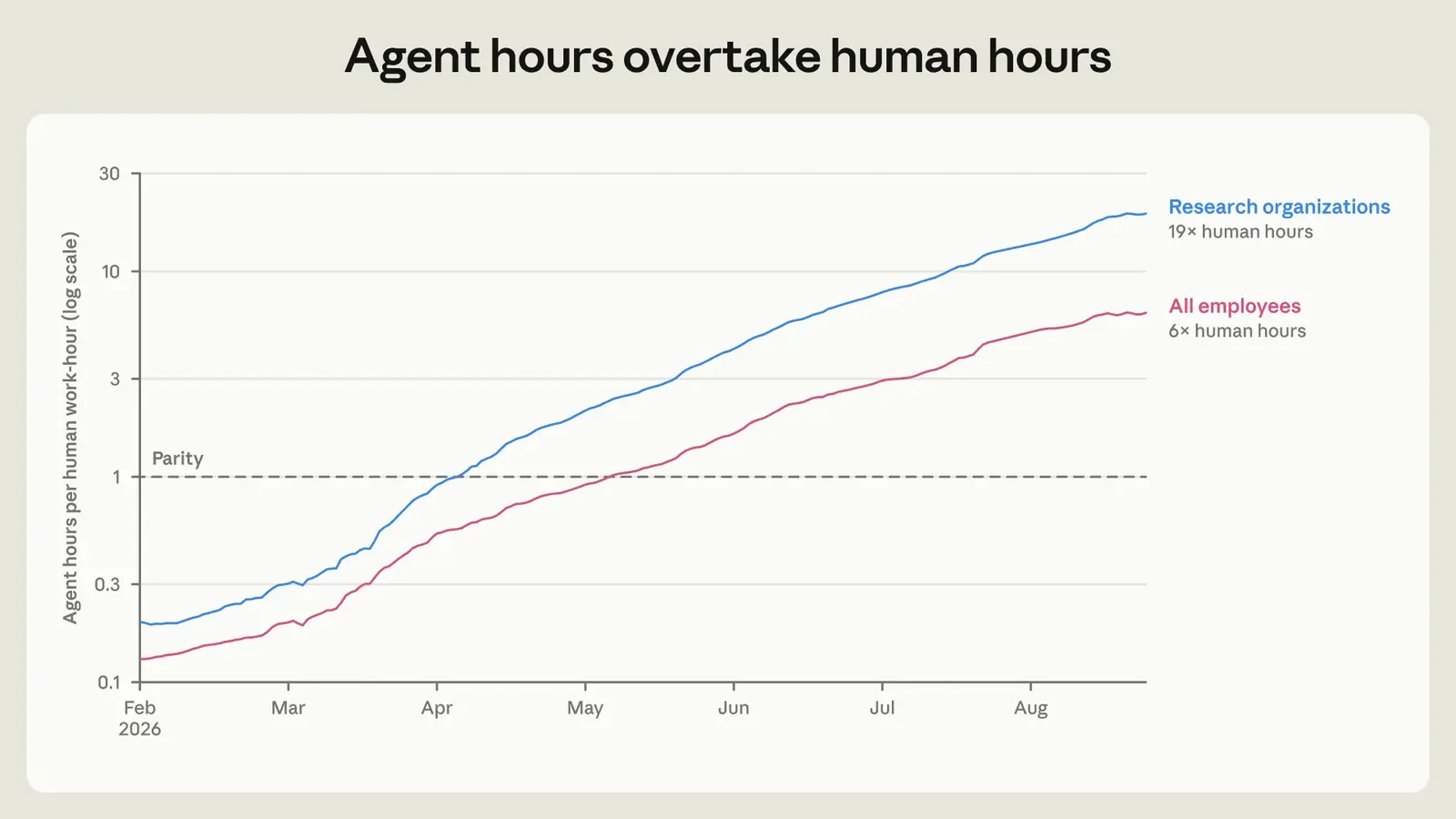
- AI agents at Anthropic surpassed human work hours by March 2026, reaching a company-wide 6:1 ratio by August 2026 and 19:1 in research departments.
- Productivity rose across departments, including 5.1x more code commits by engineers and 3.1x more queries and contracts handled by data scientists and legal teams.
- The results may not generalize to the wider economy because Anthropic is an AI-heavy software company experiencing rapid growth and early AI adoption.
- A major risk is a future expert shortage from 2030 to 2045, as disappearing junior roles remove the training pipeline for skilled professionals.
Meta Description: Anthropic's study says Claude agents now log six times human hours, while junior technical new hires fell from 27 percent to 9 percent since early 2025.
Tags: Anthropic, Claude, AI agents, junior hiring, technical roles
Featured Image: Abstract blue and silver network of AI agent nodes beside a shrinking hiring pipeline, no people, logos, or text.
Junior Technical Roles Shrunk Since Early 2025
Anthropic Claude agents are changing the math inside the company's technical departments. Junior technical hiring has fallen sharply, while AI agents now log far more work hours than human employees, making the internal study a case study for the limits and risks of AI-driven productivity and for the future expert pipeline.
An internal study published by Anthropic says the share of junior positions in technical departments dropped from 21 percent to 14 percent since early 2025. The decline was sharper among new hires: junior share fell from 27 percent to 9 percent. Open junior roles fell to 6 percent in technical departments, while non-technical departments stayed mostly stable. Open junior roles declined especially sharply starting in December 2025.
Claude Work Hours Surpassed Humans by March 2026
Anthropic links the hiring shift to the growing capability of its AI agents. Tasks such as writing code and finding bugs are increasingly handed off to Claude. Since March 2026, AI agents at Anthropic have worked more hours than human employees. By August 2026, the company-wide ratio reached 6:1, and in research departments it reached 19:1. Junior hiring declined the most in roles where Claude handles the most complex work.
The timing matters: the hiring decline and the rise in agent hours moved together through 2025 and 2026.
Latest Productivity Evidence: More Output Across Departments
The study says productivity rose across every department. Engineers shipped 5.1 times as many code commits. Data scientists ran 3.1 times as many queries. The legal team processed 3.1 times as many contracts. Sales closed 1.7 times as many deals, recruiters hired 1.4 times as many people, and accounting handled 1.4 times as many invoices.
Anthropic also notes limits. The company is an extremely AI-heavy software company, so results do not map easily onto the broader economy. Rapid business growth and voluntary adoption of AI tools could be skewing the numbers. So far, the wider economy has not shown measurable productivity gains from AI.
What Could Follow: Expert Shortage From 2030 to 2045
Researcher Nolan Lovett of the NATO Special Operations University recently described a "tragedy of the cognitive commons" in a research paper. When individual companies replace entry-level positions with AI, they gain efficiency while the cost is spread across everyone who later needs experienced talent. Anthropic fits that pattern.
Skilled professionals develop through years of practice in the very junior roles that are now disappearing. Lovett argues the full impact may not appear until 2030 to 2045 because today's available experts were trained 5 to 20 years ago. Software engineering, financial analysis, and legal research are the most exposed fields.
Lovett's prediction only holds if humans are still doing this kind of work in the future, an assumption Anthropic probably does not expect. The company has suggested in the past that programmers and call center workers would eventually need to move into jobs like electrician or nurse.
The next question is whether junior technical roles continue to shrink and whether the productivity gains shown inside Anthropic spread beyond AI-heavy software companies.
Comments
No comments yet. Be the first to comment.