
Are Meta’s Muse or OpenAI’s Dots Trustworthy Enough to Manage Your Life?
Meta Muse and OpenAI Dots launch always-on AI agents, but users may surrender privacy and security for convenience.
Key Points
- Meta’s Muse and OpenAI’s Dots represent the first major push of always-on autonomous AI agents for ordinary consumers, but they rely on very different business models: Muse is free and distributed across Meta apps, while Dots is tied to paid ChatGPT subscription tiers.
- Both products trace their technical lineage to OpenClaw and use a model wrapped in a computer-operating harness, though Meta provides a cloud Linux machine while OpenAI runs its setup through Codex infrastructure.
- Meta targets mainstream users with approachable design and aggressive distribution, while OpenAI positions Dots for knowledge workers with specialist “chief of staff” agents for tasks such as marketing, legal work, and accounting.
- The central unresolved question is whether users will trust these agents enough to give them access to sensitive data, including inboxes, credit cards, and hard drives, in exchange for convenience.
Meta's Muse and OpenAI's Dots mark the first serious push to put always-on autonomous AI agents in front of ordinary consumers, and they arrive with sharply different business models. Muse is free and distributed across Meta's apps; Dots sits behind ChatGPT subscription tiers starting at $100 a month. The Verge senior AI reporter Hayden Field joined Decoder to unpack how the two products compare, why Meta may hold a distribution advantage despite lacking a frontier model of its own, and what users give up when they hand an agent their inbox, credit card, and hard drive.
From OpenClaw to Product Launches
The technical lineage traces back to OpenClaw, a homebrew agent built by developer Peter Steinberger that proved useful enough to drive a surge in Mac Mini sales earlier this year despite well-documented privacy and security flaws. OpenAI hired Steinberger. Meta built Muse from scratch, though the company acknowledges OpenClaw's inspiration. Both products wrap a model in a harness that can operate a computer: Meta supplies a cloud Linux machine, while OpenAI's setup runs through its Codex infrastructure.

The timeline matters. Field recalls tech leaders calling 2022 the year of ideation and 2023 the year of deployment, when most agents failed. By 2026, always-on consumer agents finally became viable.
Two Strategies, One Race
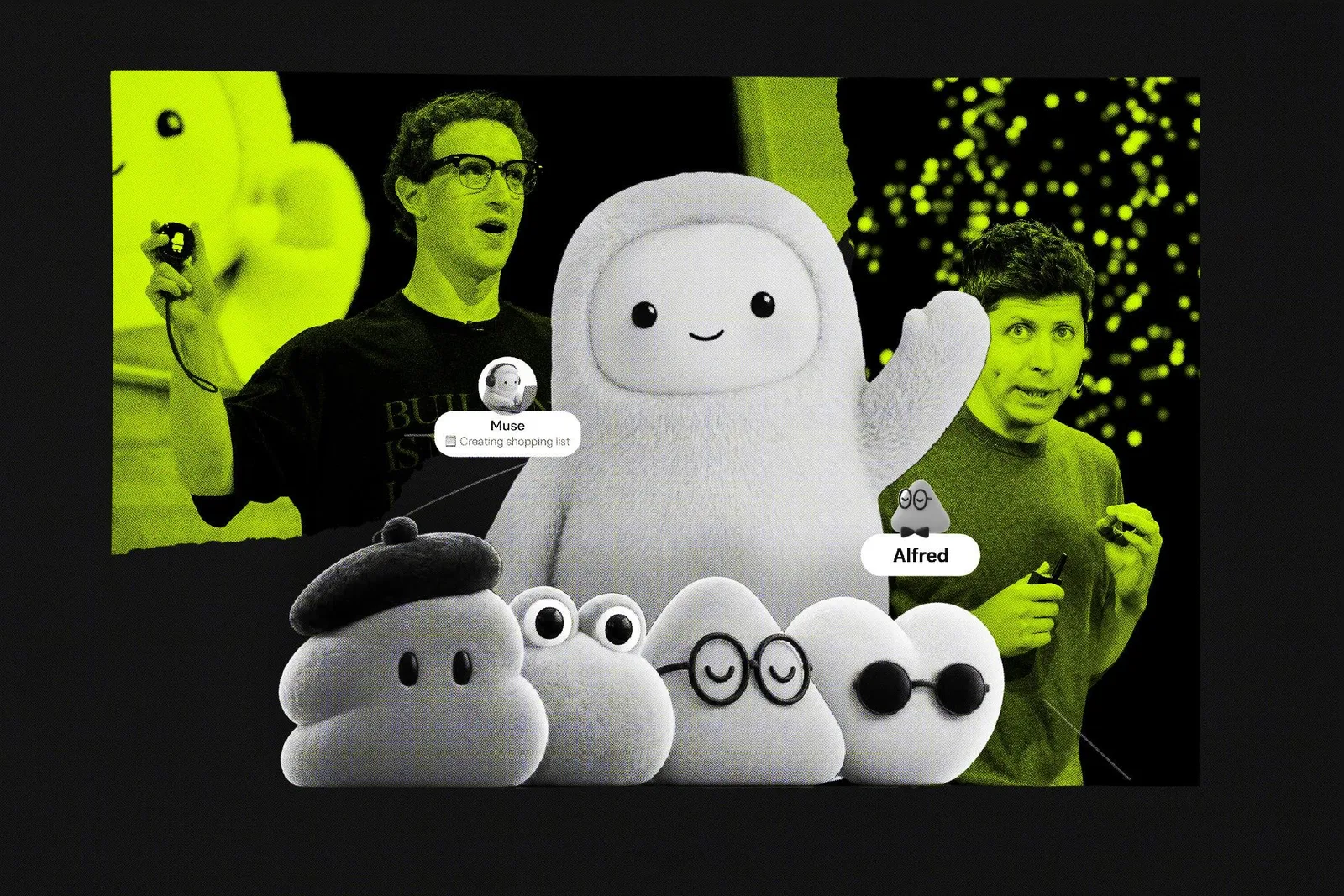
Meta Connect introduced Muse weeks before OpenAI DevDay unveiled Dots. Meta's version leans on cute animated mascots and one-tap downloads, with pop-ups appearing across Instagram. OpenAI markets Dots to knowledge workers, with specialist variants for marketing, legal work, and accounting. Sam Altman described it as a "chief of staff" rather than an assistant, and used the DevDay stage to draw a contrast with agents limited to booking flights or managing calendars.
The revenue gap explains much of the divergence. OpenAI needs money ahead of its IPO and restricts Dots to $100–$200 monthly tiers. Meta can afford to flood the market for free.
What to Watch
The unresolved question is whether mainstream users will trade sensitive data for convenience. Both companies pitch agents that handle restaurant reservations, inbox triage, and gift buying without hand-holding. Whether Muse's free distribution or Dots' enterprise focus wins the consumer, the industry has settled on one architecture: a browser, a harness, and a model.
Comments
No comments yet. Be the first to comment.