
The Unpleasant Economics of Consumer AI
Consumer AI's comeback faces weak monetization: only 2.2% pay $31 monthly, while high costs keep adoption and profits hard to scale.
Key Takeaways
- A new consumer AI rebound is emerging through Meta’s Muse, OpenAI’s Dots, and the rising Instinct assistant, showing renewed interest in personal AI agents beyond enterprise use.
- The core challenge is not capability but economics: AI services are expensive to run, and frontier labs have become cautious because consumer subscriptions may not cover inference and support costs.
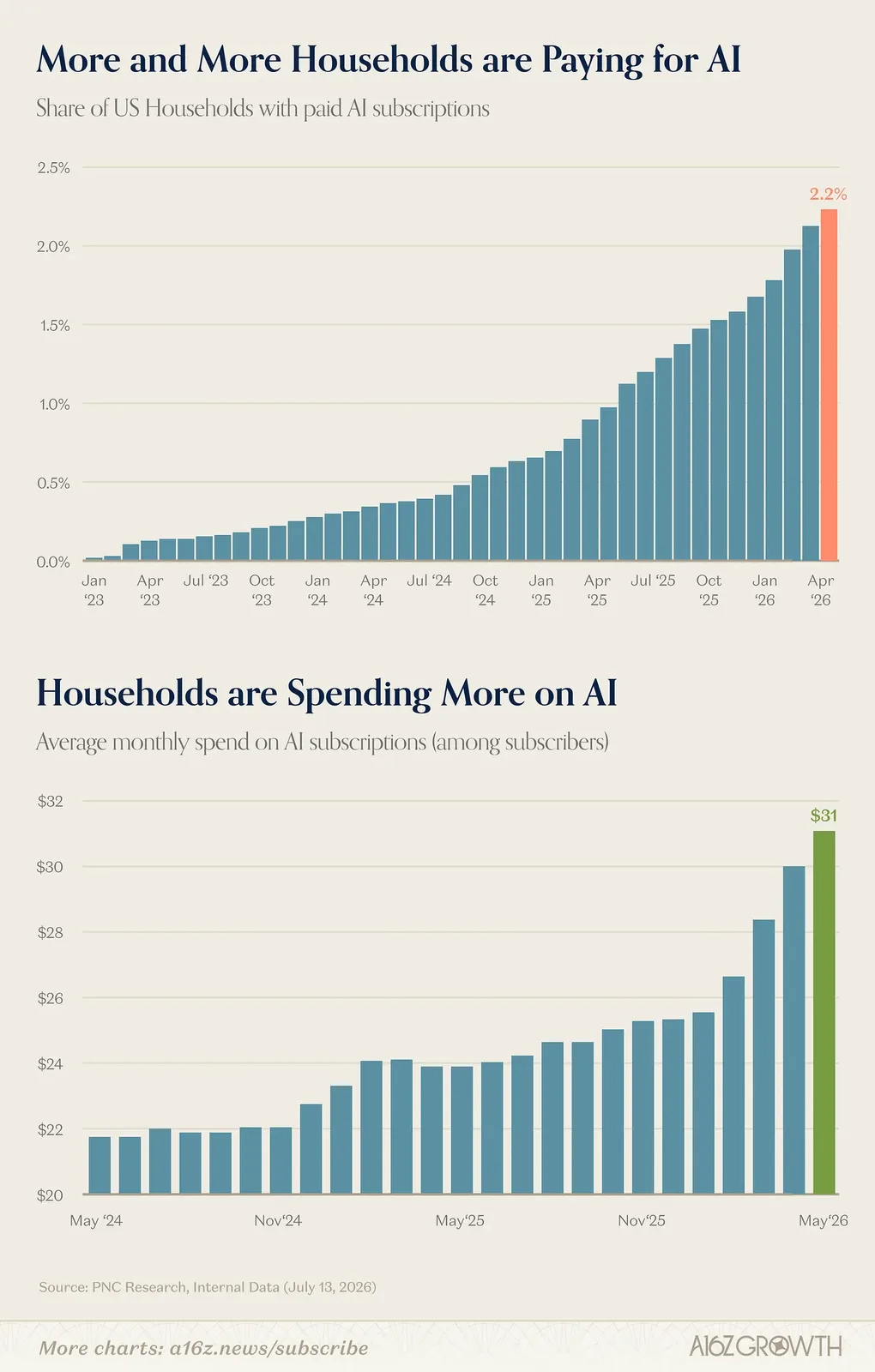
- Adoption data remains narrow: as of May, only 2.2% of consumers were paying for AI services, averaging $31 per month, and willingness to pay has grown slowly even as model performance improves.
- Consumer AI is unlikely to scale as a purely direct-pay product, so companies are expected to rely more on enterprise pricing, advertising, or transaction-based monetization to make the business model viable.
Meta description: Muse, OpenAI Dots and Instinct signal a consumer AI rebound, but PNC data shows only 2.2% of consumers paid $31 monthly for AI services in May.
Tags: consumer AI, Meta Muse, OpenAI Dots, Instinct, AI monetization
Featured image: Abstract soft-glow AI assistant interface with task cards and data flows, no real people, no company logos, no text.
Consumer AI is re-entering the mainstream. This week, Meta’s personal AI assistant Muse and its plush-like mascot Jolly have become a surprise hit, while OpenAI’s Dots, released just yesterday, appears aimed at the same cartoony personal-assistant idea. The up-and-coming Instinct assistant reached a $10 billion valuation because its agentic errand-running can book travel, make restaurant reservations, or cancel subscriptions. The renewed consumer push matters because it tests whether ordinary users, not just companies, can pay enough to cover one of the most expensive product categories in software.
Background: Why Frontier Labs Stepped Back From Consumer AI
The modern consumer AI wave is usually dated to the ChatGPT launch in 2022, when large language models made interactive assistants feel possible for ordinary users. But the mood changed as firms examined the revenue side. Popular technology products began hitting a ceiling on what consumers would pay, and better models did not clearly translate into a more profitable consumer business.
That is why frontier labs grew cautious about consumer AI. The issue was not capability, but cost. The industry moved toward the Anthropic model: enterprise contracts and vertical-by-vertical expansion. AI is unusually expensive to operate, especially compared with lighter predecessors such as social networking or cloud computing. Even hundreds of millions of paying customers may not guarantee break-even, because inference and support costs remain high.
Development: Muse, Dots, and Instinct Return to Consumers
The bull case is easy to see. Agentic AI, meaning software that can take multi-step actions rather than only answer questions, has become reliable enough for everyday tasks. Companies are increasingly pitching that service to ordinary users, who appear to get real value from it. To observers, that resembles the ChatGPT launch in 2022: a raw capability opening a product category that had not existed before.
Muse and Instinct can avoid that pressure partly because their public rollout is not yet centered on direct consumer revenue. Instinct’s $10 billion valuation rests on a narrow set of tasks: booking travel, making restaurant reservations, and cancelling subscriptions. That focus can create value without immediately requiring a large consumer subscription fee. Even so, the cost structure remains unforgiving, and new entrants will eventually face the same monetization test.
Latest Progress: Adoption Data Shows a Narrow Monetization Path
A reminder of those economics came from Andreessen Horowitz’s semiannual State of Markets report, which pulled figures from a PNC research report from this summer. In two charts, the report tracks the slowly growing percentage of consumers paying for AI services and the slowly growing amount they pay. As of May, 2.2% of consumers were paying for AI, at an average spend of $31 a month.
Andreessen puts a positive spin on this, saying, “it’s still so early when it comes to mature AI adoption and utilization.” There is a lot of room to grow. But in both charts, the pace of growth seems linear. Even as models make huge improvements, there is not a ton of movement in the number of customers willing to pay for AI or how much they are willing to pay. The enormous performance jump from GPT-5.2 to Astra, for instance, is barely visible on the chart.
Other surveys point in a similar direction. Bank of America found in March that roughly 3% of U.S. consumers paid for AI, up 40% from the previous year. A Menlo survey from September gives a slightly sunnier view, finding that a quarter of adults use AI daily and half of those users are paying for it.
OpenAI’s path shows how the industry can bridge the gap. The company’s widely reported pivot to enterprise has been largely successful, with enterprise bookings reportedly doubling since July. Even the Dots launch had a strong enterprise angle, showing how the new personal agent could be useful for software engineers and agency creatives. One long-standing way to make money from popular-but-cheap consumer services is to sell them to businesses at a markup, and OpenAI seems to be following that playbook.
For Muse, Meta’s personalized ad targeting gives it more options for monetization and more time before the question becomes urgent. Notably, Meta is already exploring the enterprise angle. Instinct has a separate plan involving taking a cut of purchases made through the agent, which might raise the ceiling, and it presumably can avoid the cost of training a frontier model. The current stage is not a clean consumer AI comeback: it is a rebound with a known limit, because the economics of consumer AI put a hard cap on how large a company can plausibly grow without tapping into enterprise revenue. That is a lesson major labs have already learned.
Comments
No comments yet. Be the first to comment.