
VisionWeave Creates Elastic Visual Representations as a Native Capability of Multimodal Large Language Models
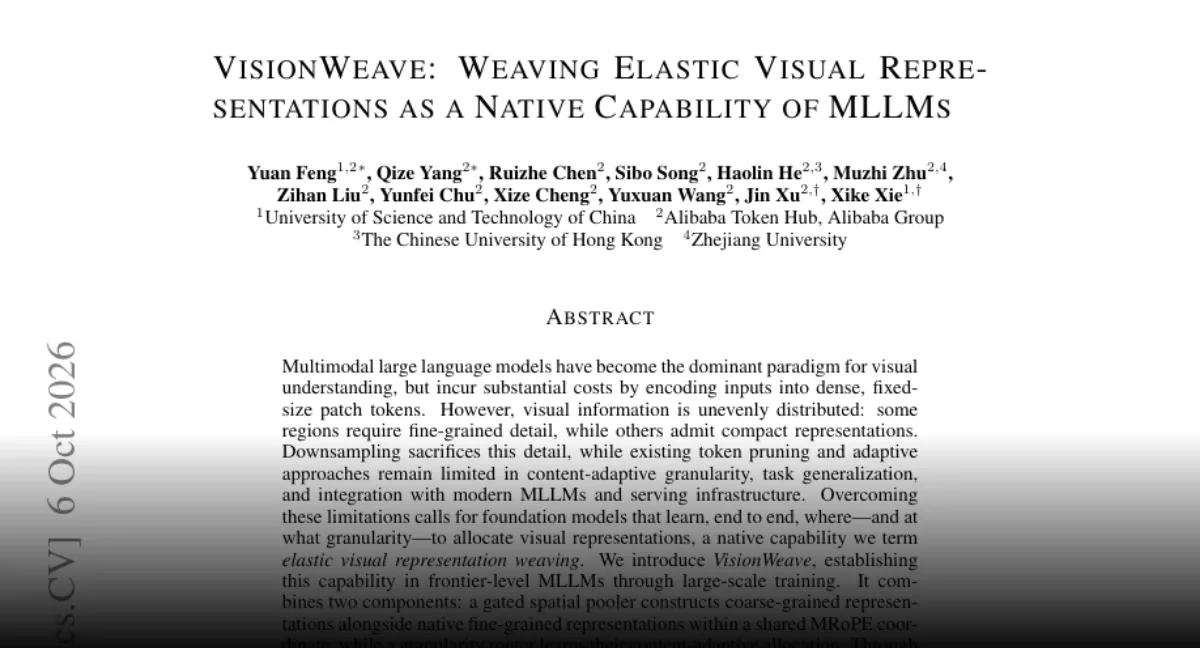
VisionWeave uses elastic visual representations, reducing visual tokens 43.0% on Qwen3.8-27B while retaining 98.9% performance with higher throughput.
Key Takeaways
- VisionWeave introduces elastic visual representations as a native capability for multimodal large language models, reducing visual tokens by 43.0% on average while retaining 98.9% of native performance.
- It addresses the visual token bottleneck in long-horizon multimodal interaction by adaptively allocating visual detail to different parts of images or video, rather than using fixed-resolution token processing.
- Validated on Qwen3.8-27B across 8 benchmarks, multiple resolution tiers, and video frame rates, the method shows broad efficiency gains rather than narrow task-specific tradeoffs.
- In SGLang deployment, VisionWeave improves practical serving performance with 2.30× throughput and 54.4% lower time to first token.
- The work positions visual token efficiency as a future built-in model capability, supporting faster and more scalable multimodal systems.
VisionWeave is a new visual token efficiency approach for multimodal models, and its reported validation on Qwen3.8-27B shows why the field is paying attention: it reduces the number of visual tokens by 43.0% on average while retaining 98.9% of native performance. For long-horizon interaction, where a model repeatedly perceives images or video, that kind of native efficiency can change the cost and speed of practical deployment.
Background: Long-Horizon Multimodal Interaction Exposes a Bottleneck
Multimodal models increasingly need to operate over long stretches of visual context, including digital and real-world environments. Each image or video frame is converted into visual tokens, and those tokens consume compute, memory, and latency. As interactions become longer, the visual token count can become a practical bottleneck for deployment, not just a research metric.
The VisionWeave argument is that the next step is not only to compress inputs after the fact, but to let models natively operate over elastic visual representations. That capability is meant to support adaptive, efficient understanding when visual detail matters less, and more when it matters more.
Development: Sparse Attention Set a Pattern for Native Efficiency
Over the past year, sparse attention moved from a post-training trick to a native model capability. VisionWeave draws a parallel to that shift. Building on prior ideas in this line of research, it pushes visual token efficiency away from a task-specific trick and toward a robust, model-native paradigm.
The framing is broader than a single optimization: efficiency, robustness, and real-world deployability are treated as parts of one capability. If visual tokens can be managed natively, long-horizon multimodal systems may become easier to deploy without sacrificing the understanding quality that makes the model useful.
Latest Progress: Elastic Visual Representations on Qwen3.8-27B
The core idea is elastic visual representation. The model adaptively weaves visual representations of mixed granularities conditioned on the input content. Instead of treating every visual input at one fixed resolution or token density, VisionWeave lets the model allocate visual detail where the content requires it.
The method was validated on the frontier model Qwen3.8-27B and evaluated across 8 domain benchmarks, multiple resolution tiers, and multiple video frame rates. The reported average result was a 43.0% reduction in visual tokens while retaining 98.9% of native performance. That combination is the key signal: the efficiency gain is not presented as a narrow tradeoff against one task, but as a capability tested across varied visual settings.
Deployment Signal: Throughput and First-Token Latency
Under SGLang deployment, the reported gains were 2.30× throughput and 54.4% lower time to first token. These numbers matter because practical multimodal systems are judged by both the cost of carrying visual context and the responsiveness of each interaction. Lower time to first token can make a model feel faster, while higher throughput can allow more concurrent requests or longer sessions within the same serving budget.
Current Stage: A Native Capability Candidate
VisionWeave is currently a research capability demonstrated on Qwen3.8-27B and published at arXiv: https://arxiv.org/abs/2610.07987. The result suggests that visual token efficiency is moving from an optimization detail toward a built-in model ability. The work positions elastic visual representations as a possible built-in ability of future models, paving the way for efficient, long-horizon interaction between multimodal foundation models and their visual environments.
Meta description: VisionWeave introduces elastic visual representations on Qwen3.8-27B, cutting 43.0% of visual tokens and retaining 98.9% performance in deployment.
Tags: VisionWeave, Qwen3.8-27B, visual tokens, multimodal models, SGLang
Featured image: Abstract woven grid of visual tokens, resolution tiers, and video frames, no people, no logos, no text.
Comments
No comments yet. Be the first to comment.