
WorldGuide: A Goal-Oriented Video World Model for Executing Procedural Tasks
WorldGuide is a goal-directed video world model from MBZUAI-ORYX that converts procedural video generation into closed-loop task execution. A ContextPlanner predicts the next atomic action or completion token from generated visual state, while an Executor renders that action as a video clip. Hierarchical visual memory bounds token costs during long rollouts. Because existing datasets lacked step-level action-video supervision, the team built WorldGuide Bench with about 59K step-annotated videos across 245 tasks in 27 procedural categories. The model achieves 33.33% task success on WorldGuide Bench and 47.69% on Video-CraftBench, outperforming baselines such as MiniMax-H3 and goal-only conditioning. The results suggest that planning with step-level supervision improves procedural task execution.
Key Takeaways
- WorldGuide is a goal-oriented video world model from MBZUAI-ORYX that treats procedural video generation as closed-loop task execution rather than fixed open-loop rollout.
- It combines a ContextPlanner to predict the next atomic action or completion token and an Executor to render that action as a video clip, with hierarchical visual memory limiting long-rollout token cost.
- The team introduces WorldGuide Bench, a dataset of about 59K step-annotated videos covering 245 tasks across 27 procedural categories to enable step-level action-video supervision.
- WorldGuide achieves 33.33% task success on WorldGuide Bench, surpassing MiniMax-H3 at 29.90%, and reaches 47.69% on Video-CraftBench versus 32.73% for goal-only conditioning.
- The results suggest that closed-loop planning with step-level supervision is more effective for procedural tasks than goal-only conditioning, while longer-horizon scalability remains an open question.
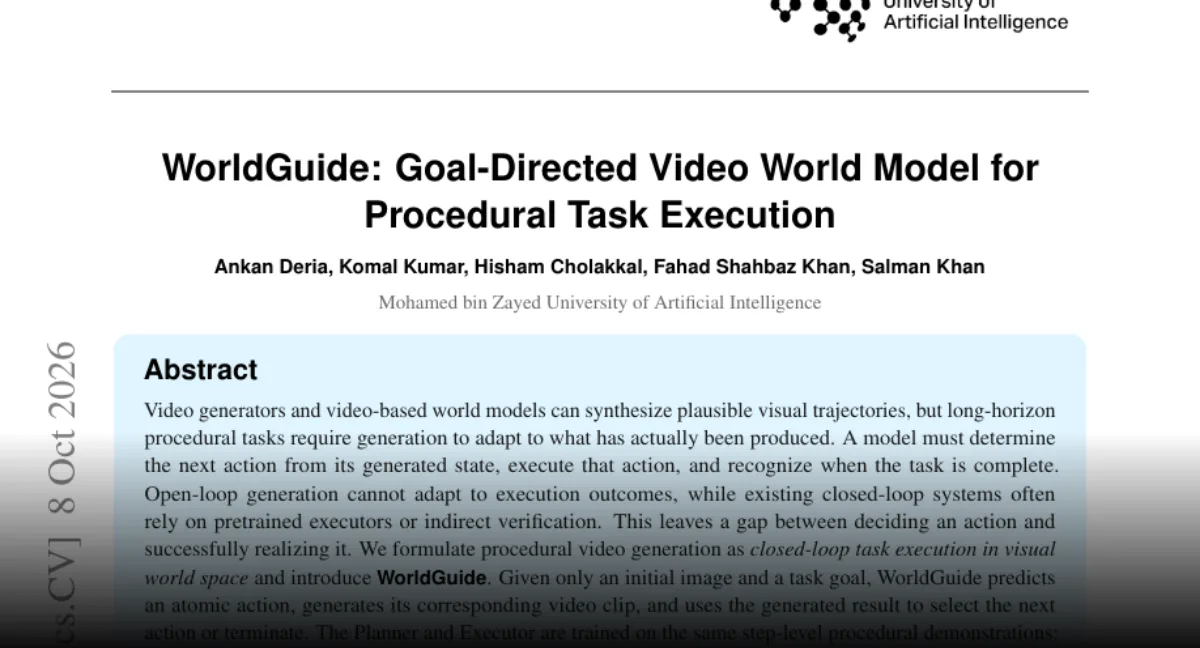
MBZUAI-ORYX has unveiled WorldGuide, a goal-directed video world model that reframes procedural video generation as closed-loop task execution rather than a fixed open-loop rollout. The system pairs a ContextPlanner, which predicts the next atomic action or a completion token from the generated visual state, with an Executor trained on the same step-level demonstrations to render that action as a clip. The rendered result then guides the next action or triggers termination, with hierarchical visual memory keeping long rollouts at bounded token cost.
Background: Why Step-Level Supervision Was Missing
Most video world models generate a fixed sequence of frames without checking whether the task is actually progressing. Procedural tasks — assembling, cooking, operating equipment — require the model to decide what to do next based on what it has already produced. WorldGuide addresses this by treating generation as a loop: plan an atomic action, render it, observe the new state, repeat or stop. To train such a loop, the team needed step-level action-video supervision that existing datasets did not provide.
Development: WorldGuide Bench and the Executor
To fill that gap, the researchers built WorldGuide Bench, comprising roughly 59K step-annotated videos spanning 245 tasks across 27 procedural categories. The Executor is trained on these same step-level demonstrations, so the clip it renders corresponds to a specific predicted action rather than a generic continuation.
Latest Results: Task Success Rates
On WorldGuide Bench, WorldGuide reaches 33.33% Task Success, compared with 29.90% for MiniMax-H3, which receives reference action plans. On Video-CraftBench, WorldGuide reaches 47.69%, versus 32.73% under goal-only conditioning. The project page is available at https://mbzuai-oryx.github.io/WorldGuide, and the code is at https://github.com/mbzuai-oryx/WorldGuide.
What to Watch Next
The comparison against MiniMax-H3 is notable because that baseline is given reference action plans, while WorldGuide must predict its own next action from generated visual state. The gap on Video-CraftBench — 47.69% versus 32.73% — suggests that closed-loop planning with step-level supervision outperforms goal-only conditioning on procedural tasks. Whether hierarchical visual memory scales to longer horizons and more categories than the 27 in WorldGuide Bench remains an open question for follow-up work.
Comments
No comments yet. Be the first to comment.