
Meta's Watermelon matures into a frontier model.
Meta Superintelligence Labs launched Muse Wonder, a closed frontier AI model codenamed Watermelon, ranking second behind Claude Opus 5.5 in Artificial Analysis. The release shifts the frontier race from OpenAI and Anthropic by adding cheaper API plans, a consumer agent app, and massive infrastructure. Related updates include Andrej Karpathy's view on limited frontier access and Microsoft's Maia 300 AI chip push, showing silicon and access are now central to AI competition.
Key Takeaways
- Meta's closed Muse Wonder model family, codenamed Watermelon, has reached frontier-tier AI, ranking second in Artificial Analysis' intelligence index behind Claude Opus 5.5 and challenging the OpenAI–Anthropic race.
- Benchmark results show task-specific tradeoffs: Muse Wonder Full outperforms Claude Opus 5.5 in legal work, long coding, and memory, while Claude remains ahead in health, computer use, and some coding tasks.
- Meta's advantage is not only model performance but also its consumer agent app Muse, massive user base, and large-scale data-center infrastructure, making its frontier push harder for rivals to ignore.
- The AI competition is expanding beyond models into custom silicon and access tiers, with Microsoft's Maia 300 chip promising higher AI output and mass deployment, while Karpathy highlights how few people truly access frontier capabilities.
- Other developments—Sora revival talks, Epic Games' AI retooling, DeepMind's math agent, and Coinbase's Qwen-based fraud model—show the frontier race now spans models, chips, agents, and practical enterprise use.
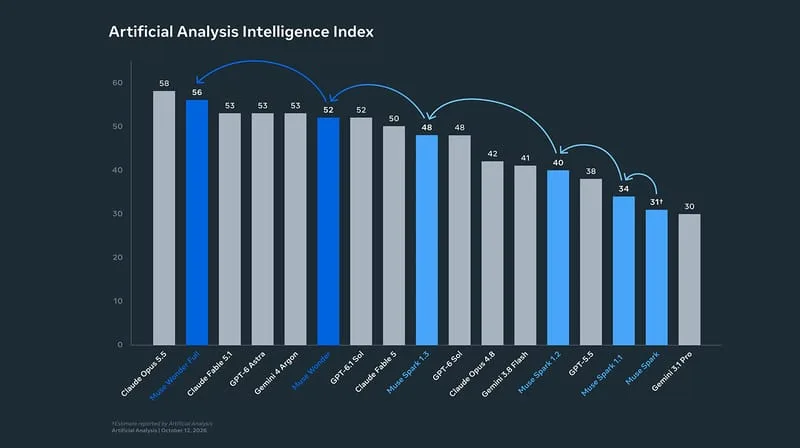
Meta Muse Wonder, the model family from Meta Superintelligence Labs codenamed Watermelon, arrived on October 13, 2026, and moved the company into the frontier tier of large AI systems. The full version, Muse Wonder Full, landed second in Artificial Analysis' intelligence rankings behind Anthropic's Claude Opus 5.5. The release changed the competitive story: the frontier had been framed as a two-horse race between OpenAI and Anthropic, while Meta now has a closed model, a consumer agent app in Muse, and the infrastructure to make the result harder to ignore.
Background: Meta's Closed Frontier Push
Meta's earlier public identity in frontier AI was tied to open Llama releases. Muse Wonder breaks that pattern. Both Muse Wonder and Muse Wonder Full are closed, and Alexandr Wang said API prices will sit "meaningfully below" OpenAI and Anthropic's top models. Meta's advantage is not only benchmark scores. It has data centers, billions of users, and a hit agent app in Muse, qualities that rivals cannot easily replicate. The Rundown AI newsletter, written by Zach Mink, welcomed 4,730 new readers with this release.

Development Process: Benchmark Results and Task Tradeoffs
Artificial Analysis placed Gemini 4 Argon, GPT-6 Astra, and Claude Fable 5.1 at 53 on its Intelligence Index. Wonder Full was three points clear of that pack, putting it at 56, and two points behind Claude Opus 5.5. The tests were not one-sided. Wonder Full passed Opus 5.5 and Astra in legal work, long coding, and memory. Opus 5.5 remained ahead in health, computer use, and a few coding areas. The result gives Meta a credible second-place claim while showing that the frontier is still split by task type.
Latest Progress: Access, Silicon, and Practical Use
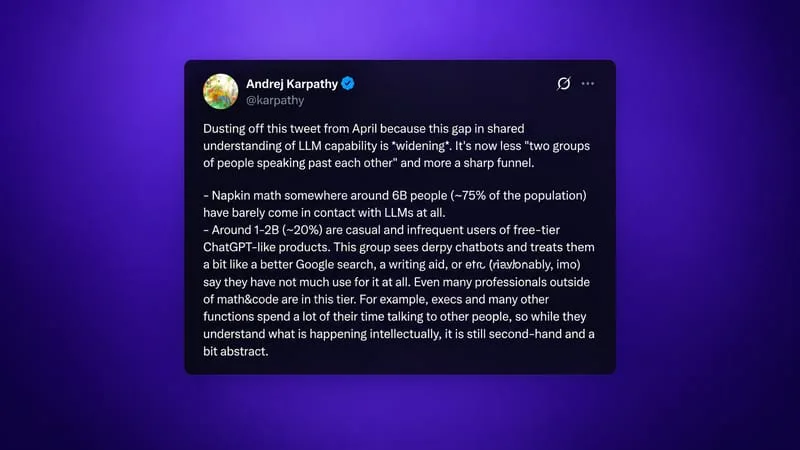
Andrej Karpathy revisited his April post on how people judge AI and described a "sharp funnel." He estimates that about 5,000 people inside labs have access to true frontier AI capabilities, such as weeks-long agent swarms or solving open math problems. Nearly 6 billion people, about 3/4 of the world, have hardly used AI, while 1 to 2 billion users rely on free chatbots for quick answers. Karpathy traced the split to access tiers, problem size, and models that excel where answers are checkable and lucrative, like code and math. He called it the "weirdness of the moment," with most people still underestimating AI while a select few feel "the curve going vertical."

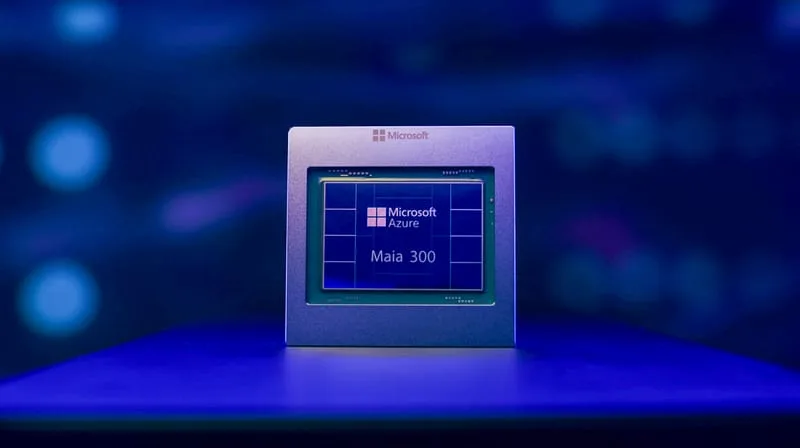
Microsoft unveiled Maia 300, its latest in-house AI chip. Satya Nadella called it "our biggest bet yet on our own silicon." Microsoft expects 40% more AI output than leading GPUs on the same power and plans to make Maia the main engine for running AI across Copilot and other products from 2027. The first multi-gigawatt Maia rollouts are slated for next year, and Reuters reported that Microsoft could deploy over 1 million of the new chips next year. The current Maia 200 already powers Copilot and serves OpenAI's models. Microsoft's spending on data centers and equipment is set to top $175 billion this year. The push lands as OpenAI, Anthropic, and others build their own chips, and it matters for Nvidia because self-silicon buyers can reduce the pricing leverage that helped make Nvidia the kingmaker of the AI chip world and the first $5.5 trillion company.
Quick Moves and Current Stage
Other developments included Bill Peebles reportedly negotiating to bring OpenAI's shuttered Sora video AI back through a new filmmaking startup, with OpenAI taking a stake in return. Epic Games CEO Tim Sweeney said the company is retooling "for maximum AI acceleration," reportedly telling the team "no more hand-written code" to integrate AI tools in development work. Anthropic released research showing that small AI models are getting closer to copying themselves between everyday gadgets such as smart ovens or TVs. DeepMind published its AlphaProof Nexus math agent, showing it cracked 9 of 353 unsolved Erdős problems by pairing Gemini proofs with software checking every step. Coinbase released blogs detailing how the crypto exchange trained Alibaba's small, open Qwen model on its own data to beat top AI models at catching fraud at lower costs. The trend list also included Muse Wonder, Z.ai's GLM-Legal, Reverse Engineer Anything, and Anthropic's Haiku 5.5.
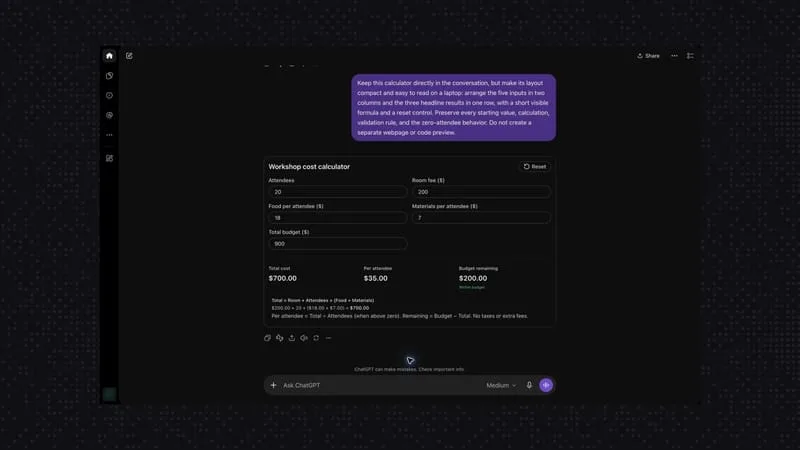
A practical test showed how Muse Code could use Wonder on a workshop brief with fixed times and activity lengths. The guide tells users to check access and billing first because the consumer Muse app has a separate rollout. It then checks that all six activities fit before noon for 24 people at a planned cost of $990, with no bookings or messages. After attendance rises to 30, the cost should become $1,089 while the agenda stays unchanged. Moving the facilitator to a later slot should force Wonder to explain why noon completion no longer works and ask which rule could change. The guide also says to ask the AI to flag a conflict before changing rules, because a tidy agenda can still hide a shorter session or an unquoted cost. Pro members receive the briefs, change requests, answer key, and comparison record.
At this stage, Meta has not overtaken Claude Opus 5.5, but it has turned a closed frontier model into a second-place benchmark result while OpenAI, Anthropic, Microsoft, and Nvidia's ecosystem continue to push the race across models, chips, and enterprise access.
Meta Description: Meta's Muse Wonder lands second in Artificial Analysis rankings behind Claude Opus 5.5 as Microsoft, OpenAI and Anthropic push the frontier AI race.

Tags: Meta Muse Wonder, Artificial Analysis, Claude Opus 5.5, Microsoft Maia 300, Andrej Karpathy
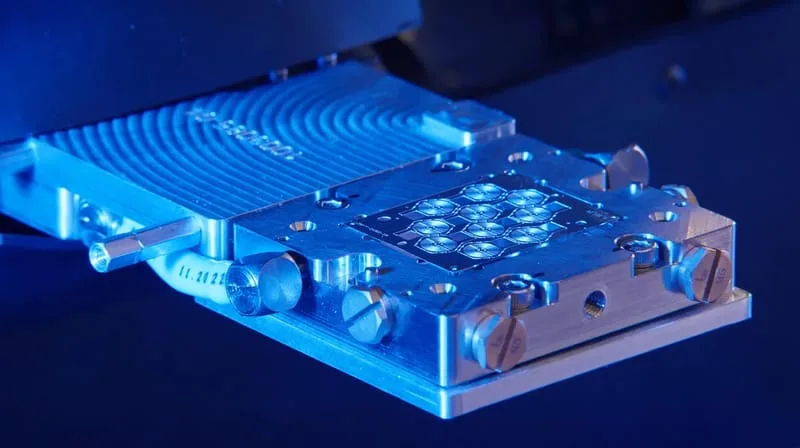
Featured image: Abstract technology style with neural-network lines and a silicon-chip motif, no real people, no company logos, no text.
Comments
No comments yet. Be the first to comment.