
Google’s Gemini 4 Argon Narrows the Divide with OpenAI and Anthropic but Fails to Establish a Clear Advantage
Google Gemini 4 Argon cuts costs and improves agentic scores, but limited rollout and mixed efficiency mean no clear frontier AI lead.
Key Points
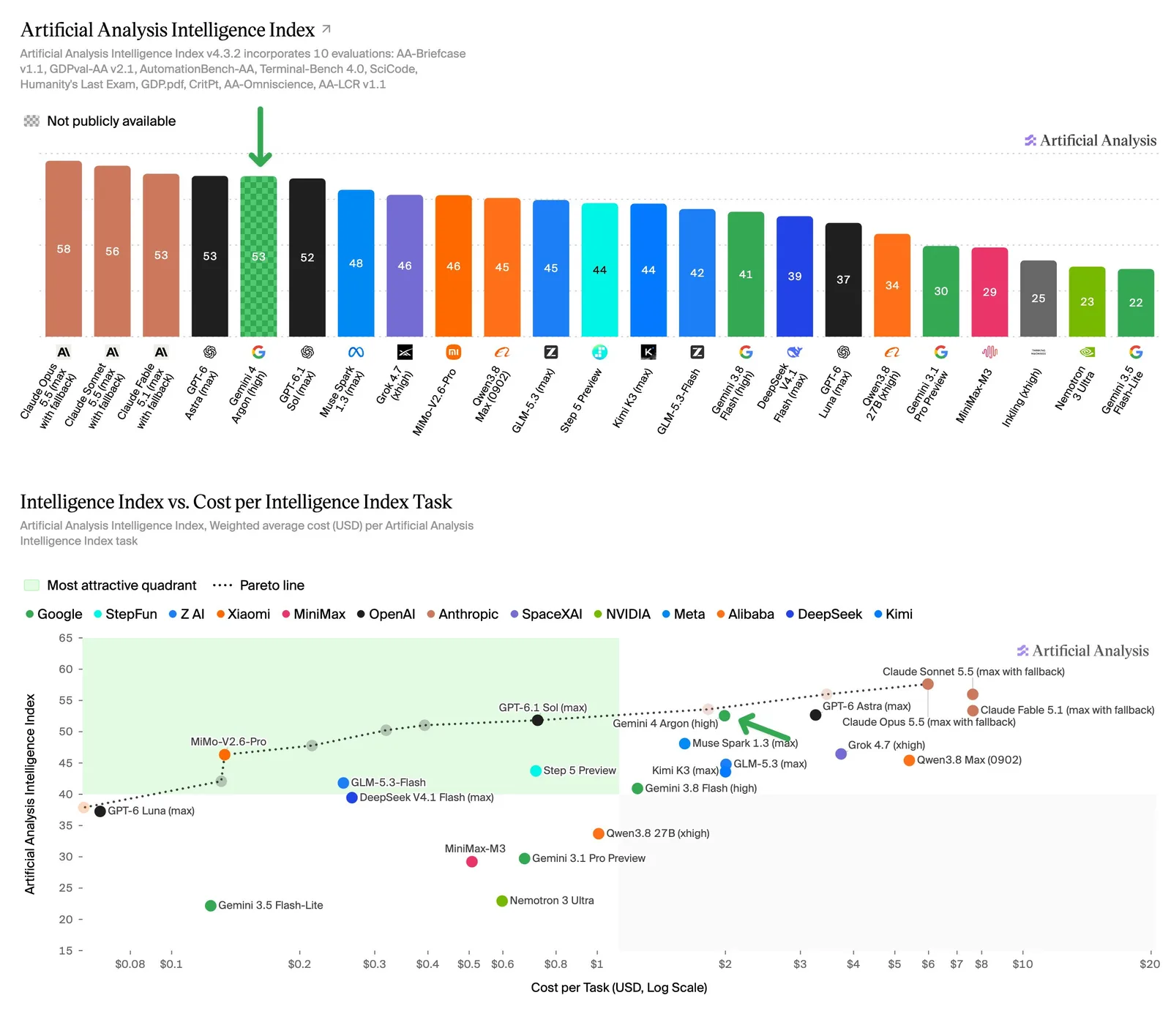
- Google’s Gemini 4 Argon narrows the frontier-model gap by matching top rivals on Artificial Analysis benchmarks, though it does not clearly surpass Anthropic’s leading models.
- The rollout is limited and phased, starting with trusted cyber defenders, Google internal teams, and US government early-access programs before broader public availability.
- Its introductory token pricing is lower than rival frontier models and its output limit jumps to 1 million tokens, but real efficiency is mixed because it uses far more output tokens than GPT-6 Astra.
- It shows major gains on agentic tasks, leading AutomationBench-AA and improving strongly on Terminal Bench, while still trailing some competitors on key coding and agentic benchmarks.
- Human-preference tests rank it first in general text Arena, including coding and creative writing, but web development performance and overall product maturity still lag behind leading rival ecosystems.
Meta description: Google Gemini 4 Argon closes the frontier AI gap with cheap tokens, strong agentic scores, limited rollout, and independent tests showing mixed efficiency.
Tags: Google, Gemini 4 Argon, Artificial Analysis, Arena.ai, frontier AI
Featured image: Abstract technology style illustration of glowing benchmark charts, token streams, and safety gates, no real people, no company logos, no text.
Background: Google's frontier gap return
Google has unveiled Gemini 4 Argon, a new frontier AI model intended to narrow the distance from rivals OpenAI and Anthropic. It is Google's first frontier model in more than seven months, following Gemini 3.1 Pro, after a drawn-out period that skipped the already-announced Gemini 3.5 frontier model. It places Google back among the top three AI labs, though Anthropic likely still leads. Most users will still have to wait.
Development: limited rollout, pricing, and output limits
Google is releasing Gemini 4 Argon gradually. It will first go to a group of trusted cyber defenders as part of the Fairwind program, along with Google's internal teams, which will receive the model without cyber guardrails. Google calls this a phased approach for AI capabilities at this level. The company is also participating in the US government's voluntary program that gives agencies access to new models before public release.
Pricing is set at least for an introductory rate: $2 per million input tokens and $10 per million output tokens. Cached input tokens are 95 percent cheaper than the regular input price, working out to about 10 cents per million, compared with a 90 percent cache discount for Gemini 3.8 Flash. That puts Google below other frontier models on raw token price.
Google also raised the output limit from 64,000 to one million tokens, calling it an industry first. The larger window supports solving hard problems in one pass. To support that, Google is adding Long Decode Continuation to the Gemini API, which pauses long responses and resumes them through follow-up requests so reasoning does not hit a timeout. The input context window stays at one million tokens. Gemini 4 Argon accepts text, images, video, and audio as input, but outputs only text.
Latest progress: parity, cost, and benchmarks
Artificial Analysis provides an independent assessment. At its highest available reasoning level, High, Gemini 4 Argon scores 53 points on the Artificial Analysis Intelligence Index. That ties it with OpenAI's GPT-6 Astra (max) and Anthropic's Claude Fable 5.1, and puts it one point ahead of GPT-6.1 Sol (max). Anthropic's Claude Opus 5.5 remains ahead at 58 points, while Claude Sonnet 5.5 scores 56. Compared with Google's last frontier model, Gemini 3.1 Pro Preview, Argon jumped 23 points. High is typically Gemini's top reasoning tier, though Deep Think is sometimes supported.
The cost picture is more mixed. At the current promo price, one Intelligence Index task costs $1.99. That is 60 percent of GPT-6 Astra's cost of $3.26, but 2.7 times more expensive than GPT-6.1 Sol. Once the discount ends, the cost rises to $3.98, about 20 percent above GPT-6 Astra. The advantage comes from lower token rates, not efficiency: Argon uses an average of 62,000 output tokens per task, while GPT-6 Astra needs only 27,000.
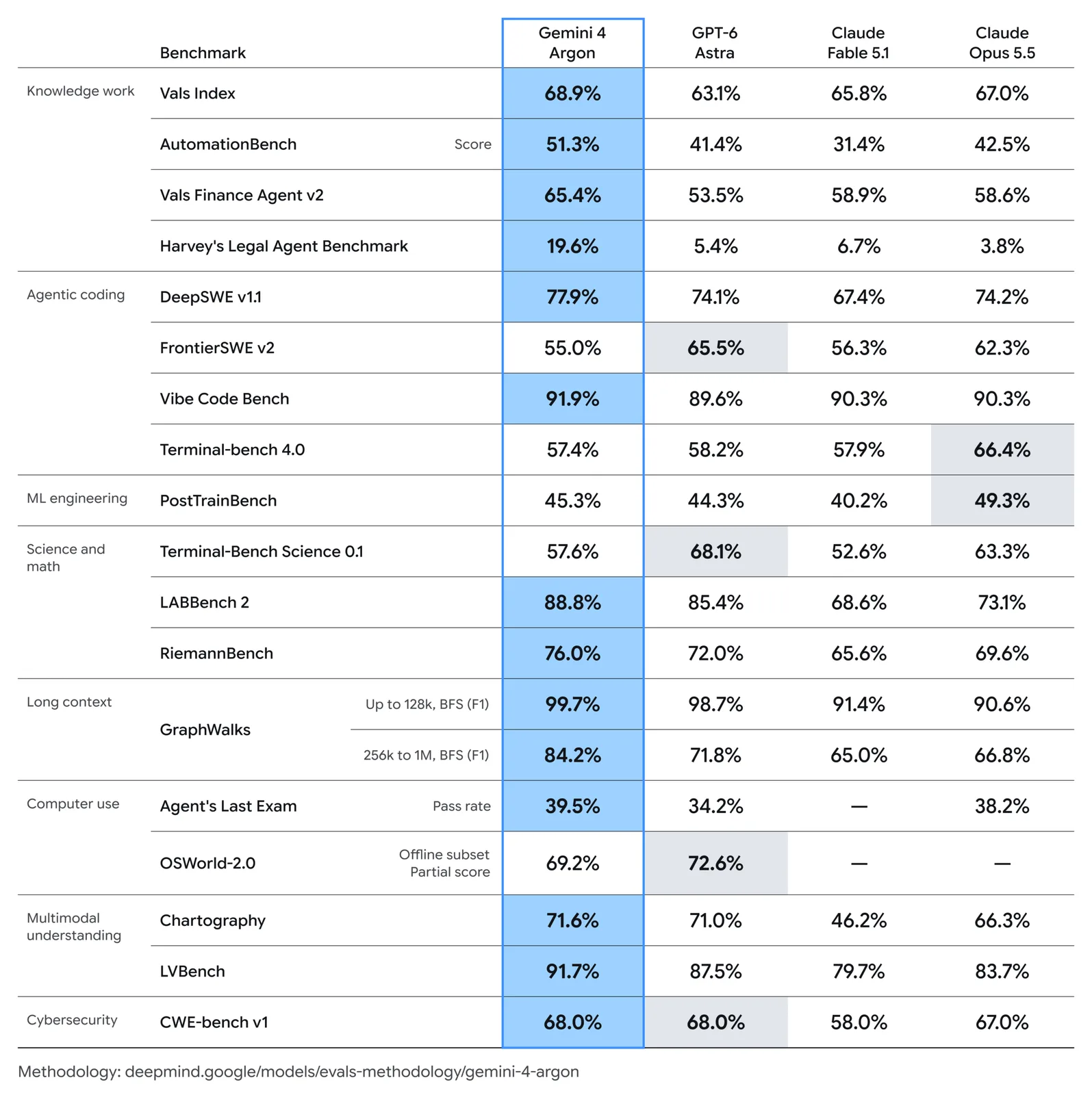
Argon also gains on agentic tasks, a weak spot for Gemini models. On AutomationBench-AA, the Artificial Analysis variant, it takes first place at 77.5 percent, six points ahead of Claude Sonnet 5.5 (max). On Terminal Bench 4, it reaches 57 percent, a 53-point jump over Gemini 3.1 Pro Preview, but remains behind Claude Sonnet 5.5 at 64 percent, Claude Opus 5.5 at 60 percent, and GPT-6 Astra at 59 percent.
On AA-Omniscience, a benchmark for factual knowledge and honest handling of knowledge gaps, Argon's hallucination rate is 15 percent, below GPT-6 Astra (max) at 51 percent and GPT-6.1 Sol (max) at 54 percent. Its accuracy is 50 percent, five points below Gemini 3.1 Pro Preview and 13 points below GPT-6 Astra (max) at 63 percent. The overall AA-Omniscience score is 42, roughly even with GPT-6 Astra at 43 and GPT-6.1 Sol at 42.
Google's own benchmarks show Argon leading most tests by wide margins. It also tops the Vals Index at 68.9 percent, making it the first Gemini model to lead that index, according to Vals AI. Google says Argon finishes in the top five on 20 of 22 tested benchmarks, with strength in finance, law, coding, and security. The test needs caution because Claude Sonnet 5.5 also outranks Claude Opus 5.5.
Arena.ai tests human preference. In Text Arena, Gemini 4 Argon (High) takes first place with 1,525 points, 20 points ahead of Claude Opus 4.6 (High). Arena says it leads in coding, hard prompts, instruction following, longer queries, and creative writing, as well as across all evaluated professional fields and in English, Chinese, Russian, and non-English queries overall. The result follows a long drought in competitive writing models; Claude Opus 5.5 still trails Claude Opus 4.6 in human preference rankings. Google's previous model, Gemini 3.8 Flash (High), had been in eleventh place.
Web development is less dominant. In Code Arena: WebDev, Argon scores 1,679 points and lands eighth, a 96-point improvement over Gemini 3.8 Flash (High) and a jump from 29th. At a blended rate of $8 per million tokens, Arena says Argon shifts Text Arena's Pareto frontier and is currently the ranking's most cost-efficient model.
Current stage: limited access, stronger scores
Gemini 4 Argon returns Google to the frontier conversation with competitive scores, low introductory token pricing, and a larger output limit. The current stage remains limited: access is restricted, pricing is introductory, and real-world performance depends on the software layer. Compared with Claude Cowork and ChatGPT Work, the Gemini app still lags behind. Next, benchmark gains must translate into broad use as rollout expands.
Comments
No comments yet. Be the first to comment.