
Intern Lumina U2 is a multi-codebook diffusion LLM for omni-visual understanding and image generation.
Intern Lumina U2 is a discrete diffusion LLM with 1.4 billion active parameters, unifying understanding, generation and editing in one interface.
Key Takeaways
- Intern Lumina U2 is a 16.9B mixture-of-experts diffusion LLM with only 1.4B activated parameters, unifying image, video, and 3D understanding with text-to-image generation and image editing.
- It is described as the first diffusion LLM to model multi-codebook visual tokens in a fully discrete space, using 8 AToken codes per visual position and parallel decoding.
- Its key architectural advantage is sharing one backbone, one token interface, and one masked-diffusion objective across all tasks, avoiding separate continuous generation modules.
- It reports strong benchmark results across image, video, 3D, and text-to-image tasks, including competitive performance against larger unified and specialist generation models.
- It introduces Plateau-Halton sampling with V-verify for a 4.45× end-to-end image-generation speedup, while scalability to longer video and richer 3D assets remains an open question.
Intern Lumina U2 is a single unified model that handles image, video and 3D understanding alongside text-to-image generation and image editing. Built as a 16.9B mixture-of-experts (MoE) diffusion large language model (dLLM) with only 1.4B activated parameters, it is described as the first dLLM to model multi-codebook visual tokens in a fully discrete space.
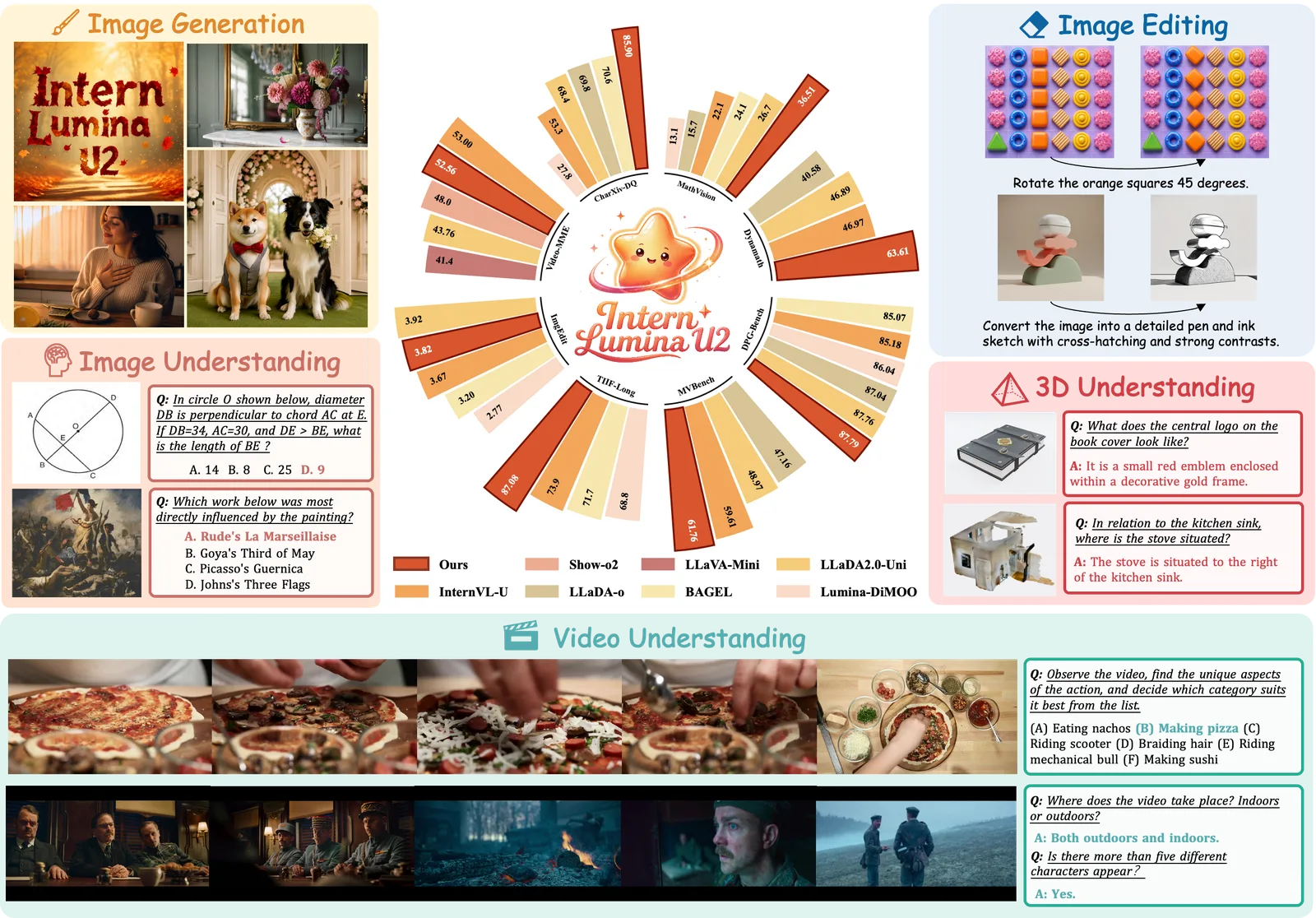
The release matters because most unified systems still bolt a separate continuous generator onto an understanding backbone. Intern Lumina U2 instead shares one backbone, one token interface and one masked-diffusion objective across all tasks.
Background: Why a Fully Discrete Visual Interface
Unified multimodal models typically face a trade-off. Understanding favors discrete tokens that a language backbone can process, while generation has often relied on continuous latent generators. That split adds components and complicates training.
Intern Lumina U2 addresses this by keeping the entire visual pipeline discrete. Each visual position carries 8 AToken codes, which increases detail without lengthening the sequence. Positions are decoded in parallel by the diffusion backbone, while a lightweight autoregressive head predicts the codes within each position.
Development: Training and Sampling Choices
The model was trained, inferred and evaluated on 1,024 Ascend 910B NPUs, with an additional NVIDIA run for cross-platform validation.
For generation speed, the team introduced Plateau-Halton sampling with V-verify (PHV), which delivers a 4.45× end-to-end speedup for image generation.
Results Across Understanding and Generation
On image understanding, Intern Lumina U2 ranks best or tied-best on 6 of 10 benchmarks and beats the same-backbone LLaDA2.0-Uni on 8 of 10. Reported scores include CharXiv-DQ 85.9, HallusionBench 64.6, MathVision 36.5 and DynaMath 63.6.
For video and 3D, it leads all three video benchmarks: Video-MME 56.7, MLVU 62.1 and MVBench 61.8. It also records 3D MM-Vet 50.5, ahead of 3D specialists ShapeLLM and PointLLM.
In text-to-image, it is the best among unified models on DPG-Bench (87.79), UniGenBench (86.11) and TIIF-Bench (88.57 short / 87.08 long), and ties the best on GenEval (89). It outperforms FLUX.1-dev and surpasses Qwen-Image on GenEval, UniGenBench and TIIF-Bench while using roughly 14× fewer activated parameters.
On scientific diagrams, it achieves the best Local score on VeriphyT2IBench (76.58, above GPT-Image-1 and Gemini 2.5 Flash Image) and the highest GenExam-Physics relaxed score among general-purpose unified models (44.8).
What to Watch Next
The headline claim is architectural: one discrete diffusion backbone covering understanding, generation and editing without a separate continuous generator, at 1.4B activated parameters. Whether that efficiency holds outside benchmark suites, and how the multi-codebook token scheme scales to longer video and richer 3D assets, are the open questions worth tracking.
Comments
No comments yet. Be the first to comment.