
On-Policy Self-Distillation for Extreme Visual Token Reduction: Self-Teaching with Fewer Tokens
The paper addresses extreme visual token reduction by using on-policy self-distillation to train multimodal models to remain useful with sparse visual inputs. It treats token loss as a learning problem, aiming to preserve language grounding and accuracy under aggressive visual compression.
Key Takeaways
- Multimodal systems can face a major efficiency bottleneck because images and videos are converted into many visual tokens, increasing memory, training, and inference costs.
- Extreme visual token reduction improves efficiency but can weaken language grounding, causing failures on small text, rare objects, motion cues, and spatial relationships.
- The paper proposes on-policy self-distillation as a repair mechanism, using the model’s own current behavior and internal targets to train it to remain useful with sparse visual input.
- The main contribution is methodological: token reduction should not be treated only as compression, but as a learning problem where model behavior is shaped to handle fewer visual tokens.
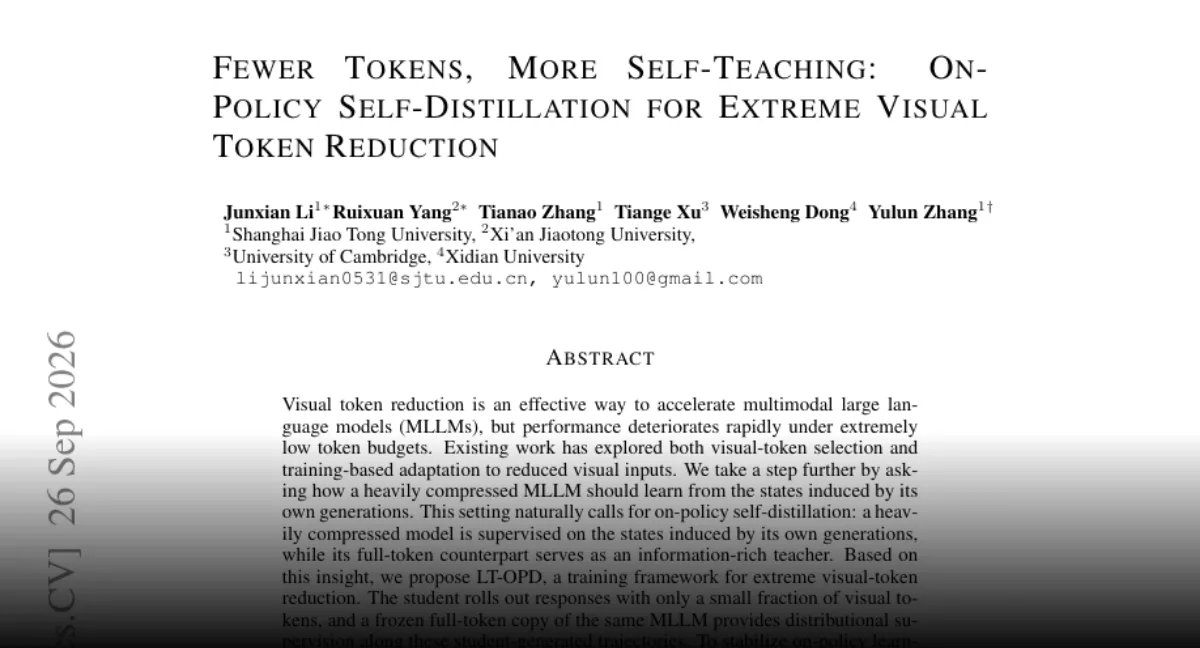
A paper examines extreme visual token reduction and uses on-policy self-distillation as its central response. The topic matters because multimodal systems often spend a large share of their token budget on visual inputs, and shrinking those inputs too aggressively can make images less connected to language. The paper’s angle is not just to cut visual tokens, but to treat the reduction as a learning problem: the model is guided by a distillation process tied to its own current behavior.
Background: Visual Tokens Can Become the Bottleneck
In transformer-based multimodal systems, images and videos are commonly split into small patches or frames, and each patch becomes a token that the model must process. Tokens are the basic units the model reads, so more tokens usually mean higher memory use, longer inference time, and greater training cost. High-resolution images and long videos can multiply that pressure quickly.
This is why visual token reduction has become an efficiency path. If a system can keep the most useful visual evidence while discarding redundant tokens, it may run faster and cheaper. The difficulty is deciding what counts as redundant. A model may lose text in an image, small objects, motion cues, or spatial relationships when visual detail is trimmed too hard.
Development: Extreme Reduction Creates a Stability Problem
The scenario described by the paper is more aggressive than ordinary token pruning. Extreme visual token reduction means the model must retain useful behavior after a much larger share of visual representations is removed. At that point, the challenge shifts from simple compression to alignment.
A reduced visual stream can still support broad scene descriptions, but it may fail on precise questions, rare objects, or small text. The model can also become less stable when visual evidence and language instructions interact in unfamiliar ways. In other words, the method has to compensate for information loss not only in architecture, but also during training or adaptation.
Latest Progress: On-Policy Self-Distillation as a Repair Mechanism
On-policy self-distillation is a training approach in which the model’s current policy supplies the behavior being distilled, while a teacher signal or internal target guides the model toward better outputs. The “on-policy” part means the learning signal is tied to the behavior the model itself is likely to produce, not only to fixed examples. The “self-distillation” part suggests the target and learner are related rather than completely separate systems.
In the paper’s framing, this mechanism is used to address the harm caused by extreme visual token reduction. The idea is to teach the model to remain useful under a sparse visual input. Instead of expecting a simple filtering rule to recover all detail, the method shapes the model’s own decision process so it can make better use of fewer visual tokens.
The available summary names no publication date, dataset, benchmark score, model family, or organization, so the contribution is best understood as a methodological claim: token reduction can be improved by adding a policy-aware distillation stage. That framing is useful because it connects efficiency engineering with model behavior, rather than treating visual token count as a standalone metric.
What to Watch Next
The next layer of detail would show how far the approach can go in real systems. Important missing pieces include the exact model class, whether images or videos are the target, the reduction ratio used, and the tasks where accuracy is measured. A method like on-policy self-distillation may matter most when extreme token cutting is required for latency, memory, or cost limits.
For readers tracking multimodal AI efficiency, the broader signal is that token budgets are becoming a design surface. The question is no longer only how to shrink visual input, but how to shrink it while keeping the model’s language grounding intact. The paper positions on-policy self-distillation as one way to make that tradeoff more manageable.
Meta description: An analysis of a paper using on-policy self-distillation to address extreme visual token reduction and its implications for efficient multimodal AI.
Tags: visual token reduction, on-policy self-distillation, multimodal AI, model efficiency, AI research
Featured image: abstract technology style with compressed token streams and a distilled feedback loop, no text, no logos, no people.
Comments
No comments yet. Be the first to comment.