
Correction training is applied to diffusion models to improve output quality.
Correction training refines diffusion model outputs, improving quality without classifier-free guidance, keeping diversity and reducing oversaturation.
Key Points Summary
- Correction training improves diffusion model image quality without relying on classifier-free guidance during sampling.
- It adds a corrector that iteratively refines the denoiser’s predictions toward the same clean image target.
- The method improves output quality while preserving diversity and avoiding strong oversaturation.
- It achieves competitive or better FID scores than classifier-free guidance on DiT, SiT, and JiT models.
- An early public release provides examples, project page, code, and checkpoints, with reproducibility and wider adoption as next steps.
Meta description: Correction training refines diffusion model predictions to improve image quality while preserving diversity and avoiding oversaturation, by UC Berkeley and Reve.
Tags: Diffusion Models, Image Generation, AI Research, Classifier-Free Guidance, UC Berkeley
Featured image: abstract diffusion grid of noise and clean shapes, no people, no logos, no text
Background: Guidance Has Been the Usual Shortcut for Diffusion Images
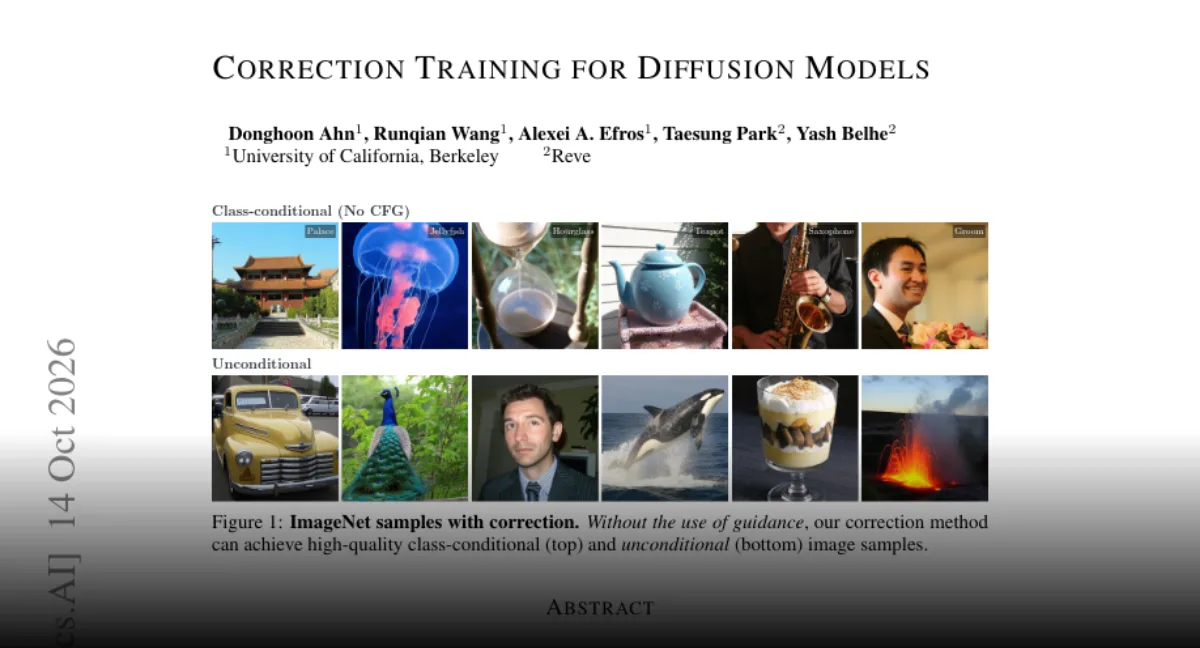
Diffusion models create images by gradually removing noise from a random signal. In many image generation workflows, classifier-free guidance is used to steer outputs toward a desired target during sampling. A release from UC Berkeley and Reve asks whether diffusion models can generate high-quality images without that step. The answer given by Donghoon Ahn, Runqian Wang and Alexei A. Efros, together with Taesung Park and Yash Belhe, is yes. Their method is called correction training, and it is presented as a simple and effective way to improve diffusion sample quality.
Development: A Corrector Refines the Denoiser During Sampling
The core idea is not to replace the denoiser with a different target. Instead, a corrector learns to refine the denoiser’s predictions toward the same clean target. During sampling, this correction is applied iteratively. The release describes the result as substantially improved quality while largely preserving diversity and avoiding strong oversaturation.
For readers, the significance is practical: correction training suggests a path to improve generated images without relying on classifier-free guidance as the main sampling adjustment. It keeps the clean image target intact and adds a refinement step that helps the denoiser move more accurately toward it.
Latest Progress: Results Across DiT, SiT and JiT
The method is evaluated across DiT, SiT and JiT. In those settings, correction achieves FID scores (Frechet Inception Distance, a common image quality metric) that are competitive with or better than classifier-free guidance. The release also includes visual examples, a project page, and code and checkpoints.
Visualization: https://x.com/donghoon_ahn/status/2110038016622493951
Project page: https://sunovivid.github.io/correction-training/
Code and checkpoints: https://github.com/sunovivid/correction-training
Current Stage: Early Public Release of Method and Resources
The work is currently in an early public release stage: the method, examples, project page, code and checkpoints are available, and the reported comparisons cover DiT, SiT and JiT. The next signal will be whether the published correction-training results can be reproduced with the released code and checkpoints, and whether the method is adopted beyond the model families already shown.
Comments
No comments yet. Be the first to comment.