
AI may instantly improve junior patent attorneys' performance while quietly impeding their professional growth
AI improved junior assisted patent drafting, but unaided redlining showed no durable junior gains; seniors kept stronger judgment.
Key Takeaways
- A Google Labs InFlow study found that AI assistance helped junior patent attorneys produce better patent claim drafts, especially by reducing low-quality outputs.
- The drafting benefits were stronger for juniors than seniors, suggesting AI can quickly narrow performance gaps in AI-assisted tasks.
- However, in an unaided redlining task, juniors did not retain an advantage from AI use, while seniors continued to show stronger judgment.
- The study suggests AI may boost immediate productivity while risking weaker long-term skill development for less-experienced professionals.
- Broader research across law, software, consulting, and writing shows similar concerns: AI can help performance short term but may undermine durable expertise and entry-level skill formation.
Title: Google Labs InFlow Study Shows AI Helps Junior Patent Drafting
Meta description: Google Labs InFlow patent drafting study shows AI helps juniors improve claim quality, while seniors retain stronger redlining judgment in unaided reviews.
Tags: Google Labs, InFlow, patent drafting, AI skill formation, legal technology
Featured image: abstract technology style with layered patent claim blocks and blurred review markers, no real people, no company logos, no text
Background: A study split AI drafting from unaided judgment
The Google Labs InFlow study separated two questions by having attorneys first use AI assistance and then complete a task without it. The design allowed researchers to score both the quality of AI-assisted work and the durability of attorneys' own judgment. A Google-funded experiment gave two-thirds of participants access to InFlow, an unreleased AI assistant from Google Labs, while the remaining third worked without AI. In two patent claim drafting tasks, only the treatment group could use InFlow; the control group completed the same assignments unaided. In a third task called redlining, all participants reviewed an existing patent draft critically without AI. The authors framed drafting as a measure of immediate AI-assisted performance, while redlining measured internalized judgment, a task patent attorneys routinely perform without any tools. Blinded patent attorneys at an independent firm scored every result across five categories: enforceability, technical accuracy, strategic ambiguity, completeness, and clarity.
Development: AI lifted junior drafting scores at 10-day and 90-day marks
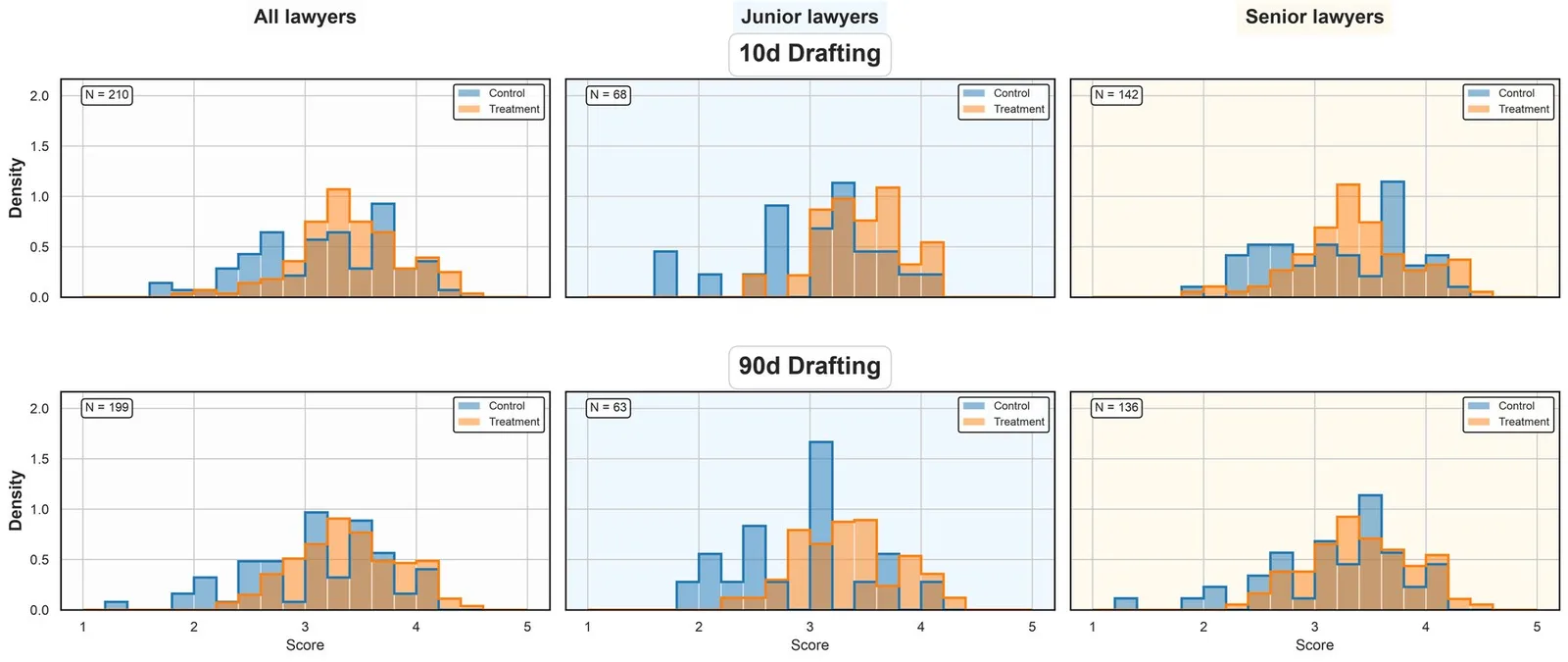
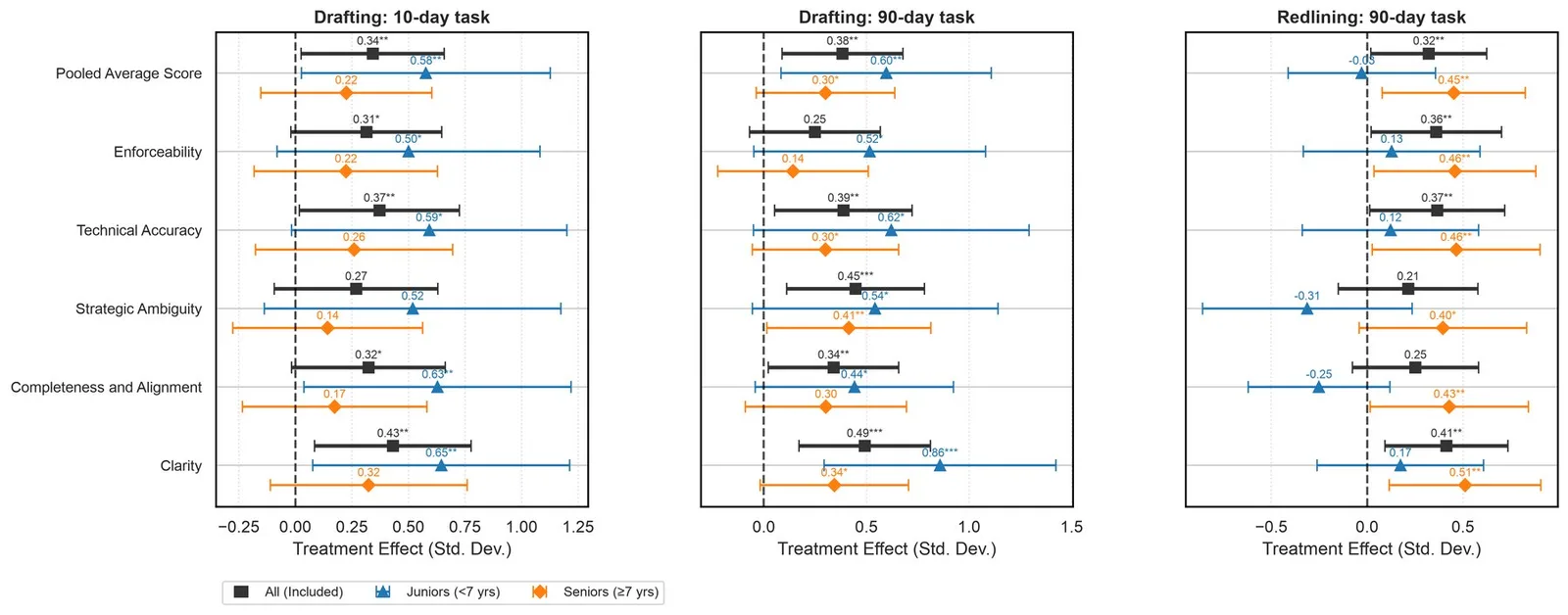
At both the 10-day and 90-day marks, the treatment group clearly outperformed the control group in drafting. The gains appeared across all five scoring categories. Higher totals came mostly from fewer bad ratings and more mid-range scores, while top scores barely moved. Junior attorneys received far fewer low scores when they had access to AI during patent drafting. The effect was much larger for juniors with fewer than seven years of experience than for senior attorneys. The researchers linked that pattern to a growing body of studies showing AI narrows performance gaps between less and more experienced workers, an effect already observed in writing, customer service, and software development.
Latest progress: Redlining revealed who kept the advantage
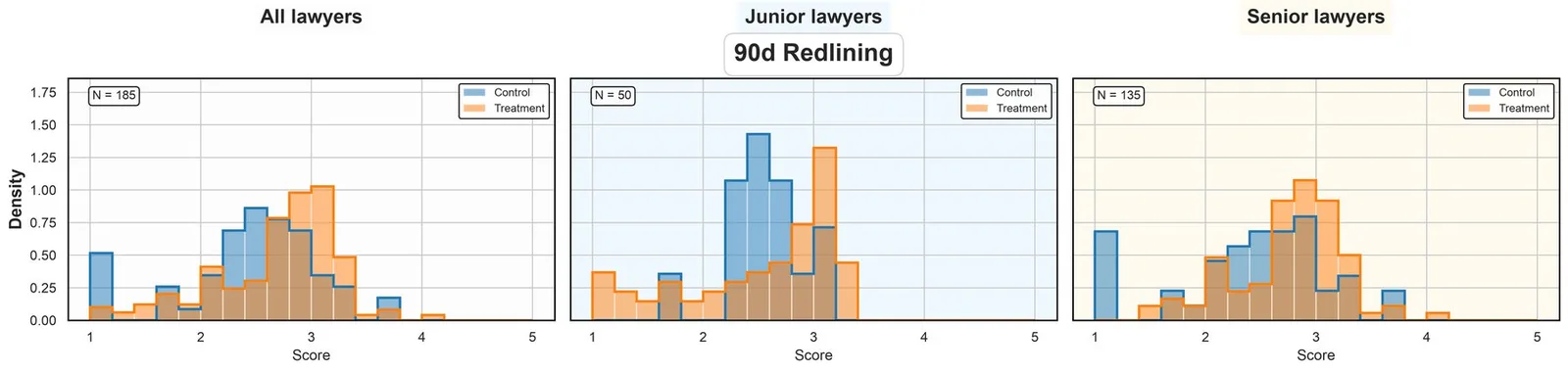
Redlining produced the opposite result. The AI-experienced group scored better overall, but the advantage came entirely from senior attorneys; juniors saw no benefit, even after posting the largest gains during AI-assisted drafting. Junior results split apart: far fewer mid-range scores were replaced by more bad and more good ratings, with no growth at the top. The authors read that pattern as a sign that AI sped up skill-building in some juniors while replacing skill-building in others, though the experiment did not explain why the effects diverged. The attorneys who gained the most from AI appeared to retain the least lasting skill, leading researchers to suggest that baseline expertise may be a prerequisite for turning AI-assisted practice into durable ability.
A supplementary text analysis offered one possible explanation. Senior attorneys more often restructured a flawed draft and grounded their changes in legal principles. Juniors more often spotted serious flaws without fixing them, leaving notes that read like instructions to an AI assistant. Because that behavior also appeared in the control group, the authors did not attribute it to an AI-trained habit. They instead described it as a baseline deficit at the junior level that AI use did not fix.
The study also carried limits. The sample size was small, driven by high billable rates for top attorneys, and the participating firms were not representative of professional services as a whole. The researchers lacked a baseline skills measurement, and the three-month window was short compared with the years needed to build patent expertise. Even so, the tension between immediate productivity gains and lasting skill development matters as long as professional work still requires judgment without AI, and the researchers argue it likely will for a long time. Even if AI eventually supports redlining, it probably will not be available to attorneys in real time during client meetings and courtroom proceedings, where stakes are high and judgment calls happen on the spot.
What to watch next: Productivity and durable expertise
Similar patterns have appeared in other fields. An Anthropic study found that younger developers who learned a new programming library with AI help scored 17 percent worse on a follow-up knowledge test than those who learned without it. In essay writing, the MIT Media Lab found signs of cognitive debt from outsourced thinking. In management consulting, a BCG study from 2023 showed weaker consultants improved far more with GPT-4 than strong performers did. Stanford researchers have explained declines in entry-level jobs across multiple industries by arguing that AI can mostly replace textbook knowledge from school and college, the main thing early-career workers bring, while experienced professionals also carry hands-on expertise that AI can't easily substitute.
The patent attorney study feeds a broader debate about the erosion of professional expertise, what some researchers call the "tragedy of the cognitive commons". Individual firms benefit from automation, while the cost of stunted talent development can spread across an entire profession. The study adds more experimental evidence from real-world practice to that concern. Anthropic recently said junior positions in its engineering departments dropped from 21 percent to 14 percent since early 2025.
Comments
No comments yet. Be the first to comment.