
Chinese AI model Kimi K3.1 Pro is narrowing the gap with Anthropic's Claude Opus 5.5
Kimi K3.1 Pro by Moonshot ranks fourth on an AI index, cuts prices, boosts agentic and modeling workflows, and may lead in open weights by November 4
Key Takeaways
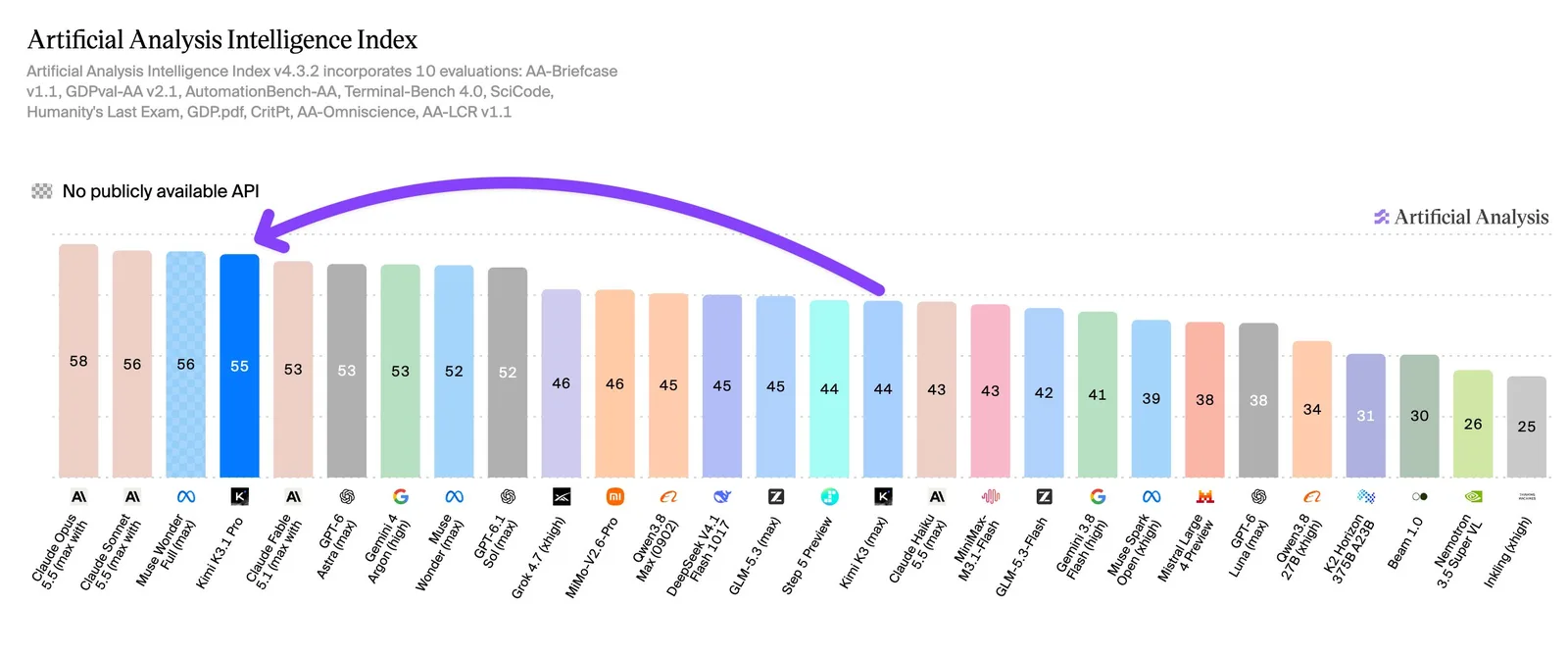
- Moonshot AI released Kimi K3.1 Pro, scoring 55 on the Artificial Analysis Intelligence Index, an 11-point jump from Kimi K3 and placing it fourth overall.
- If Moonshot publishes the model weights by November 4, 2026 as planned, K3.1 Pro could become the highest-scoring open-weights model and narrow the gap to top proprietary models to about 3 points.
- The model shows major gains in agentic benchmarks, office and finance tasks, 3D modeling and CAD work, and reduced hallucinations, while keeping the same 2.8T total / 104B active parameter architecture and a 1M-token multimodal context window.
- Hosted versions are already available through Kimi.ai, Kimi Work, Kimi Code, and the Kimi API, with 33% lower token prices, while the future open-weights release will remove cyber-related training data to limit offensive cybersecurity capabilities.
Moonshot AI, a Chinese AI company, has released Kimi K3.1 Pro, which now sits fourth on the Artificial Analysis Intelligence Index at 55 points. The score is an 11-point jump from Kimi K3, and it narrows the gap to the top proprietary models to three points if Moonshot releases the weights as planned by November 4, 2026. K3.1 Pro is available now through Kimi.ai, Kimi Work, Kimi Code, and the Kimi API.
Background: A heavier post-training pass
Kimi K3.1 Pro is a post-trained version of Kimi K3, built with significantly more post-training compute, according to Moonshot. On the Artificial Analysis Intelligence Index, only three models rank higher: Claude Opus 5.5 at 58 points, Claude Sonnet 5.5 at 56, and Muse Wonder Full at 56.
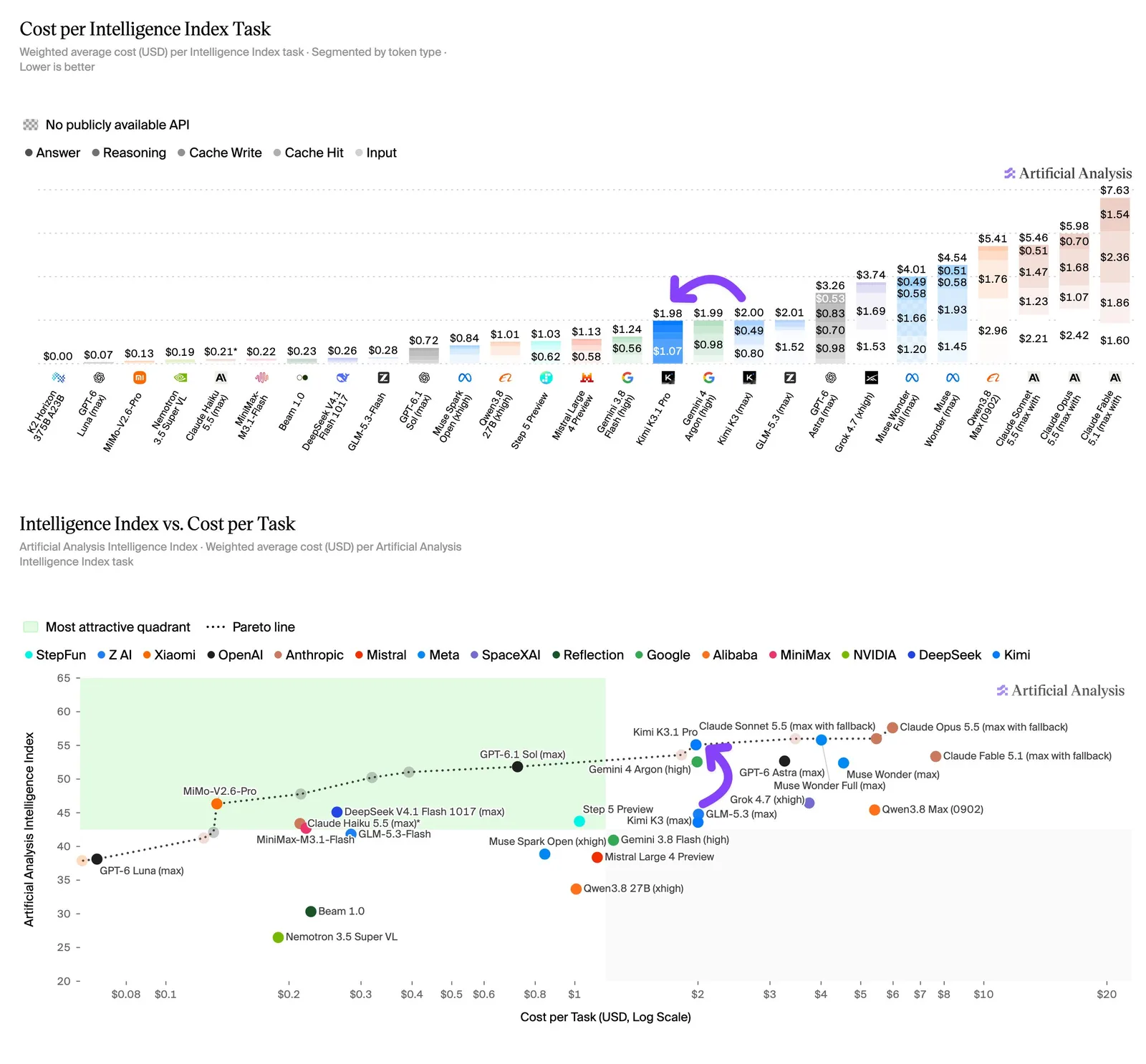
If Moonshot releases the model weights by November 4, 2026, K3.1 Pro would become the highest-scoring open-weights model available. That would shrink the gap between open and proprietary models from 12 to just 3 points, assuming nothing else changes by then.
Alongside the main model, Moonshot is shipping K3.1 Pro Highspeed, a variant the company says runs two to three times faster. Both are accessible through Kimi.ai, Kimi Work, Kimi Code, and the Kimi API.
Development: Agentic scores, office work, and pricing
The biggest benchmark gains appear in agentic tasks. On GDPval-AA, Artificial Analysis reports 1,846 Elo for K3.1 Pro, 312 points above K3. That places it just behind Claude Opus 5.5 at 1,866 and Muse Wonder Full at 1,857. On Terminal-Bench 4.0, Moonshot reports 65.7 percent, ahead of GPT-6 Astra at 58.2 percent and barely behind Claude Opus 5.5 at 66.4 percent. K3 managed only 13 percent on the same test.
Moonshot reports a sharp drop in claim-level hallucinations on its internal Kimi Hallu Bench Hard, from 23.4 percent with K3 to 8.3 percent with K3.1 Pro. The company says the benchmark is a stress test, not a measure of general error rates. GPT-6 Astra still has an edge on the same test at 5.5 percent.
For finance work, Moonshot says K3.1 Pro gained 7.2 points on Financial Modeling and 11.6 points on Financial Research. On general office tasks, it tops all tested models on OfficeQA Pro v2, according to Moonshot. All benchmark results were reported with reasoning effort set to "max."
The model keeps the same dimensions as K3: 2.8 trillion total parameters and 104 billion active parameters. Its context window spans one million tokens, and it handles both text and images. Artificial Analysis says it sits at the top of the Pareto frontier, with no model of comparable parameter count scoring higher on the Intelligence Index.
Token prices fall by 33 percent. Input costs $2 per million tokens, down from $3; output costs $10, down from $15; cache hits cost $0.20, down from $0.30. Each Intelligence Index task costs $1.98, almost identical to K3 at $2.00, because the model generates 14 percent more output tokens.
Development: 3D modeling and game engine work
Moonshot says K3.1 Pro works directly with Unity, Unreal Engine, and Godot, handling both quick fixes and full project builds. On BenchCAD, it scores 92.7 percent with tools, close to Claude Opus 5.5 at 96.2 percent and GPT-6 Astra at 95.9 percent. Without tools, it reaches 72.8 percent, nearly matching Claude Opus 5.5 at 73.0 percent.
The company says the model is strongest at parametric modeling of mechanical parts, architectural models, and configurable products. It can write and run scripts for Blender and CAD software without MCP connectors. Moonshot also launched a feature called "3D Make" on Kimi.com that lets users preview, edit, and export 3D models.
Latest progress: Open weights with cyber limits
Moonshot devoted an entire section of its technical blog post to cybersecurity. It observed that vulnerability research capabilities kept growing as post-training scaled up, because cyber-related content was embedded in the general mid-training corpus and related tasks were part of the reinforcement learning environment mix.
For the open-weights release, Moonshot stripped cyber-related data from both training phases. On its internal xdev-bench-hard, which reproduces recently disclosed vulnerabilities in software like the Linux kernel, Node.js, and JavaScriptCore, the uncleaned version solves 90.5 percent of tasks. After data cleaning, K3.1 Pro solves 81.0 percent. DeepSeek-V4.1-Flash reaches 85.7 percent on the same test, while Kimi K3 scored 33.3 percent.
Moonshot says no open-weights model should push the absolute frontier of offensive cyber capabilities. At the same time, the company wants to gradually raise what open models can do, since they also serve defensive purposes like auditing legacy systems. Anthropic previously showed that even GLM-5.3, which scores 45 on the Artificial Analysis Index, can write exploits at near-Claude Mythos levels.
Current stage: Hosted first, weights later
The hosted versions of Kimi K3.1 Pro and K3.1 Pro Highspeed are available now, while the open-weights release is planned by November 4, 2026. The current position is defined by three measurable changes: an 11-point rise on the Artificial Analysis Intelligence Index, stronger agentic and 3D benchmark results, and a lower token price at nearly the same Intelligence Index task cost. The next question is whether the published weights will deliver the same results as the hosted model and whether other open-weights systems will close the remaining three-point gap to the top proprietary scores.
Meta description: Moonshot AI Kimi K3.1 Pro scores 55 on Artificial Analysis Index, ranks fourth, and may become top open-weights model if released by November 4, 2026.
Tags: Moonshot AI, Kimi K3.1 Pro, Artificial Analysis Index, open-weights model, agentic benchmarks
Featured image: Abstract technology style graphic with no real people, no company logos, and no text.
Comments
No comments yet. Be the first to comment.