
Anthropic says a single AI agent outperforms many subagents now that models can handle complexity independently
Anthropic argues that newer AI models can manage complex workflows in one agent loop, often outperforming fleets of subagents on quality, cost, and latency. Its new migration kit helps teams compare architectures, use skills and on-demand tools, and avoid blind consolidation where separate agents still help.
Key Takeaways
- Anthropic recommends that teams test whether many specialized sub-agents can be consolidated into one main agent that loads context and skills only when needed.
- Single-agent setups can improve quality while reducing cost and latency, especially as newer models can handle complex plans directly in one loop.
- Anthropic has released a GitHub migration kit to help teams compare architectures, but warns against merging sub-agents blindly if specialist behavior may be lost.
- Sub-agents are still useful in limited cases, such as when a single agent’s context window degrades, tasks need parallel separate contexts, or tool selection becomes too complex.
- The company’s broader guidance is to keep system prompts clean, own them centrally, package workflows as skills, and use knowledge bases for reference material instead of bloating prompts.
Anthropic is urging teams to check whether separate sub-agents can be folded into a single-agent architecture. The company says one main agent that brings in context only when needed often produces better results than a fleet of specialized agents on quality, cost, and latency. Its Applied AI team is backing the recommendation with a GitHub migration kit so teams can compare architectures before switching.
Background: Fleets of sub-agents became a common pattern
The guidance is based on hands-on work across multiple enterprise deployments. Anthropic found that a single agent using skills frequently beat both one large monolithic prompt and a setup made of sub-agents on quality. At one company, a customer-facing agent contained a dozen specialized sub-agents. That structure made it difficult to keep a consistent brand experience, and high latency hurt usability.
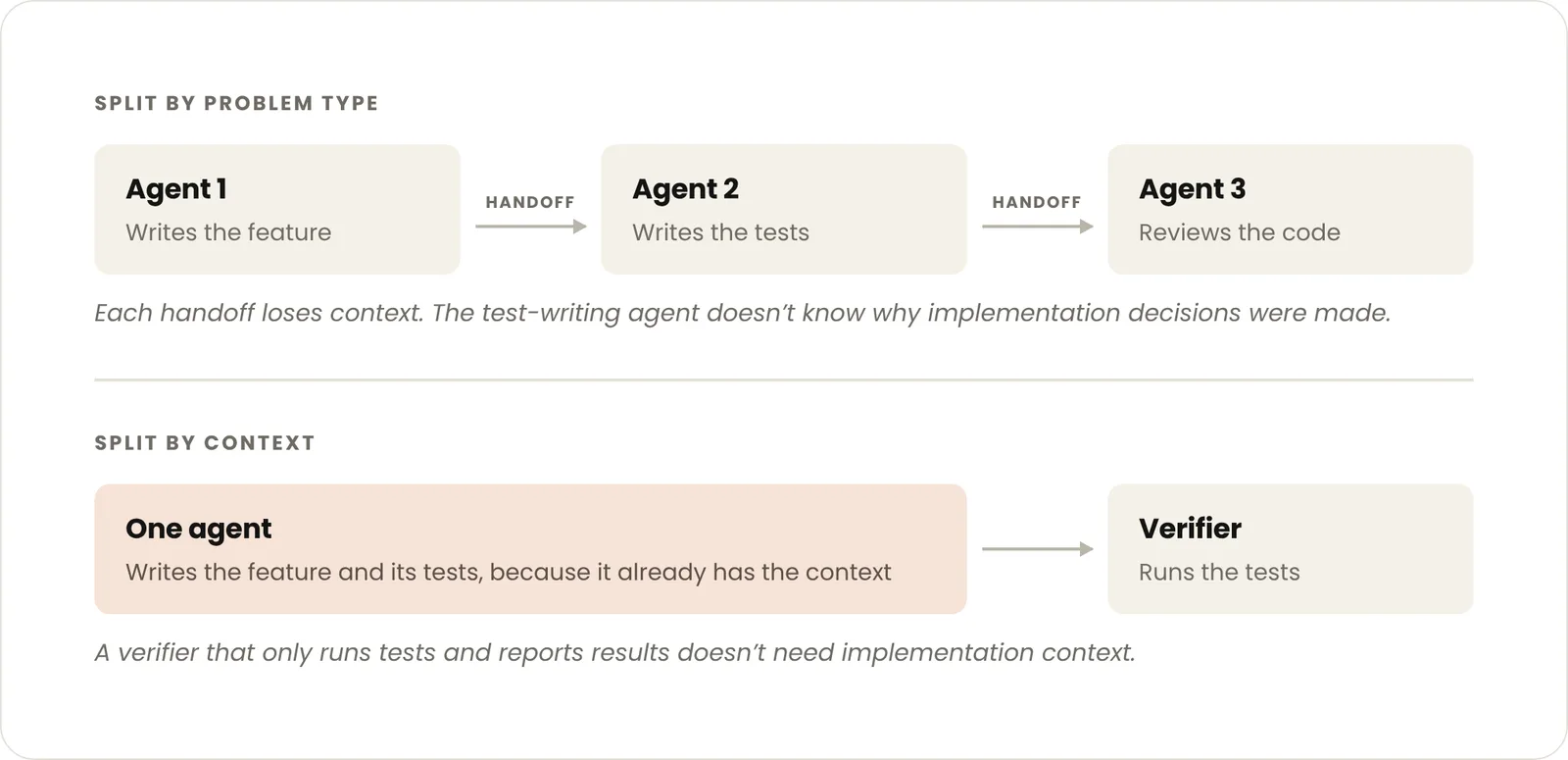
The handoff problem also appeared in engineering workflows. In Anthropic's illustration, when feature writing, test writing, and code review are split across agents, context can be lost at every transfer. In the single-agent example, one agent writes both the feature and the tests because it already holds the context. A separate verifier then only runs the tests and reports the results.
Development: Newer models moved orchestration into one loop
Anthropic describes a common design as a chain of intent detection, a fixed processing pipeline, user segmentation, separate recommendation branches, and an orchestrator on top. Much of that coordination can now be handled by the model itself for the relevant use case. Newer models starting with Opus 4.5, along with Opus 5.5 and Fable 5.1, can manage complex plans directly in a single loop, which can reduce costs and wait times. In one comparison, Anthropic says the single-agent architecture ran about twice as fast as the multi-agent setup.
Anthropic uses the phrase "Conway's Law" for agents to describe the org-chart version of this problem. The architecture becomes a copy of the organization, with each team shipping its own sub-agent until hundreds of overlapping agents pile up with no shared standards. That process creates what Anthropic labels a "Frankenprompt," where every team adds rules to the system prompt that end up contradicting each other. The company says a clean system prompt, four or five lean data tools, and fixed output guardrails cover much of the relevant use case.
Anthropic has already made that change in its own products. It cut the Claude Code system prompt for newer models by over 80 percent, partly because skills and tools now load only when needed. Newer models can also narrate their progress and verify their own output, which can make some extra control layers unnecessary.
Anthropic still sees three situations where sub-agents are useful: when a single agent's context window shows measurable performance degradation, when multiple tasks need to run in parallel with separate context windows, or when a single agent struggles with tool selection.
Latest: A migration kit and outside research point to consolidation
For teams ready to test the idea, Anthropic has published a migration kit on GitHub. The kit guides teams through spotting current patterns, comparing other options, and confirming the best approach. Anthropic also warns against merging blindly. In one support-agent test, collapsing a sub-agent into the main agent cut latency but damaged a process that had previously worked: the main agent began responding directly rather than asking the appropriate specialist.
Rather than letting each team create its own agent, Anthropic recommends packaging workflows into skills and loading tools on demand through a tool search. A small central team should own the system prompt and overall quality. Anthropic notes that the model's tool selection tends to degrade beyond 30 to 50 tool definitions, so designated owners on each team should maintain the skill libraries to keep them from ballooning.
For reference material like guidelines, product specs, or metric definitions, Anthropic recommends knowledge bases that the agent queries only when needed through a search tool. That kind of information can also be embedded as reference files inside a skill. It cautions against pulling context with code and inserting it straight into prompts.
These findings line up with recent research. Vals reported that agent teams may be faster than single agents without improving quality. Moving from ten agents to 30 or 100 agents did not raise quality and raised costs significantly. OpenAI developer Eric Provencher has also challenged the value of agent swarms, calling them "almost certainly" wasted money.
Anthropic is now at a transition stage: it is not declaring multi-agent systems dead, but it is pushing teams to test whether a single-agent architecture with on-demand context can do the job. The next signal to watch is how far the migration kit is used and whether teams can keep specialist behavior intact after folding sub-agents back into one loop.
Meta description:
Anthropic says single-agent AI with on-demand context can beat multi-agent fleets on quality, cost and latency, and offers a GitHub migration kit.
Tags: Anthropic, single-agent AI, multi-agent systems, AI agent migration, Claude Code
Featured image: Abstract technology style, glowing nodes connecting into one central loop, no real people, no company logos, no text.
Comments
No comments yet. Be the first to comment.