
Xiaomi's budget-friendly flagship AI tops open-source models, with Anthropic crediting Claude for its role in the achievement
Xiaomi launched the MiMo-V2.6 AI family, with flagship MiMo-V2.6-Pro becoming the strongest openly available model, scoring 46 on the Intelligence Index while costing just $0.13 per test task. The gains came from a scaled-up reinforcement learning phase completed in under six days. Xiaomi also released its RL toolkit and thousands of training tasks, though the launch follows Anthropic allegations that Xiaomi extracted over 400,000 exchanges from Claude to enrich its training data.
Xiaomi has launched its MiMo-V2.6 family of AI models, and the flagship variant now leads the pack among openly available models — while charging dramatically less per task than its competitors. The leap in performance comes from a greatly expanded reinforcement learning effort, though the release lands amid accusations that Xiaomi trained on data extracted from Anthropic's Claude.
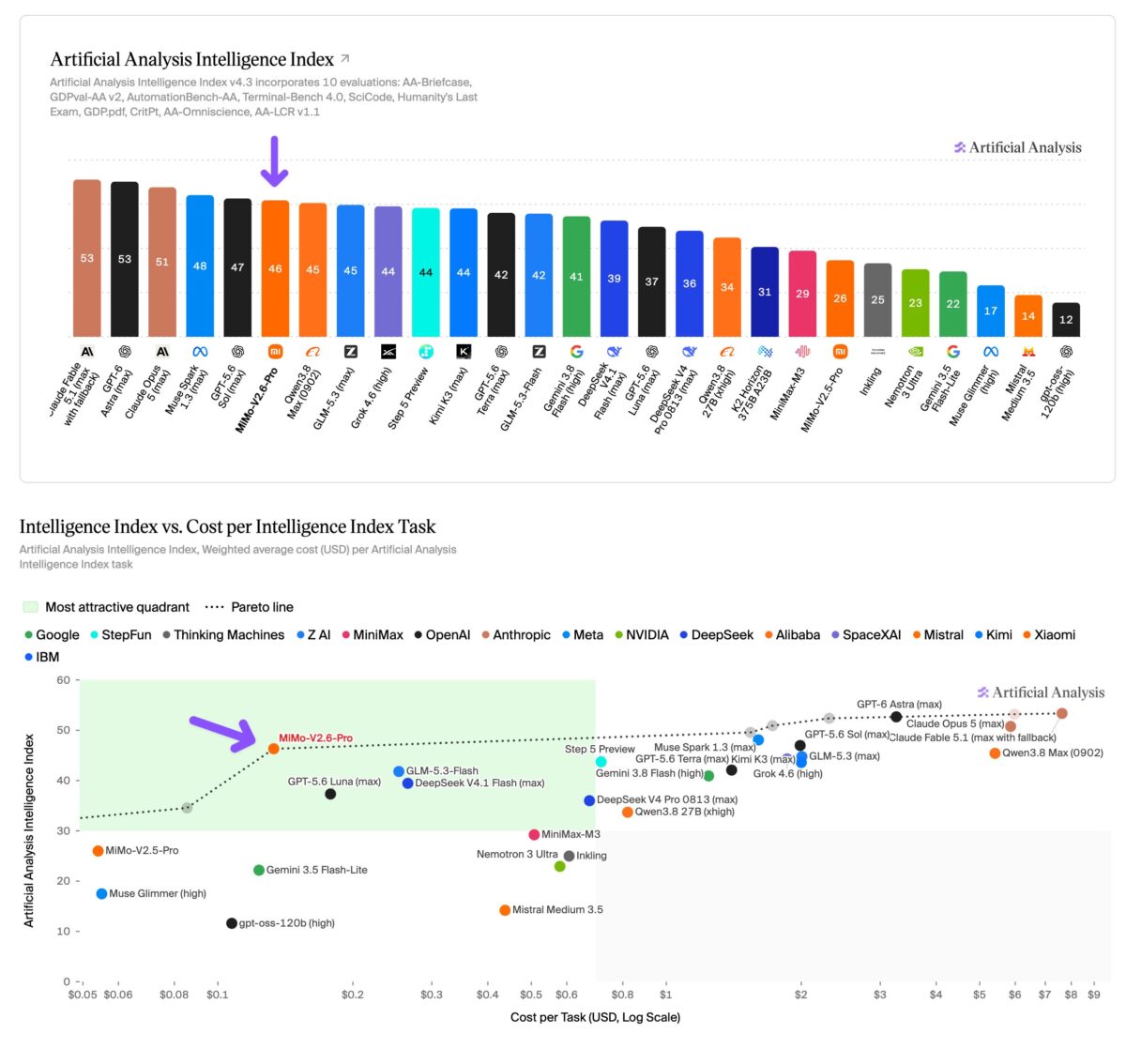
Frontier-level performance, budget pricing
According to Xiaomi, the larger of the two releases, MiMo-V2.6-Pro, scores 46 points on the Intelligence Index from analysis firm Artificial Analysis. That makes it the strongest openly available AI model at the moment, surpassing rivals such as Kimi K3 and Qwen. The pricing is equally notable: $0.435 per million input tokens and $0.87 per million output tokens.
Artificial Analysis calculates that a single test task costs roughly $0.13 — a small fraction of what comparably capable models charge, placing MiMo-V2.6-Pro on the Pareto frontier of intelligence versus cost.
Technically, Pro is a mixture-of-experts model with 1.02 trillion parameters, of which only 42 billion are active per request. It sits alongside the smaller, more efficient MiMo-V2.6-Flash.
Reinforcement learning drove the gains
Xiaomi attributes the performance jump to a substantially scaled-up reinforcement learning phase — training through trial, feedback, and reward. The company expanded this stage along three dimensions: more data per training step, a broader variety of task environments, and more compute dedicated to grading solutions.
The entire run took under six days, Xiaomi says, costing roughly $2.62 million for Pro and $0.85 million for Flash. On the DeepSWE coding benchmark, Pro improved from 58.4 to 72.6, while Flash climbed from 48.8 to 65.7. To keep training stable at scale, Xiaomi froze the model's internal distribution mechanism and added multiple safeguards against "reward hacking," where models game rewards without genuinely solving tasks.
An unusually open release
Xiaomi is also shipping a fast Pro-UltraSpeed variant with up to 20 times the output speed. More striking is the company's decision to open up its RL toolkit: the technical report, the complete training framework, a smaller model for further training, and roughly 7,000 ready-made training tasks with automatic graders covering software development, cybersecurity, office work, and web design, plus about 1,000 tasks for music composition.
The tasks draw on mixed sources. Some code originates from real GitHub pull requests by employees and from user queries, while other task descriptions were generated by a language model. The cybersecurity tasks build on OSS-Fuzz, a collection of tens of thousands of real software vulnerabilities, and the office environments were synthetically reconstructed.
Openness amid Anthropic's allegations
This display of transparency contrasts sharply with charges Anthropic raised just two weeks earlier. In its threat intelligence report covering discovered Claude abuse between December 2025 and August 2026, Anthropic named seven Chinese labs linked to campaigns against the model: Alibaba, Moonshot AI, DeepSeek, Zhipu, Xiaomi, MiniMax, and SenseTime.
Collectively, the labs are said to have generated around 190 million exchanges to extract Claude's capabilities for training their own systems — a practice Anthropic calls illegal distillation.
Xiaomi appears by name. In a case labeled GTG-16008, Anthropic tracked more than 400,000 exchanges over 20 days in March and April 2026, during which Xiaomi routed user conversations and coding sessions from its own MiMo models through OpenClaw and OpenCode to Claude, reportedly to enrich training data for future models. The report offers little documentation on where earlier training and teacher data for the internal distillation of teacher models originated.
In other words, the report alleges Xiaomi recorded user conversations with its MiMo models and then fed them into Claude to harvest training data — the same data now credited with pushing the company to the top of the open-model rankings.
Meta description: Xiaomi's MiMo-V2.6-Pro tops open AI model rankings with a 46 Intelligence Index score and $0.13 per-task costs, amid Anthropic distillation allegations.
Tags: Xiaomi, MiMo-V2.6, open-source AI, reinforcement learning, Anthropic
Featured image: Abstract technology style, no real people, no company logos, no text.
Comments
No comments yet. Be the first to comment.