
The alleged OpenAI spy used his wife's chatbot account to vibe-code a surveillance device.
Alfozan allegedly used his wife's chatbot prompts to build hidden recorder in OpenAI's executive room; agents arrested him; OpenAI says no data loss.
Key Takeaways
- OpenAI engineer Abdulrahman Alfozan was arrested on Oct. 9 for allegedly hiding a continuous audio recording device in an executive conference room.
- DOJ says he used a chatbot account linked to his wife to obtain prompts for building, connecting, improving, and encrypting the surveillance device.
- The case highlights physical surveillance risks around OpenAI’s confidential executive spaces amid the company’s expanding Gulf-state partnerships and counterintelligence concerns.
- OpenAI said there are no indications that Alfozan accessed or exfiltrated model weights, source code, or customer data; he has been fired, and if convicted he faces up to five years in prison and a $250,000 fine.
Meta description: U.S. Department of Justice says OpenAI engineer Abdulrahman Alfozan was arrested Oct. 9 for allegedly hiding an audio recorder in an executive conference room.
Tags: OpenAI, Abdulrahman Alfozan, U.S. Department of Justice, FBI, Stargate UAE

An OpenAI engineer named Abdulrahman Alfozan was arrested on October 9, according to a U.S. Department of Justice press release, on suspicion of hiding an audio recording device in a conference room used by company leadership. The case matters because it brings physical surveillance into view inside OpenAI while the company's relationship with Gulf states has grown over several years.
Background: OpenAI's Gulf Ties and Executive Room Security
The relationship between OpenAI and the Gulf states has grown over several years, driven by OpenAI's rising need for capital and infrastructure. The UAE and Saudi Arabia are the key players. MGX from the UAE has repeatedly shown up as a partner or financial backer, including in the Stargate project. In May 2025, OpenAI and G42 jointly announced "Stargate UAE," a project that would make ChatGPT free across the UAE. A deal with the Trump administration made it possible by allowing delivery of up to 500,000 high-performance AI chips per year, a sharp turn from the export restrictions Biden had put in place.
Against that backdrop, the alleged incident touched a sensitive setting: a room used for confidential discussions about research, product plans, and business strategy. The U.S. Department of Justice said Alfozan, 35, was a Saudi national working as an engineer at OpenAI since July 2025. He did not have access to the room.
Development Process: Chatbot Prompts and a Hidden Recorder
According to the indictment, Alfozan allegedly built the surveillance device with help from "a chatbot." It is not specified whether the chatbot was ChatGPT. A chatbot account linked to his wife was used between September 24 and 30 to enter prompts. Those prompts covered how to build a "continuous audio recorder," how to adjust Wi-Fi connectivity, how to improve "audio and live listening," and how to encrypt the SD card, among other things.
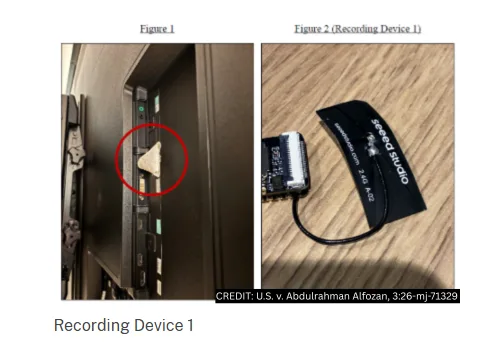
The account shared several matching identifiers with Alfozan's own chatbot account. Prompts that directly referenced the recovered recording device, including its MAC address, were also entered through it. A government image caption describes the device as wrapped in toilet paper and plugged into a USB port on the back of a TV in OpenAI's executive conference room, shown at left; it says the recovered device is shown at right, and credits U.S. v. Abdulrahman Alfozan, 3:26-mj-7132 9. A second recording device was found in his bag.
Latest Progress: Charges, Company Response, and Penalty Exposure
OpenAI said there are "no indications of this individual inappropriately accessing or exfiltrating model weights, source code, or customer data." The employee has been fired. FBI Director Kash Patel called protecting American "super intelligence innovations" "one of our highest counterintelligence priorities." If convicted, Alfozan faces up to five years in prison and a $250,000 fine.
Current Stage: A Physical Surveillance Case Without Confirmed Data Loss
The case is currently framed around alleged physical concealment inside an executive space rather than confirmed digital exfiltration. OpenAI's statement separates the arrest from evidence of access to model weights, source code, or customer data. The penalty range, the fired employment status, and the chatbot-linked prompts mark the current stage: a federal case connected to counterintelligence priorities and focused on how a hidden recorder was assembled and placed, while OpenAI says no data loss has been indicated.
Comments
No comments yet. Be the first to comment.