
Google’s AI worlds are now able to respond.
Genie 4 makes AI worlds speak and respond; Anthropic aids drug discovery; Axiom verifies a huge math proof.
Key Takeaways
- Google DeepMind’s Genie 4 is a next-generation world model that creates real-time, photorealistic scenes from text prompts, now adding native audio, lifelike conversational characters, and persistent scene edits.
- Genie 4 moves beyond simple exploration toward practical tools for gaming, creative direction, and robot training, with the Apollo humanoid checkers demo showing its potential as simulated training infrastructure.
- Anthropic is expanding from AI models into drug discovery, acquiring Mithril Medicine and sharing results showing Claude can accelerate regulatory drafting, lab coordination, and antibody design, though its own drug bets may not generate revenue.
- AI math startup Axiom used a swarm of agents to complete a machine-checked version of the “Classification of Finite Simple Groups,” demonstrating how AI can verify enormous mathematical proofs that no single human could fully check.
Google DeepMind unveiled Genie 4, its next-generation world model that turns text prompts into explorable, photorealistic scenes in real time. The update adds natively generated audio—background noise and music—and lifelike characters that users can hold live conversations with. It is the first Genie model to produce its own sound. Users navigate with keyboard controls and can issue text prompts to change a scene mid-exploration while it stays coherent between inputs. In one demo, a simulated Apptronik Apollo humanoid played checkers, with Gemini 4 Argon planning each move—a signal of where Genie is headed as a robot-training tool.

From Silent Worlds to Director’s Tool
Genie 3, released last year, let users wander an AI-generated world for a few minutes. Genie 4 extends that run into something closer to a production tool: built-in sound, characters you can talk to, and prompt-driven edits that persist. The gaming applications are obvious, but the combination of audio, conversational agents, and scene stability positions Genie as much as a director’s instrument as a world simulator. The Apptronik Apollo checkers demo points to a second use case—simulated environments where robots can be trained and tested before physical deployment.

Anthropic Moves From Models to Medicine
Anthropic shared early results with its drug-development partners and disclosed that it is now running its own drug discovery programs, including the acquisition of Mithril Medicine, a solo-founder biotech. Mithril’s Claude-assisted muscular dystrophy candidate could reach human trials as early as late 2028. The candidate showed promise in mice within 18 months, with Claude helping founder Cody Tranbarger coordinate contracts and tests across 11 outside labs. Tranbarger, who ran the pseudonymous biotech account “Professor Oak” on X for six years, calls the arrangement a “Pipeline-in-a-Person.”
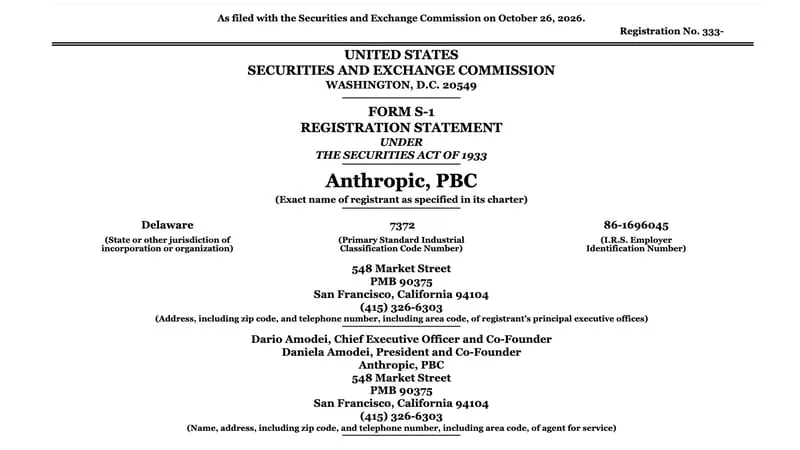
Partner results sketch out the pattern. At Enveda, Claude wrote a first draft of a key regulatory filing in 4 hours versus roughly 3 months by hand, and flagged seven batch-record issues humans missed. For Divergence Labs, three of roughly 35,000 antibodies Claude designed appeared to beat today’s main drug at unhooking allergy triggers from cells. Anthropic’s IPO filing this week pitched a global pharma market expected to top $2T this year, while warning that its own drug bets “may never generate revenue.”
CEO Dario Amodei said in August to expect “early glimmers” from Anthropic’s biology push in the coming months. With Anthropic running its own wet lab and its IPO filing noting that Claude can operate equipment such as microscopes, the components for hands-on AI science are assembling quickly.

Axiom’s Agent Swarm Checks Math’s Longest Proof
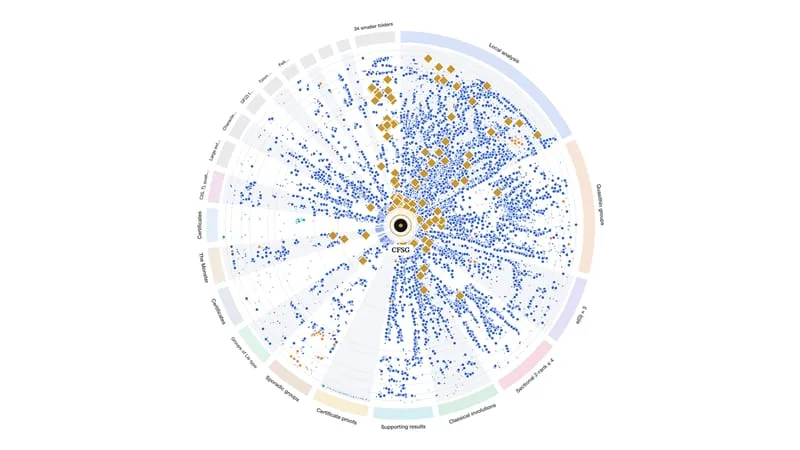
AI math startup Axiom completed a fully machine-checked version of the “Classification of Finite Simple Groups,” math’s longest proof, using a swarm of AI agents steered by its team to rebuild the decades-long effort in 24 days. The theorem catalogs what Axiom calls the “periodic table of symmetry”—the complete list of basic pieces every symmetry pattern in mathematics breaks down into. More than 100 mathematicians spread the original across roughly 15,000 pages and 500-plus papers, and Axiom says no single expert has read it cover to cover.
Axiom split the work into 108 milestones, and dozens of agents produced about 43 million lines of Lean, the coding language that lets a computer verify each logical step. The theorem stands, but the AI caught a false claim in one key step and patched it with a new proof based on 1976 work by mathematician Ronald Solomon. The result follows OpenAI’s use of agents on the Navier–Stokes Millennium Prize Problem in September—another case of machines being pointed at verification work no individual mathematician could complete alone.
Quick Hits
- Anthropic paper: Anthropic published a paper saying an internal Claude model also disproved the Exponential Time Hypothesis, on the same day as OpenAI’s own result.
- Trump on “AI”: U.S. President Donald Trump posted that he will be “BANNING the term, ‘AI/Artificial Intelligence,’ in all relevant documents” in another push toward Super Intelligence.
- Physics proofs: AI-for-physics lab Physical Superintelligence released five new papers, each paired with a computer-checked proof, claiming progress on long-unsolved quantum physics problems with help from its in-house AI.
- Meta’s chip-backed raise: Meta lined up $4B toward its $95B AI fundraise from chip suppliers Nvidia ($3B) and AMD ($1B), with both companies expanding the hardware they run in Meta’s data centers.
- Google and Oracle: Google signed a deal to put its TPU chips inside Oracle’s cloud from 2027—the first time a rival cloud giant will offer the in-house Nvidia alternative to customers.
- Tool watch: Liquid AI released LFM3, a family of small on-device multimodal models; Microsoft launched MAI-Image-2.7 for editing first; Parallel shipped a Decisions API that classifies with live web data; and OpenAI’s GPT-6.1 Terra is positioned as a cheaper, faster model for everyday computer work.
What to Watch
Genie 4’s audio and conversational characters will be judged on how well scenes hold together under sustained interaction, and the Apollo demo will be watched as an early test of world models as robot-training infrastructure. Anthropic’s Mithril candidate faces a late-2028 window for human trials, with its own filing cautioning that revenue may never materialize. Axiom’s 24-day formalization gives mathematicians a machine-checked reference for a proof that previously had none—and a template for attacking other results too large for any one person to verify.

Comments
No comments yet. Be the first to comment.