
Trump Debuts “Super Intelligence Force” That Has Nothing to Do With Real Superintelligence
Trump's SIF uses an ASI-style name to coordinate AI outreach after voluntary audit pledges, raising questions about policy influence.
Key Takeaways
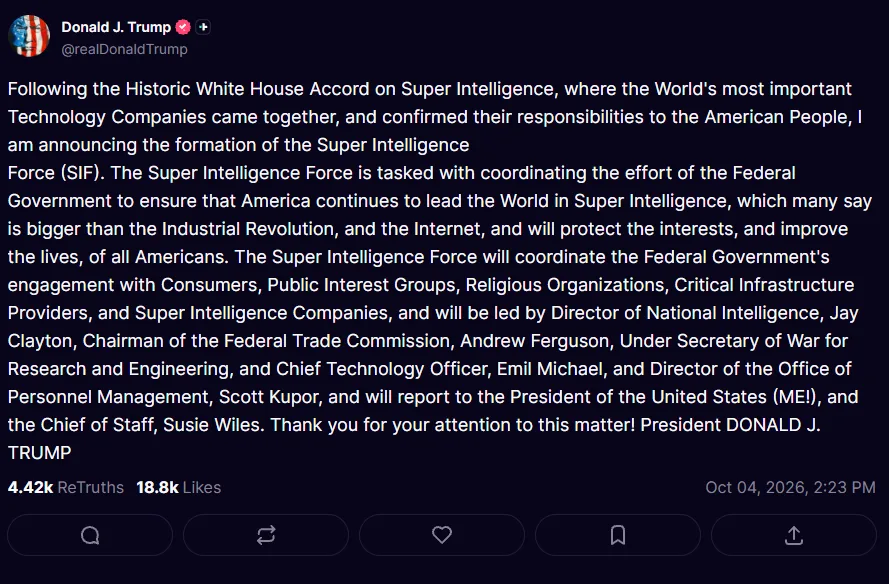
- Trump has created a “Super Intelligence Force” to coordinate U.S. government messaging and outreach on AI, with a direct reporting line to the president and chief of staff.
- The name borrows the long-standing AI research term “superintelligence,” but the unit’s stated role is immediate coordination and communication, not a response to present-day superintelligent systems.
- The force’s audience includes consumers, interest groups, religious organizations, critical infrastructure operators, and AI companies, making it a named federal channel for AI stakeholder engagement.
- The launch follows a White House meeting where tech CEOs signed a voluntary, “morally binding” pledge for third-party audits of whether AI models are “operating as intended.”
- The article’s key open question is whether the SIF becomes a real policy mechanism tied to verification, procurement, and infrastructure coordination, or remains mainly a communications and stakeholder body.
Meta description: President Donald Trump announced a Super Intelligence Force to coordinate AI outreach across consumers, infrastructure and companies, reporting to him.
Tags: Super Intelligence Force, Donald Trump, AI policy, Truth Social, White House

President Donald Trump has announced a new unit called the Super Intelligence Force (SIF), using the name to coordinate federal outreach around artificial intelligence. The move matters because it turns a general policy discussion into a named government structure with officials, a direct reporting line, and an audience that includes AI companies and critical infrastructure operators.
Background: A New Label for an Old Idea
Trump's announcement uses "Superintelligence" as his label for artificial intelligence. Within AI research, the phrase superintelligence—or Artificial Superintelligence (ASI)—has existed for decades. It describes systems that could improve themselves and vastly surpass human intelligence. That is not the AI available today, so the name points to a long-running capability debate rather than a present-day model, product, or benchmark.
The choice of label also changes the tone of the policy story. Instead of framing the unit around a current technology problem, it borrows a future-oriented term. That may matter to readers because AI companies, infrastructure operators, and regulators often respond to different definitions of risk. A name tied to superintelligence invites attention to long-term capability, while the stated task—outreach—is immediate and organizational.
Development: From White House Meeting to SIF Mandate
The SIF launch comes after a recent tech CEO gathering at the White House. At that meeting, executives signed a "morally binding" contract under which independent third-party auditors would check whether AI models are "operating as intended." That voluntary pledge gives the new unit context: it appears after an attempt to create an external verification norm, not before it.
The SIF's stated audience includes five groups: consumers, interest groups, religious organizations, critical infrastructure operators, and AI companies. The announced leadership list includes Intelligence director Jay Clayton, FTC chair Andrew Ferguson, undersecretary for research Emil Michael, CTO Scott Kupor, and other government officials. Its reporting line points straight to the president and chief of staff Susie Wiles. The creation was announced through Truth Social.
That structure places the unit close to the top of the administration's decision chain. For readers, the practical effect is a named channel for AI messaging. The announcement does not say whether SIF will issue rules, fund programs, or coordinate audits, so the immediate meaning is coordination and access rather than confirmed enforcement.
Latest Progress: What Readers Can Track Next
The next detail to watch is how SIF connects the voluntary auditor contract to any formal federal process. If the unit turns outreach into verification, procurement guidance, or infrastructure coordination, the phrase "operating as intended" could become a reference point for public trust. If it remains a communications and stakeholder body, its influence will be measured by who participates and what sectors respond.
The timeline currently has three clear points: a White House meeting where tech CEOs accepted a "morally binding" audit pledge, a Truth Social announcement creating SIF, and a leadership list that reports directly to the president and chief of staff Susie Wiles. The open question is whether those pieces become a single policy mechanism.
Comments
No comments yet. Be the first to comment.