
MOPD-Router: Revisiting Teacher Routing for Multi-Teacher On-Policy Distillation
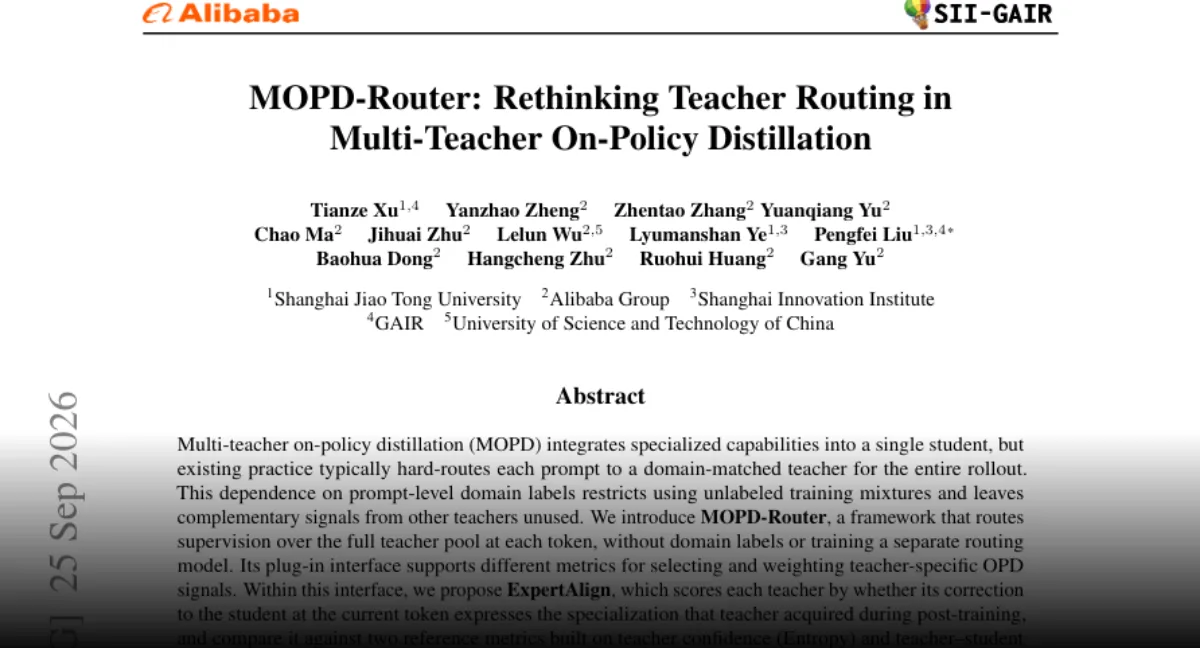
MOPD-Router replaces prompt-level hard routing with token-level routing, improving multi-teacher on-policy distillation via finer teacher signals.
Key Takeaways
- MOPD-Router is a label-free framework for multi-teacher on-policy distillation that routes teacher signals at the token level instead of the prompt level.
- Prompt-level hard routing assigns one teacher to an entire prompt, which can discard useful teacher signals from different parts of a response.
- Token-level routing enables finer control by selecting the most relevant teacher guidance for each token or training decision point.
- Using ExpertAlign as the evaluation metric, MOPD-Router consistently outperforms prompt-level hard routing across two data regimes and student scales.
- The contribution is method-level rather than universal: it shifts the control unit in on-policy distillation from the prompt to the token.
Meta description: MOPD-Router routes multi-teacher on-policy distillation signals at token level and uses ExpertAlign to beat prompt-level hard routing across two data regimes.
Tags: MOPD-Router, On-Policy Distillation, ExpertAlign, Token Routing, Multi-Teacher Models
Featured image: Abstract technology style with routing paths between multiple teacher nodes and a student model, no real people, no company logos, no text.
Background: The Limits Of Prompt-Level Routing
MOPD-Router is a label-free framework that routes multi-teacher on-policy distillation signals at the token level. The work compares that design with prompt-level hard routing, and with the ExpertAlign metric it reports consistent gains across two data regimes and student scales. The change is small in wording but large in practice: the routing decision moves from the whole prompt to the individual token.
In multi-teacher on-policy distillation, a student model is trained from the responses it generates, while more than one teacher model provides guidance. Prompt-level hard routing assigns one teacher to each prompt. That is easy to implement, but it treats the entire answer as a single unit of judgment. If teachers are useful for different parts of a response, one full-prompt choice may discard part of the available signal. The source work frames the problem as a routing problem rather than a model-training problem.
Development: A Label-Free Router For Multi-Teacher Signals
The introduced framework, MOPD-Router, is described as label-free. In the source description, the routing mechanism is not presented as depending on an external label set for each decision. Its core operation is to route multi-teacher on-policy distillation signals at the token level. For each token produced or considered during on-policy training, the framework can direct the student toward the teacher signal that is most relevant at that point.
Token-level routing creates a different engineering shape than prompt-level routing. A prompt-level router selects a teacher once, then all tokens follow that choice. A token-level router evaluates guidance more frequently, so the control point is finer. The source work does not describe MOPD-Router as a new student architecture or a new teacher training recipe. It describes it as a routing layer for distillation signals, with the token as the unit of control.
Latest Progress: ExpertAlign Across Two Data Regimes
The reported comparison uses ExpertAlign as the metric. Against prompt-level hard routing, MOPD-Router consistently outperforms the alternative across two data regimes and student scales. The claim is comparative: it says the token-level router performs better than the prompt-level hard router in the settings covered by the work. The provided description does not give exact benchmark scores, named datasets, model parameter counts, or release dates, so the result should be read as a method-level evaluation rather than a public leaderboard entry.
The phrase "two data regimes" is important because it sets the scope. The work does not claim a universal improvement over every prompt-level routing system. It places the gain inside the tested regimes and student scales, using ExpertAlign as the evaluation metric. This makes the contribution narrower but clearer: token-level routing is evaluated against a specific hard-routing alternative, not against every possible distillation method.
Current Stage: A Finer Decision Unit For On-Policy Distillation
The current stage of this work is the introduction of a label-free routing framework and the reporting of consistent token-level gains over prompt-level hard routing on two data regimes and student scales. The next step for readers is to look for the technical details that define the scope: how ExpertAlign is calculated, what the two data regimes contain, and which student scales were tested. Those details will determine whether token-level routing is stable across model sizes, teacher diversity, and task families.
For now, MOPD-Router signals a shift in where control happens during on-policy distillation. The useful unit is no longer only the prompt. It is the token.
Comments
No comments yet. Be the first to comment.