
Skill2Env: Synthesizing Capability-Centric Environments from Skills for General Agents
Skill2Env turns skills into capability-centric executable environments, difficulty patterns, and 1.5K trajectories for agent post-training.
Key Takeaways
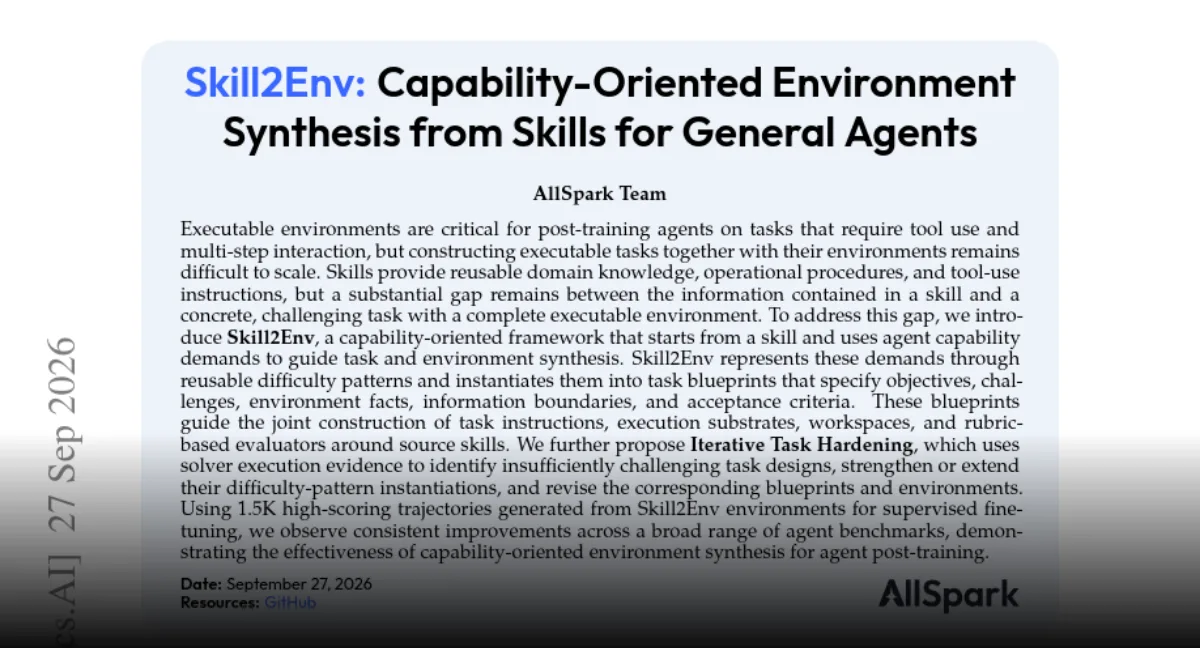
- Skill2Env converts reusable skills into executable task-environment pairs for agent post-training, aligning tasks with the capabilities agents need to develop.
- It builds task blueprints that define objectives, challenges, environment facts, information boundaries, and acceptance criteria, then generates prompts, execution substrates, workspaces, and rubric-based evaluators.
- Iterative Task Hardening uses solver execution evidence to revise weak tasks, increasing difficulty and ensuring agents must actively use skills and environments.
- Supervised fine-tuning on 1.5K high-scoring trajectories from Skill2Env environments produced consistent improvements across a broad range of agent benchmarks.
- The key remaining question is whether these synthesized environments can scale to more complex tools, longer task horizons, and cross-domain skills without hand-written construction.
Meta description: Skill2Env converts skills into executable agent environments with difficulty patterns and 1.5K trajectories, improving post-training for tool-using agents.
Tags: Skill2Env, agent post-training, executable environments, supervised fine-tuning
Featured image: abstract technology illustration of layered task blueprints, tool interfaces, and trajectory graphs; no people, logos, or text.
Executable environments for agents are the testbeds where models can plan, call tools, read outputs, and revise actions over several steps. Without them, agent training often stays close to text-only imitation, which does not teach a model how to manage files, interact with systems, or recover from partial information. The Skill2Env framework addresses that gap by starting from reusable skills and building task-environment pairs around capability demands. It then uses 1.5K high-scoring trajectories from those environments for supervised fine-tuning, a method that trains a model on high-quality examples, with consistent improvements across a broad range of agent benchmarks.
Background: The Bottleneck Behind Agent Training
Agent post-training depends on examples that resemble real work. A useful example is not only a prompt and a final answer; it needs a setting where the agent can act, observe, and be judged. The reported problem is a scaling difficulty: making executable tasks together with their environments is hard to build by hand. Skills help because they contain reusable domain knowledge, operational procedures, and instructions for using tools. Yet the gap remains between a skill as a description and a concrete challenge that has a runnable environment, clear acceptance criteria, and enough difficulty to teach something.
This is why the framework is described as capability-oriented. Instead of asking first for a generic task and then trying to fit a skill into it, Skill2Env begins with the skill and asks what agent capabilities that skill should exercise. The training value comes from aligning task design with the abilities an agent needs to improve, not simply increasing the number of prompts.
Development: Turning Skills Into Task Blueprints
The reported method converts capability demands into reusable difficulty patterns. Those patterns become task blueprints. A blueprint is not a final task; it is a specification that shapes the work. According to the framework, each blueprint covers objectives, challenges, environment facts, information boundaries, and acceptance criteria.
That structure matters for readers tracking agent data quality. Objectives define what success means. Challenges decide the cognitive and operational load. Environment facts make the setting concrete enough to run. Information boundaries prevent the task from leaking all needed answers. Acceptance criteria give evaluators a basis for judging whether the agent completed the work.
From these blueprints, Skill2Env guides joint construction of several pieces around the source skill: task instructions, execution substrates, workspaces, and rubric-based evaluators. In plain terms, the system builds the prompt, the runtime or interface where actions happen, the files or state the agent can manipulate, and the scoring rules that check the result.
Latest Progress: Iterative Task Hardening and 1.5K Trajectories
The second key part of the reported workflow is Iterative Task Hardening. The idea is to use evidence from solver execution rather than relying only on the initial design. If a generated task is not hard enough, the system can identify that weakness, strengthen or extend the difficulty-pattern instantiation, and revise the blueprint and environment.
This creates a feedback loop. The first version of a task may show that a model solves it too easily, leaves no useful failure signal, or depends on missing environment detail. The hardening step responds by adjusting the task so the agent must use more of the skill and more of the environment.
For the reported training experiment, 1.5K high-scoring trajectories were generated from Skill2Env environments and used for supervised fine-tuning. The framework says these trajectories produced consistent improvements across a broad range of agent benchmarks. It does not provide named benchmarks or exact scores, so the main factual takeaway is the scale of the trajectory set and the reported direction of the result.
Current Stage: What Readers Should Track Next
Skill2Env sits at a practical point in the agent data pipeline: between static skill documentation and executable, measurable training environments. The reported approach suggests that task synthesis can be guided by capability patterns and then improved through execution evidence. The number 1.5K is small compared with some general pretraining corpora, but it is meaningful for agent work because each trajectory may involve multiple tool calls, state changes, and evaluation steps.
The next question is how well these environments transfer beyond the skills and benchmarks used in the reported experiment. Readers should watch whether similar blueprints can support more complex tools, longer horizons, and cross-domain skills without hand-written environment construction. At this stage, the contribution is a method for generating harder, judgeable tasks from skills, plus evidence that supervised fine-tuning on 1.5K trajectories from those tasks can improve agent benchmark performance.
Comments
No comments yet. Be the first to comment.