
CompoWorld: Scaling Compositional Environments for General-Purpose Agents
CompoWorld creates cross-service agent tasks from 448 services and 10,130 tools, lifting Qwen3.6-35B-A3B by 9.17 points on eight benchmarks.
Key Takeaways
- CompoWorld is a training-data method that scales general AI agents by combining a bounded library of reusable services into cross-service tasks.
- The pipeline converts tool descriptions into verified services with typed states and shared interfaces, then uses dependency graphs to generate tasks requiring information flow across multiple services.
- Qwen3.6-35B-A3B was trained with 3K supervised fine-tuning trajectories and 1K reinforcement-learning tasks, using a Completion-Focused Rubric Reward to encourage full task completion.
- The method builds 448 services exposing 10,130 tools, producing an average gain of 9.17 points across eight benchmarks compared with the backbone model.
- On AutomationBench, the trained model surpasses frontier systems such as Claude Opus 4.6 and leads compared agent-specialized 35B-A3B models, suggesting strong results in automation-oriented multi-service settings.
Meta description: CompoWorld scales AI agent training with 448 services and 10,130 tools, lifting Qwen3.6-35B-A3B by 9.17 points across eight benchmarks in multi-service tasks.
Tags: CompoWorld, AI agents, Qwen3.6-35B-A3B, AutomationBench, reinforcement learning
Featured image: 
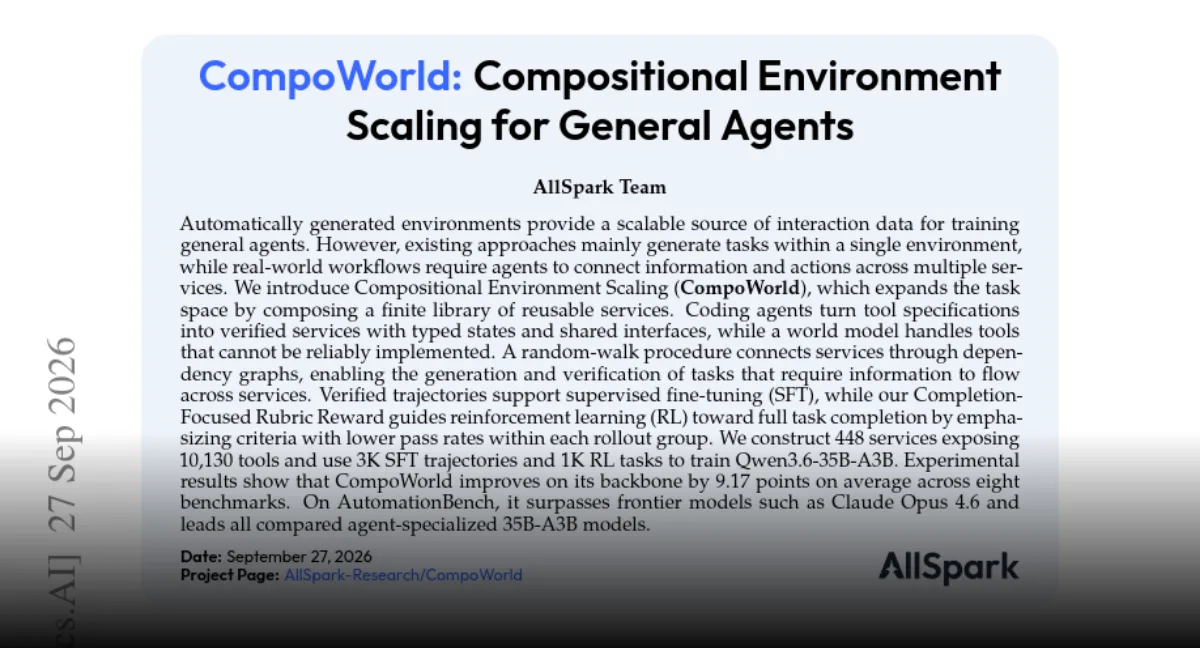
CompoWorld, short for Compositional Environment Scaling, is a training-data method for general agents that expands task generation by combining a bounded library of reusable services. The pipeline produces 448 services with 10,130 tools available behind them, creates cross-service tasks, and trains Qwen3.6-35B-A3B using 3K supervised fine-tuning trajectories and 1K reinforcement-learning tasks. The measured gain is 9.17 points on average over the backbone across eight benchmarks, a result that matters because agents increasingly need to connect information and actions across multiple services rather than operate inside one isolated environment.
Background: Single-Environment Tasks Do Not Match Real Workflows
Generated environments are often used to produce large amounts of interaction data for general agents. The weakness is that most pipelines keep task generation inside one environment. Real workflows are different: a task may require an agent to read one system, transform the result, update another system, and verify that the final state is complete. In those cases, the hard part is cross-service information flow, not merely calling one tool correctly.
CompoWorld targets that gap by treating service composition as the unit of scaling. A bounded library of reusable services becomes the base for task generation. When services are linked, the resulting problems can require data to move from one tool to another.
Development: Tool Specifications Become Verified Services and Cross-Service Tasks
The pipeline starts with coding agents. They convert tool descriptions into checked services that have typed states and shared interfaces. Typed states define the data each service expects or returns, while shared interfaces give the composition layer a predictable way to connect services. If a tool cannot be reliably implemented, a world model handles it, so the workflow can still be represented without brittle tool code.
Once services are available, a random-walk step links them in dependency graphs. These graphs encode which service output is needed as another service input. The result is not a random list of calls, but a generated task that requires information to flow across services and can be verified against that flow.
Validated trajectories feed supervised fine-tuning, or SFT. In reinforcement learning, or RL, CompoWorld uses a Completion-Focused Rubric Reward. The rubric divides task success into criteria and emphasizes criteria with lower pass rates within each rollout group. That pushes the agent toward full task completion instead of rewarding partial progress through the easy early steps of a multi-service workflow.
Latest Progress: 448 Services, 10,130 Tools, and a 9.17-Point Gain
The constructed environment library contains 448 services exposing 10,130 tools. Training uses 3K SFT trajectories and 1K RL tasks to tune Qwen3.6-35B-A3B. Measured against eight benchmarks, the method adds 9.17 points on average over the backbone. On AutomationBench, the trained model surpasses frontier systems such as Claude Opus 4.6 and tops all compared agent-specialized 35B-A3B models.
The AutomationBench result is notable because the reported comparison places Qwen3.6-35B-A3B above Claude Opus 4.6 and above other agent-specialized 35B-A3B models. The 9.17-point average across eight benchmarks also suggests the benefit is not limited to a single task format, while the model is tested in an automation-oriented evaluation setting.
Current Stage: A Service-Composition Pipeline for Agent Training
CompoWorld is at the stage of showing a complete data-generation-to-training loop: tool specifications become services, services become dependency graphs, graph-connected tasks become verified trajectories, and rubric-guided reinforcement learning uses those trajectories to update Qwen3.6-35B-A3B. The key numbers are 448 services, 10,130 tools, 3K SFT trajectories, 1K RL tasks, and the 9.17-point average gain across eight benchmarks.
What to watch next is whether this bounded service library continues to produce verified cross-service tasks at larger scale, and whether the AutomationBench lead over Claude Opus 4.6 and other agent-specialized 35B-A3B models holds as evaluation settings and service compositions become more complex.
Comments
No comments yet. Be the first to comment.