
RenderRank: Learning Text Reranking from Compressed Visual Tokens
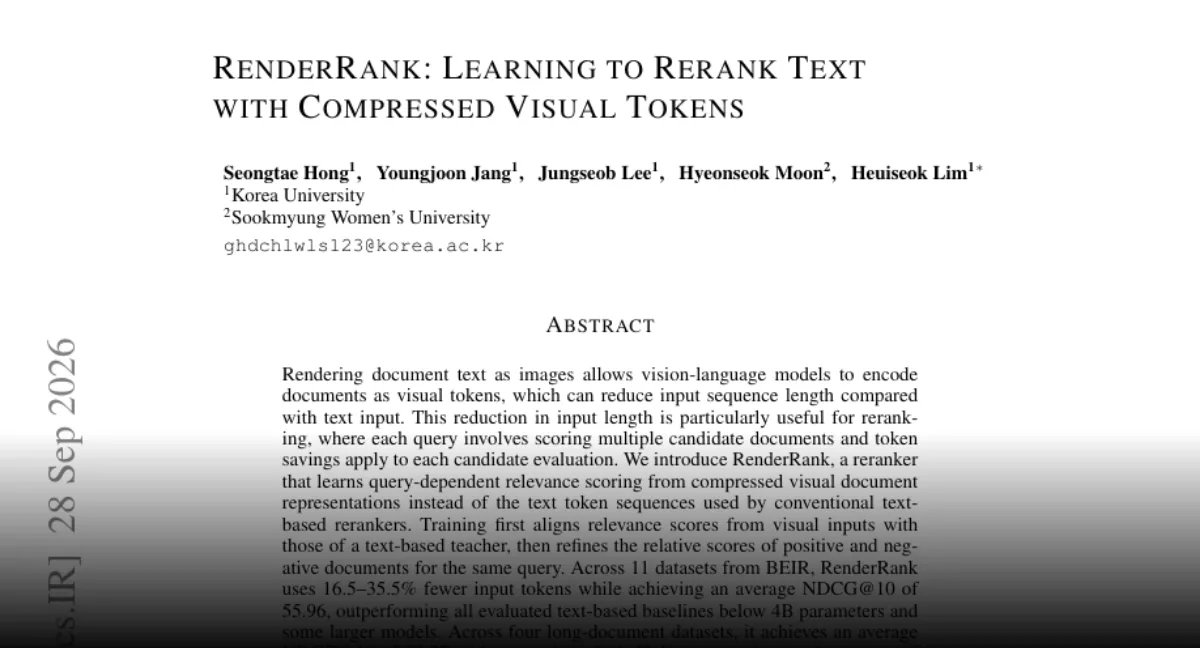
RenderRank reranks documents using compressed visual tokens, reducing input length 16.5-35.5% while achieving NDCG@10 55.96 across 11 BEIR datasets.
Key Takeaways
- RenderRank reranks documents by converting them into compressed visual tokens instead of feeding long text token sequences to the model.
- It reduces input tokens by 16.5–35.5% while achieving an average NDCG@10 of 55.96 across 11 BEIR datasets, outperforming smaller text-based rerankers and some larger models.
- Its two-stage training aligns visual relevance scores with a text-based teacher model and refines ranking signals, helping visual inputs behave reliably rather than as lossy substitutes.
- On long-document tasks, RenderRank reaches an average NDCG@10 of 88.27, uses about half the input tokens, and delivers 1.70x higher throughput than evaluated baselines.
- The method is currently demonstrated as an alternative representation for reranking, with future questions remaining about its robustness across varied layouts, resolutions, and query styles.
Meta description: RenderRank reranks documents using visual tokens, cutting input tokens by 16.5-35.5 percent while reaching NDCG@10 of 55.96 across 11 BEIR datasets.
Tags: document reranking, vision-language models, BEIR, NDCG@10, visual tokens
Featured image: Abstract technology style, showing compressed visual document pages turning into token-like colored tiles that flow into a ranking grid, no real people, no company logos, no text.
RenderRank is a reranking method that replaces the usual text token sequence with compressed visual representations of documents. Instead of feeding each candidate document to a model as a long string of text tokens, it renders the document as an image and lets a vision-language model process it as visual tokens. The reported result matters because reranking evaluates many candidate documents for every query, so token savings multiply across the whole ranking process.
Background: Reranking Turns Queries into Expensive Scoring Work
In retrieval systems, reranking sits after an initial search step. The system first collects candidate documents, then scores each candidate against the query to decide the final order. This means one query is not just one model call. It is a series of evaluations, each requiring the model to read the query and a candidate document.
Conventional text-based rerankers represent documents as text token sequences. When a document is long, the sequence becomes expensive to process. The cost is not only the single scoring call. It repeats across many candidate documents. This makes input length a central concern in reranking, especially in systems that must score many documents quickly.
Development: From Rendered Pages to Compressed Visual Tokens
The core idea behind RenderRank is to change the input representation. When document text is rendered as an image, a vision-language model can encode the page as visual tokens. This can reduce input sequence length compared with text input.
RenderRank uses that compressed visual document representation to learn query-dependent relevance scoring. Instead of relying on the text token sequence used by conventional text-based rerankers, it scores documents from their visual inputs while still adapting the score to the specific query.
The training process follows a clear sequence. First, relevance scores produced from visual inputs are aligned with the scores of a text-based teacher model. Then, the method refines the relative scores of positive and negative documents for the same query. This two-stage training aims to make visual inputs behave more like a reliable ranking signal rather than a lossy substitute for text.
Latest Results: Token Reduction and Ranking Scores
The reported evaluation covers 11 datasets from BEIR, a benchmark suite used to test information retrieval systems. Across these datasets, RenderRank uses 16.5-35.5% fewer input tokens while achieving an average NDCG@10 of 55.96. NDCG@10 measures ranking quality by checking how relevant documents are placed near the top of a result list, with a focus on the first ten positions. Higher scores indicate better ranking accuracy.
In that setting, RenderRank outperforms all evaluated text-based baselines below 4B parameters and some larger models. The result is notable because it links token efficiency with competitive ranking accuracy, rather than presenting speed alone as the benefit.
The long-document results are sharper. Across four long-document datasets, RenderRank achieves an average NDCG@10 of 88.27 while using approximately half the average input token count of the evaluated text-based rerankers. In this setting, RenderRank delivers 1.70x the highest average throughput of the evaluated baselines.
Current Stage: An Alternative Representation, Not a Universal Replacement
The findings show that compressed visual representations can support accurate document relevance scoring. They provide an alternative to text token representations for reranking. This is significant because reranking has long depended on text sequences, and any method that reduces token count without sacrificing ranking quality can affect latency, cost, and scalability in search pipelines.
The current stage is a benchmark demonstration. The evidence comes from specific evaluation settings: 11 datasets from BEIR, four long-document datasets, and comparisons against evaluated text-based baselines. The next question is how the method behaves outside those measured conditions, especially when document layouts, image resolution, or query styles vary beyond the datasets already tested.
Comments
No comments yet. Be the first to comment.