
From Traces to Agentive Worlds: Language-Driven Agent World Models for Interactive Environment Simulation
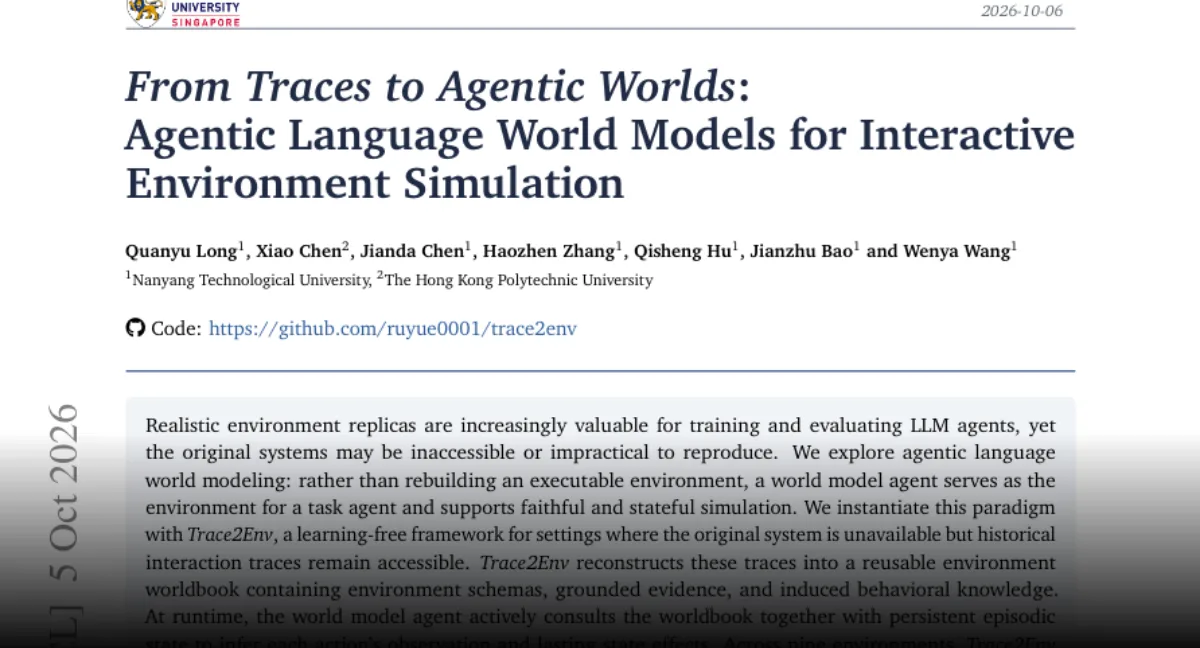
Trace2Env reconstructs text environments from traces, using a worldbook and state commits for safe, training-free, long-horizon agent simulation.
Key Takeaways
- Trace2Env is a training-free framework that reconstructs textual environments from action-observation traces, enabling safer and more reproducible agent testing without running the original system.
- It treats the environment itself as an agent, building world model agents that simulate stateful, long-horizon interactions with task agents.
- Offline traces are organized into a six-part worldbook, including schemas, transition rules, constraints, invariants, evidence, and demonstrations, to guide environment inference.
- At runtime, the world model agent uses tools and memory to propose state changes, while a shared harness verifies and commits updates to maintain consistency over time.
- The method is evaluated across terminals, repositories, Android/web apps, enterprise services, and text games, suggesting broad use for training, safe sandboxes, stateful mocks, and legacy or private environments.
Meta description:
Trace2Env is a training-free framework that reconstructs textual environments from action-observation traces, enabling stateful simulation and safe testing.
Tags:
Trace2Env, world model agents, agent simulation, textual environments, action-observation traces
Trace2Env advances agentic language world modeling with a training-free framework that treats the environment itself as an agent. It builds world model agents that stand in for textual systems, letting task agents interact through faithful, stateful, and long-horizon simulation of textual environments.
Background: Why Simulated Text Environments Matter
When language agents edit files, run terminal commands, or navigate app interfaces, the value of a test environment depends on whether state persists after each action. Real systems can be private, fragile, expensive to reset, or unavailable. A reconstructed environment can give teams a safer place to train, test, and compare agents without touching the original executable system.
This matters because many agent tasks are sequential: a command, file edit, or interface action can change the context for every later step. A faithful text environment must therefore track state, not just produce a plausible next response.
Development: From Action-Observation Traces to a Worldbook
Trace2Env reconstructs environment dynamics from recorded action-observation trajectories. It does not recover the original executable system. During offline reconstruction, the traces are organized into a worldbook. The worldbook has six parts: environment schemas, transition rules, constraints, invariants, grounded evidence, and demonstrations. Together, they give the framework a structured basis for inferring how a textual environment changes.
At runtime, the world model agent actively calls tools to inspect the worldbook, the maintained episode state, and episodic memory. It infers the next observation and the state changes that should persist. A shared runtime harness then verifies the proposal and commits accepted changes, so the consequences of earlier actions carry into later turns.
The commit step turns free-form generation into a controlled state update, which helps keep long-horizon consistency without needing to run the original software.
Latest: Evaluation Scope and Reusable Uses
In evaluation, the paper covers terminals, software repositories, Android and web apps, enterprise services, and text games. The framework is not tied to one environment domain, so it can also be applied to other text-interactive systems, including internal enterprise tools, ticketing workflows, cloud and DevOps consoles, API and MCP backends, and other textual worlds.
This breadth suggests the method targets general textual interaction rather than a single app category. The reconstructed environments could support training without the real system, testing in safe and reproducible sandboxes, stateful mocks for tools and APIs, and reconstruction of unavailable, private, or legacy environments.
The material also points to a view of what a worldbook looks like. A fake Terminal built by Trace2Env is available at https://huggingface.co/spaces/Quanyu001/trace2env_demo, the code is at https://github.com/ruyue0001/Trace2Env, and the project page is https://quanyulong.net/trace2env/.
The current stage is a training-free world-modeling framework with an offline worldbook, a runtime state commit step, and evaluation across multiple textual environment types. What to watch next is how its stateful simulation supports longer-horizon agent testing and broader integration into enterprise, developer, and legacy text systems.
Comments
No comments yet. Be the first to comment.