
Mara Chain: Reframing Failure as a Catalyst for Self-Evolving AI Systems
Mara Chain keeps failed AI candidates and traces for refinement, improving AppWorld, TerminalBench, MuSiQue, and benchmarks without weight updates.
Key Takeaways
- Mara Chain keeps rejected AI candidates, rollout traces, and residual failures inside the optimization loop, refining them instead of discarding them.
- It is a white-box, no-weight-update framework for optimizing skills, agent harnesses, and retrieval pipelines, using fixed chain depth and Pareto-filtered Top-N selection.
- Reported gains include AppWorld skill optimization with up to +20.5% relative improvement and 65.5% fewer rollouts than GEPA, TerminalBench 2.1 harness optimization reaching a 71.9% pass rate, and MuSiQue retrieval optimization improving nDCG@10 by +0.104.
- The approach was validated across GLM-5, DeepSeek, and Qwen, and is released with code, a paper, and traceable visualizations that show how failures evolve into better candidates.
Meta Description: Mara Chain keeps rejected AI candidates and traces to refine them, reporting AppWorld, TerminalBench 2.1, MuSiQue gains on GLM-5, DeepSeek, and Qwen.
Tags: Mara Chain, AI optimization, agent benchmarks, retrieval pipelines, AntOmniEvo
Featured Image: Abstract branching lineage visualizer with corridors, golden halls, and traceable candidate nodes.
Mara Chain Turns Failed AI Proposals Into Optimization Steps
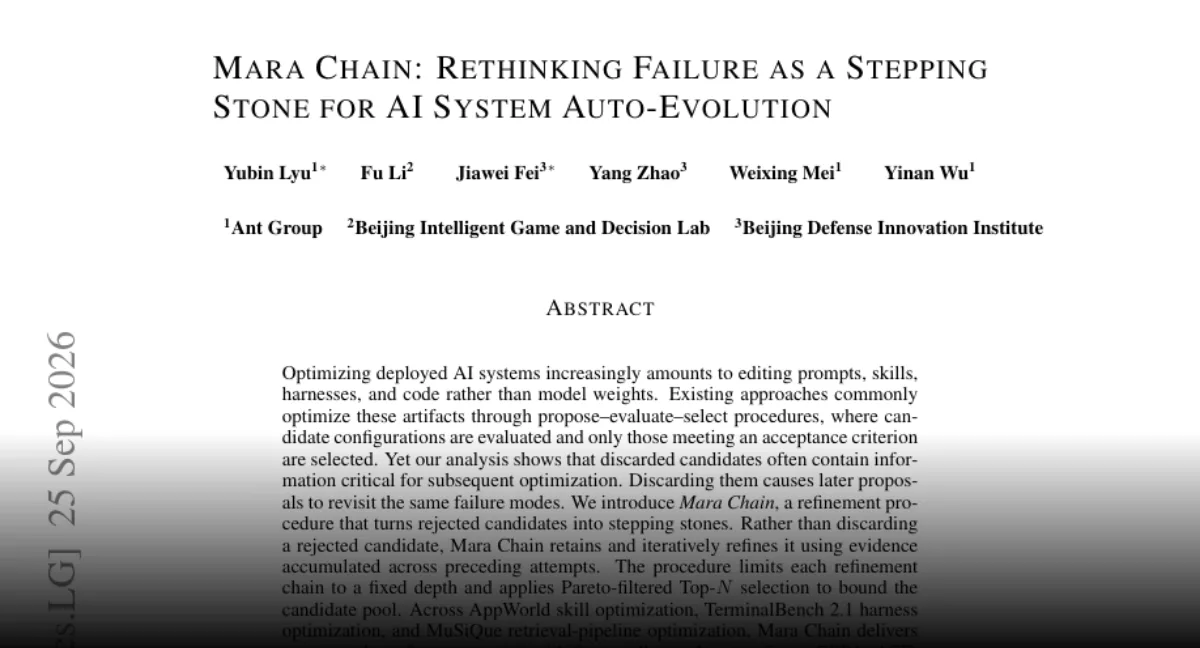
Mara Chain is a framework for AI system auto-evolution that keeps failed candidates inside the optimization loop. Standard propose-evaluate-select methods discard every candidate that fails the acceptance bar, so later proposals can keep revisiting the same failure modes. Mara Chain instead retains each rejected candidate together with its rollout traces, structured analyses, and residual failures, then iteratively refines it on the same minibatch. The code is published in the AntOmniEvo repository at https://github.com/ant-research/AntOmniEvo, whose README includes a quickstart, and the paper is listed at https://arxiv.org/abs/2609.35855.
Background: The Dead-End Problem in Propose-Evaluate-Select Optimization
Automated AI optimization often works through cycles: propose a candidate skill, harness, or retrieval pipeline; run it; evaluate the result; select only candidates that pass a threshold. The rejected candidates are usually excluded from later steps. That creates a narrow memory: the system learns from successes, but not from the traces, analyses, and residual failures attached to rejected attempts. When the same failure mode reappears, the optimizer may need to rediscover it. Mara Chain addresses this by treating failures as retained evidence rather than discarded noise.
Development Process: From Rejected Candidates to Refinement Chains
The retained-failure mechanism changes the search object. A rejected candidate is not erased; its rollout traces, structured analyses, and residual failures stay in the pool. The method then iteratively refines that candidate on the same minibatch, turning a failed attempt into a stepping stone. To keep the search bounded, the chain depth is fixed, and the pool is limited by Pareto-filtered Top-N selection. In practical terms, Pareto filtering keeps candidates that are not clearly dominated by better alternatives, while Top-N caps the pool size.
This approach is described as one framework for skills, agent harnesses, and retrieval pipelines. It requires no weight updates and is fully white-box, meaning the optimization artifacts can be inspected directly instead of hidden inside model parameters.
Latest Progress: Benchmark Results Across Three Optimization Targets
For AppWorld skill optimization, using the same model and same budget, Mara Chain reports up to +20.5% relative gain over the best prior optimizer. It reaches the target score with 65.5% fewer rollouts than GEPA: 3,280 rollouts versus 9,514, and 11.9 hours versus 35.8 hours. The best final scores on all four metrics are 89.9/83.9/76.7/59.0, compared with 48.2/35.7/33.3/19.4 for the unoptimized baseline.
For TerminalBench 2.1 harness optimization, the reported pass rate is 71.9%. That is +20.2 percentage points over AHE and +22.5 percentage points over Meta-Harness, while using fewer output tokens than the unoptimized baseline. For MuSiQue retrieval-pipeline optimization, test nDCG@10 improves by +0.104 and Recall@10 by +0.131 over a hand-written pipeline, on a test set disjoint from the tuning split.
Cross-Model Validation and Visual Traceability
The framework is verified on GLM-5, DeepSeek, and Qwen backbones, with average gains of +40.3, +32.7, and +23.4 percentage points. The stated implication is that the optimization system improves across model families rather than depending on one specific backbone.
A bonus lobster gym visualizer represents each candidate as a lobster leveling up: weak ones train in the basement, strong ones enter the golden hall. The visualizer also shows a full lineage tree, making every fix traceable. This traceability matters because the method's value comes from retained failures, not just final scores.
Mara Chain currently stands at a public benchmark and artifact-release stage: it provides code, a paper, and reported gains across skill, harness, and retrieval optimization. The next signal to watch is whether fixed chain depth, Pareto-filtered Top-N selection, and retained failure traces remain effective when applied to new task suites or deployed agent workflows beyond the reported settings.
Comments
No comments yet. Be the first to comment.