
A Structured Harness for Incremental, Open-Ended Deep Research
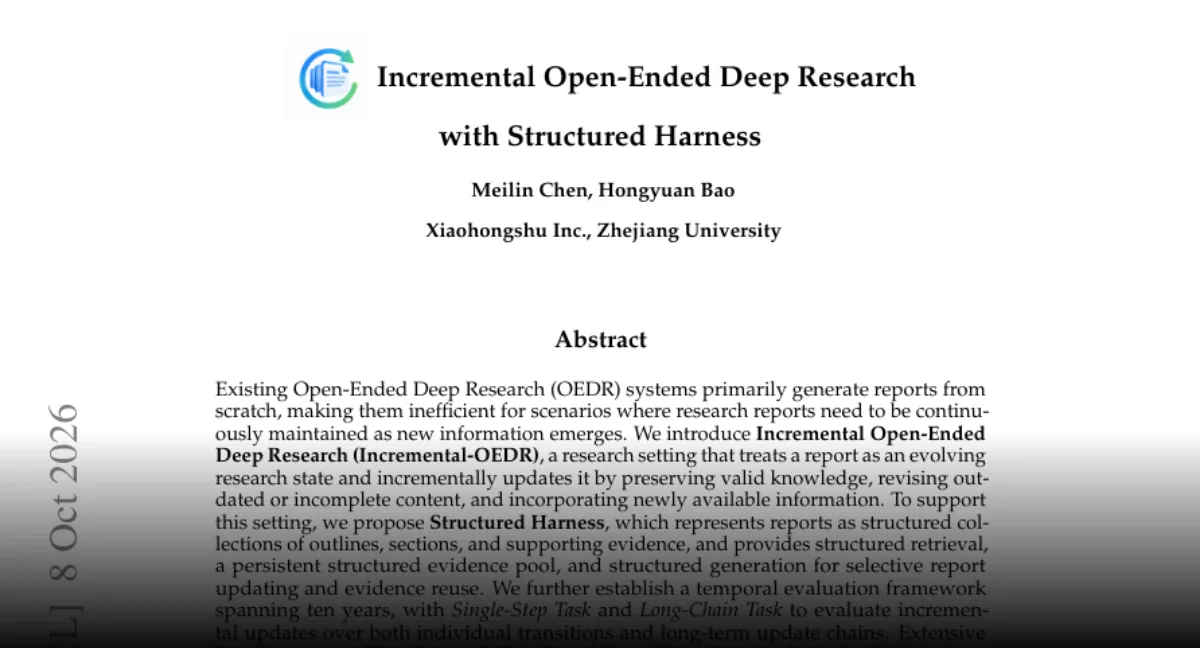
Incremental-OEDR updates evolving reports with Structured Harness, preserving knowledge, adding evidence, and cutting token and search costs.
Key Takeaways
- Incremental-OEDR shifts deep research from generating static reports from scratch to maintaining an evolving report state by preserving valid knowledge, revising outdated content, and adding new information.
- Structured Harness makes reports editable by organizing outlines, sections, and evidence into a structured map, enabling selective updates through structured retrieval, a persistent evidence pool, and structured generation.
- A ten-year temporal evaluation framework tests both single update transitions and long update chains, measuring whether systems can keep reports coherent and accurate over continuous information flow.
- On DeepResearch Bench and DeepConsult, Incremental-OEDR achieves competitive or improved report quality and continuity while cutting token consumption by 33% and search calls by 61%.
- The work defines an update-oriented research setting for policy, science, technology, and market research, with future questions focused on generalizing across fast-changing domains and strict editorial controls.
Meta Description
Incremental-OEDR updates evolving research reports with Structured Harness, improving continuity and cutting tokens by 33% and searches by 61%.
Tags
Incremental-OEDR, DeepResearch Bench, DeepConsult, Structured Harness, AI Research Systems
Featured Image
Abstract technology visual with layered report outlines, evidence nodes, and timeline arrows, no real people, no company logos, no text.
Existing Open-Ended Deep Research (OEDR) systems generate most reports from scratch. That design becomes costly when research questions keep changing and reports must stay current. Incremental-OEDR changes the unit of work: a report is no longer a one-off artifact but an evolving research state. It updates by preserving valid knowledge, revising outdated or incomplete content, and adding newly available information. This matters because continuous maintenance is the normal condition for policy, science, technology, and market research, not a special case.
Background: Static Reports Meet Continuous Information Flow
The gap in OEDR pipelines is visible when new evidence appears. Traditional systems tend to rebuild the report rather than edit it. That can waste tokens, search calls, and review effort. It can also create discontinuity: sections may move, terminology may change, and earlier valid findings may disappear unless regenerated carefully. The proposed setting, Incremental Open-Ended Deep Research, treats updating as a first-class task. The report has a state, and the system must decide what to keep, what to correct, and what to insert.
Development: Structured Harness Turns Reports Into Editable Objects
To make incremental updates practical, the method introduces Structured Harness. It represents reports as structured collections of outlines, sections, and supporting evidence. That representation gives the system a map instead of a flat text blob. Three mechanisms support the workflow: structured retrieval, a persistent structured evidence pool, and structured generation. Structured retrieval locates the relevant parts of the report and evidence base. The persistent evidence pool keeps material available across update cycles. Structured generation updates selected report components and reuses evidence rather than starting from zero. The result is a selective updating process that aims to preserve report continuity while keeping quality competitive.
Evaluation: A Ten-Year Temporal Framework Tests Long-Term Updates
The proposal also introduces a temporal evaluation framework spanning ten years. It includes Single-Step Task and Long-Chain Task. Single-Step Task evaluates one update transition, such as moving from one report state to the next after new information arrives. Long-Chain Task evaluates a sequence of updates, probing whether the system can maintain coherence across a longer research trajectory. This is a sharper test than a single snapshot. It asks whether an update system can survive repeated changes without fragmenting the outline or discarding valid evidence.
Latest Results: Quality Holds While Costs Fall
Experiments were run on DeepResearch Bench and DeepConsult under both the Open-source Configuration (OC) and Proprietary Configuration (PC). The reported outcome is that Incremental-OEDR maintains competitive report quality while substantially improving report continuity and reducing research costs. On DeepResearch Bench, IOEDR achieves up to 0.51 higher content-level ROUGE-L F1, 0.63 higher outline-level EM F1, 33% lower token consumption, and 61% fewer search calls than OEDR. The content-level ROUGE-L F1 gain points to better lexical alignment with reference content, while the outline-level EM F1 gain points to stronger preservation of report structure. The cost reductions matter for systems that rely on repeated model calls and external search.
The current stage is not a replacement for all deep research tools, but a clearer definition of an update-oriented research setting. The next thing to watch is how well Structured Harness generalizes across domains with rapidly changing facts, long evidence chains, and stricter editorial controls. If temporal evaluation remains central, the practical question becomes whether research systems can keep reports accurate without paying the full cost of regeneration each time they change.
Comments
No comments yet. Be the first to comment.