
Study reveals leading AI researchers significantly underestimated the pace of the field's progress
A new Forecasting Research Institute interim report finds that leading AI experts and superforecasters systematically underestimated AI progress. Milestones like gold-medal math olympiad performance and expert-level virology troubleshooting arrived years early, while revenue projections for top AI companies fell far short of reality. However, some forecasts on biosecurity and self-driving cars overshot, and respondents are now shifting expectations upward.
Key Takeaways
- A new FRI interim report finds that AI experts and superforecasters systematically underestimated AI progress, with major milestones arriving years ahead of predictions.
- AI achieved gold-medal IMO math performance in July 2025—five years earlier than experts' median forecast and ten years earlier than superforecasters'—and also matched top virologists on troubleshooting benchmarks far ahead of schedule.
- Economic forecasts were also far too low: experts projected ~$20 billion peak ARR for AI companies by end of 2026, while Anthropic likely reached ~$100 billion by September 2026.
- Forecasters did overshoot in some areas, such as AI's ability to help complete biological lab tasks and the pace of autonomous ride-hailing adoption.
- Respondents are updating their views upward (e.g., rising probabilities of AI becoming a "technology of the century"), and FRI is refining its methods—though the report cautions that underestimates are inherently easier to detect than overestimates in interim reviews.
A new interim report from the Forecasting Research Institute (FRI) shows that professional forecasters have systematically underestimated how fast AI capabilities would advance. Milestones expected in the 2030s—gold-medal math olympiad performance, expert-level virology troubleshooting—arrived years early, and revenue projections for leading AI companies fell far short of reality.
Who Made the Forecasts
Since mid-2022, FRI has gathered AI progress predictions across several studies and projects, including the Longitudinal Expert AI Panel (LEAP). Its first round drew 339 experts: 76 computer scientists, 76 industry experts, 68 economists, and 119 AI policy specialists. The computer scientists included 30 professors at top-20 institutions and 10 of the 200 most-cited AI authors. The panels also included superforecasters—generalists with a proven record of accurate predictions.
Milestones That Arrived Years Early
The largest gap involves mathematics. AI reached gold-medal level at the International Mathematical Olympiad in July 2025—five years ahead of the median expert forecast and ten years ahead of the median superforecaster forecast, both gathered in 2022 before ChatGPT launched.
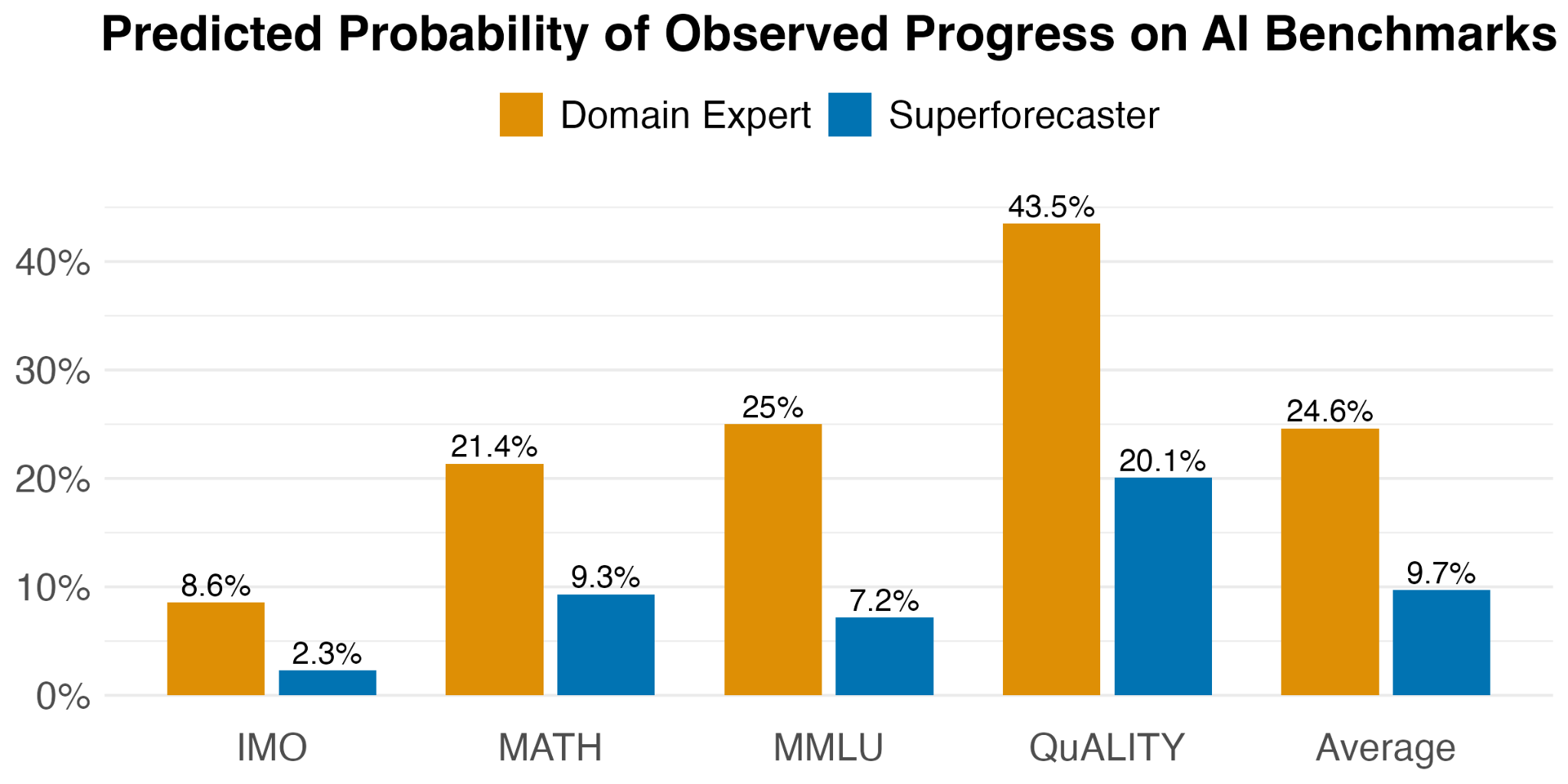
Across benchmarks, experts had assigned an average probability of just 24.6 percent to the results that actually occurred; superforecasters gave 9.7 percent. For olympiad gold-medal performance, those figures dropped to 8.6 and 2.3 percent.
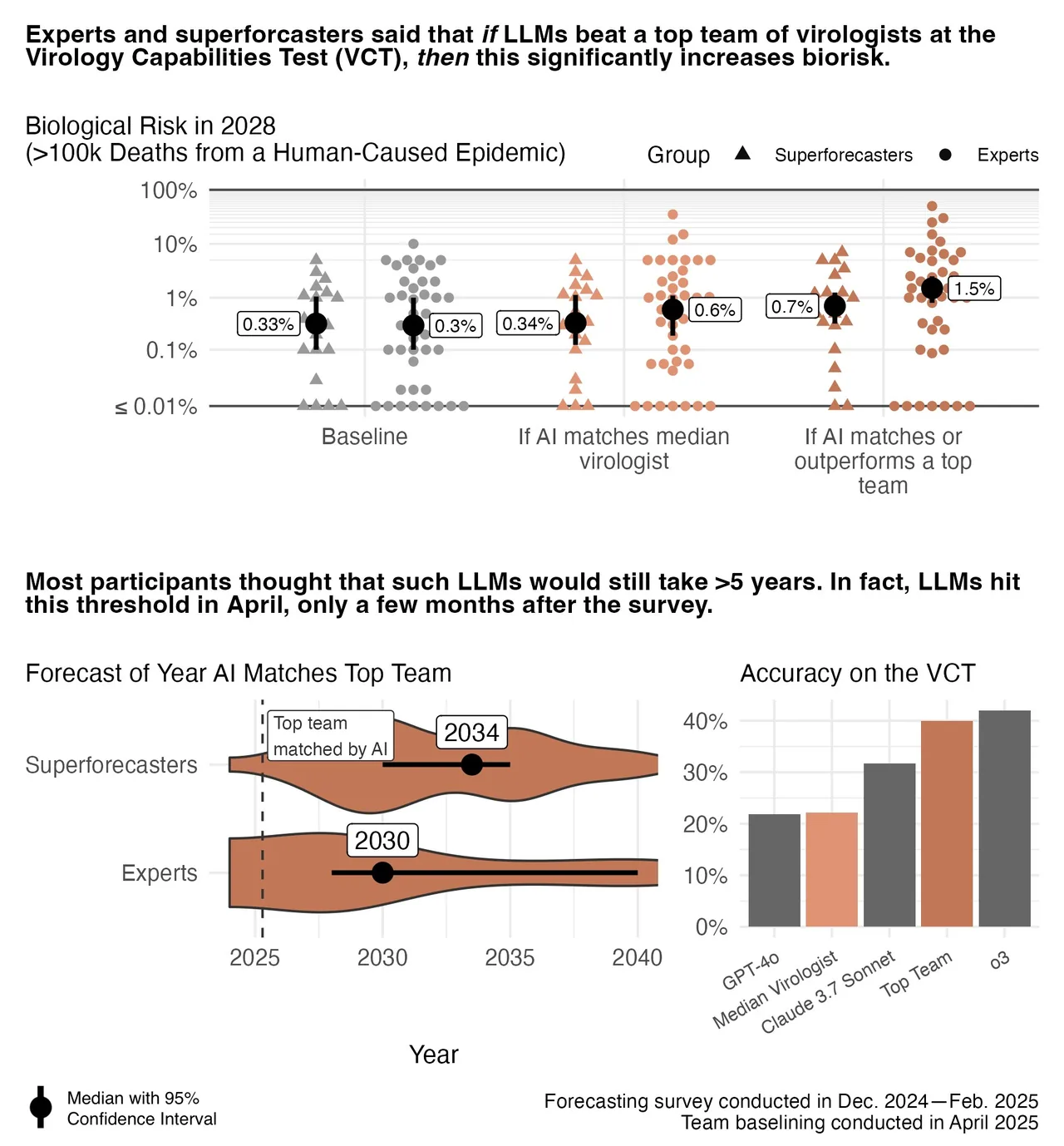
A similar pattern held elsewhere. Experts said AI wouldn't match a top team of virologists on a troubleshooting benchmark until 2030, and superforecasters said 2034—yet FRI believes it likely happened as early as April 2025. A cybersecurity benchmark showed comparable underestimates. And while experts put the odds of AI helping solve a Millennium Prize Problem by the end of 2027 at just 10 percent (superforecasters: 5.4 percent), a claimed solution emerged, though whether it meets the evaluation criteria remains unclear.
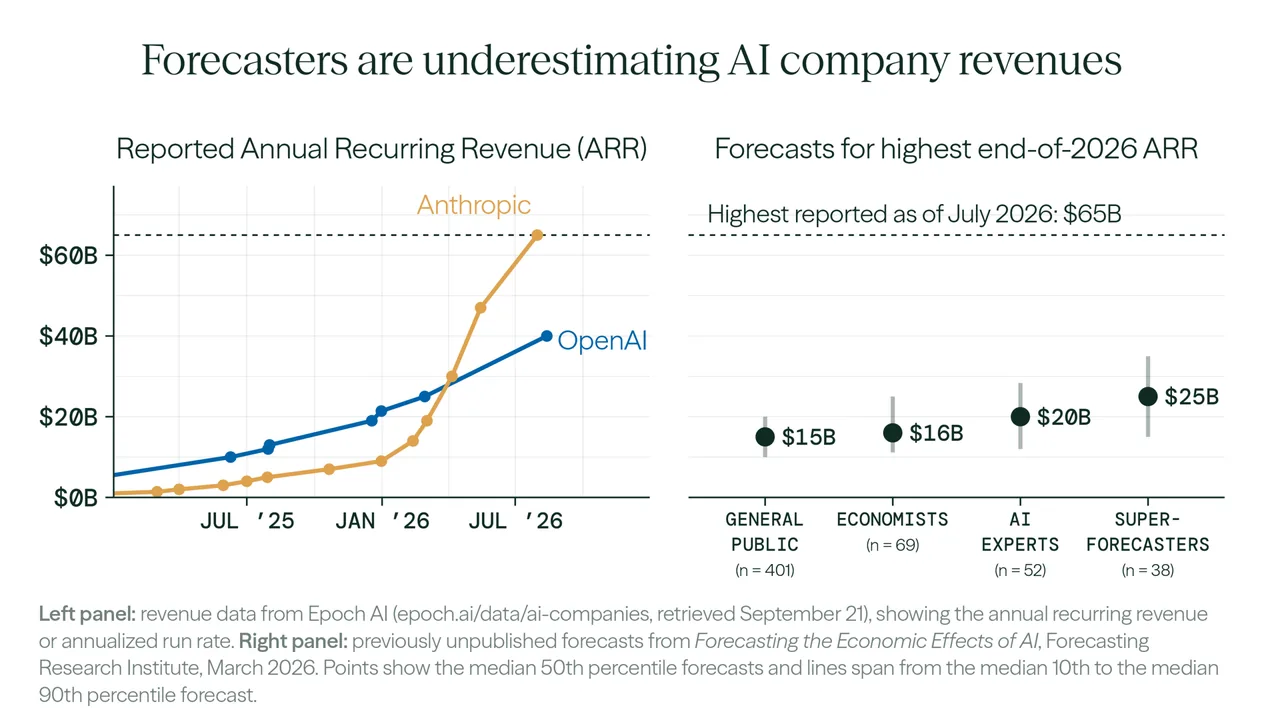
Economic forecasts were also far too conservative. Experts' median estimate for the highest annual recurring revenue (ARR) of any AI company at the end of 2026 was $20 billion, with economists at $16 billion and superforecasters at $25 billion. FRI cites roughly $100 billion for Anthropic in September 2026 as a figure likely already reached.
Where Forecasters Overshot
Not every prediction ran too low. Biosecurity experts expected 22.5 percent of participants using a language model to complete biological lab tasks; virologists expected 40 percent, superforecasters 16.2 percent. In a controlled trial, only 5.2 percent succeeded with a language model plus internet access, versus 6.6 percent with the internet alone—the model made no measurable difference, though the trial was small.
Self-driving cars may be another case: experts' median forecast put autonomous rides at 7.3 percent of US ride-hailing trips in 2027, while an LLM projection puts it at 2.5 percent. FRI notes that forecasts on economic growth, employment, and major AI harms cannot yet be reliably judged.
Expectations Are Shifting Upward
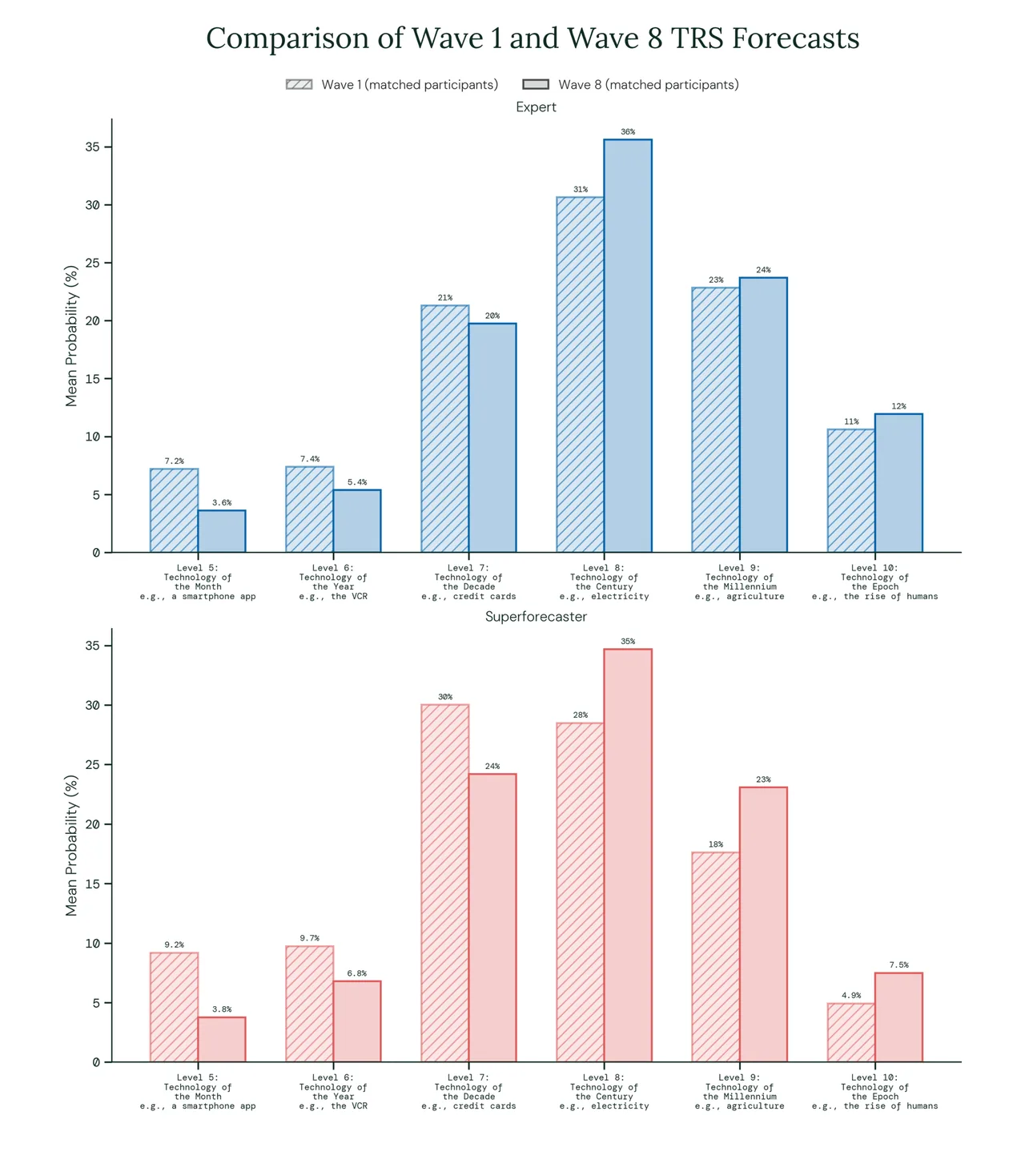
Respondents are updating their views. Among those completing both surveys, the average probability assigned to AI becoming a "technology of the century" rose from 31 to 36 percent for experts and from 28 to 35 percent for superforecasters over nine months.
FRI is also adapting its methods: it will highlight a subsample expecting very rapid AI progress through 2040, publish continuously updated LLM forecasts alongside human ones, and—once enough data exists—feature its most accurate LEAP panelists. According to ForecastBench, some models already match superforecasters on certain question types.
One caveat FRI flags about its own data: underestimates become obvious as soon as reality overtakes a prediction, while overestimates only show once a deadline passes, tilting an interim report toward examples where forecasters were too cautious. Some assessments also rely on LLM projections using information the original forecasters lacked. Where AI stands by the next round of LEAP results will show whether this upward revision continues.
Meta description: FRI's interim report finds experts and superforecasters underestimated AI progress on math, virology, and revenue milestones by years.
Tags: Forecasting Research Institute, AI benchmarks, superforecasters, LEAP, Anthropic
Comments
No comments yet. Be the first to comment.