
Adaptive Parallel Reasoning: A New Paradigm for Scaling Inference Efficiency
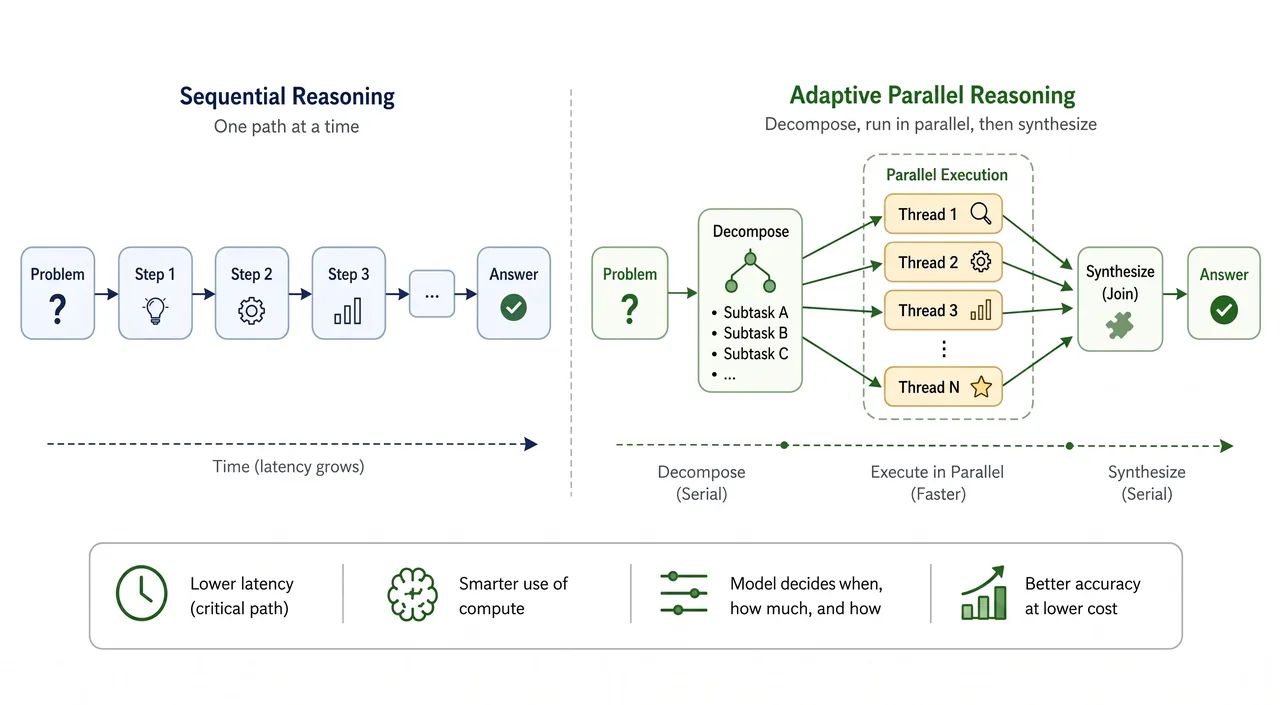
Sequential LLM reasoning faces context limits, context-rot, and long latency. Parallel reasoning offers a fix, evolving from fixed strategies like self-consistency, Best-of-N, tree/skeleton search, to trainable methods such as ParaThinker, GroupThink, and Hogwild! Inference. Yet all impose parallel structure externally. Adaptive Parallel Reasoning (APR) shifts control into the model itself, letting it decide when to decompose tasks, spawn threads, and join results for efficient, scalable inference.
Key Takeaways
- Sequential LLM reasoning is hitting scaling limits due to context-window strain, "context-rot" (difficulty distinguishing useful information from distractors), and long user-facing latency on complex tasks.
- Parallel reasoning approaches evolved through three stages—simple fork-and-join (self-consistency, Best-of-N), heuristic search (Tree/Graph/Skeleton of Thoughts, MCTS), and trainable concurrent methods (ParaThinker, GroupThink, Hogwild! Inference)—but all impose a fixed parallel structure decided outside the model.
- Adaptive Parallel Reasoning (APR), introduced by Pan et al. (2025), shifts parallelization control into the model itself, which learns via reinforcement learning when to branch, how many threads to spawn, and when to join results.
- APR's advantages: no hand-crafted decomposition heuristics, no redundant compute across threads, and the flexibility to skip parallelization entirely for simple problems.
- A key remaining systems challenge is KV-cache merging during fork/join, where independent threads create position-ID overlap and non-causal attention patterns the base model never saw in training—addressed by competing approaches like Multiverse, Parallel-R1, and NPR.
Meta description: Adaptive Parallel Reasoning lets LLMs decide when to parallelize, how many threads to spawn, and how to join results. Here's the landscape and where it's heading.
Tags: adaptive parallel reasoning, LLM inference, inference-time scaling, ThreadWeaver, Multiverse
Featured image: abstract illustration of branching threads converging into a single stream, technology style, no people, no logos.
The frontier of LLM reasoning has been shaped by inference-time scaling: models that emit explicit reasoning tokens—intermediate steps, backtracking, exploration—now dominate math, coding, and agentic benchmarks. But scaling that reasoning sequentially is hitting a wall. Adaptive Parallel Reasoning (APR) is the emerging answer: let the model itself decide when to decompose a problem, run subtasks in parallel, and coordinate the results.
Why Sequential Reasoning Is Running Out of Room
Sequential reasoning scales linearly with how much a model explores. That exploration carries three compounding costs. First, long chains of intermediate steps strain effective context limits (Hsieh et al., 2024). Second, as exploration paths accumulate, models struggle to distinguish useful information from distractors in their own context—a degradation researchers call context-rot (Hong, Troynikov and Huber, 2025). Third, latency grows with reasoning length: for complex tasks requiring millions of tokens, users routinely wait tens of minutes or even hours (Qu et al., 2025).
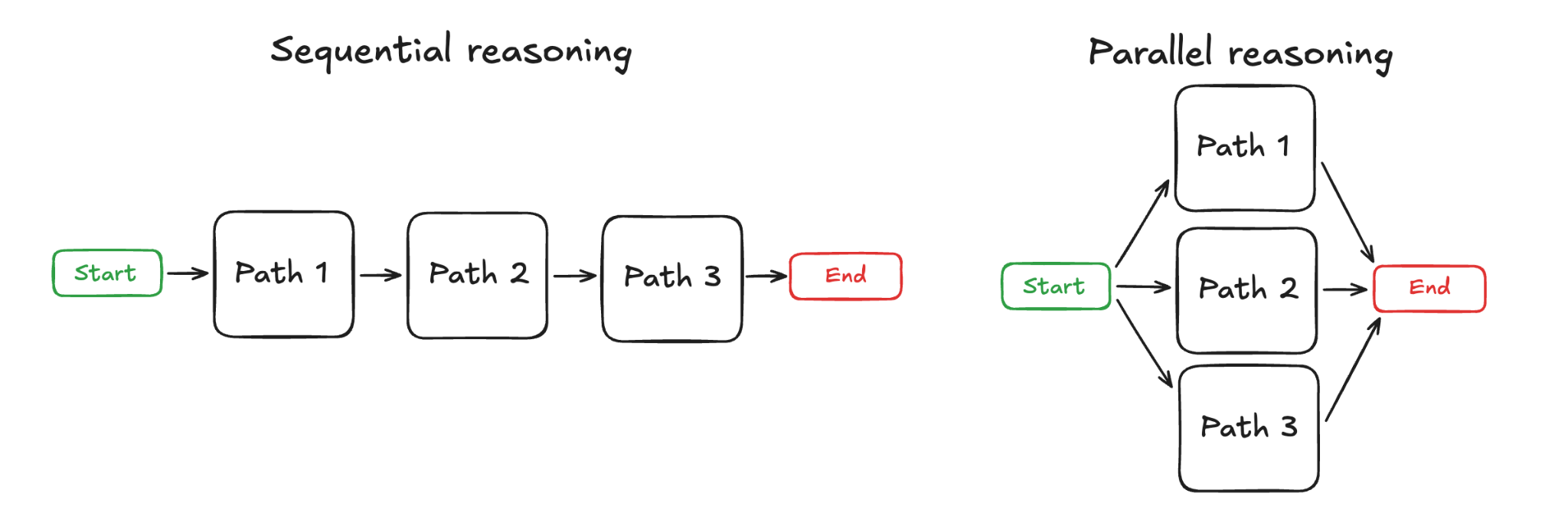
Parallel reasoning offers a structural fix. Instead of one thread accumulating context at every step, multiple threads explore independently and concurrently, without relying on each other's context. Work on this idea spans synthetic settings like the Countdown game (Katz, Kokel and Sreedharan, 2025), real-world math, and general reasoning tasks.
From Fixed Parallelism to Model-Controlled Parallelism
Most existing approaches decide the parallel structure outside the model. The landscape has evolved through roughly three stages.
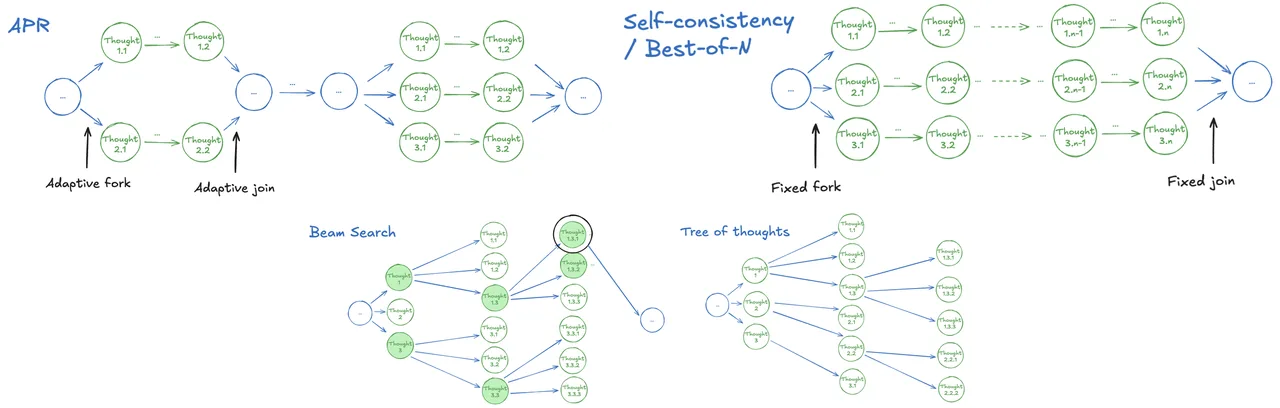
Stage one: simple fork-and-join. Self-consistency/majority voting samples multiple complete reasoning traces and returns the most common final answer (Wang et al., 2023). Best-of-N does the same but uses a trained verifier to pick the best solution (Stiennon et al., 2022). Both are easy to implement, but independently sampled branches waste compute on redundant trajectories.
Stage two: heuristic search. Tree, Graph, and Skeleton of Thoughts decompose tasks into structured "thoughts" explored with BFS/DFS and pruned via LLM evaluation (Yao et al., 2023; Besta et al., 2024; Ning et al., 2024). Monte-Carlo Tree Search estimates node values via random rollouts with Upper Confidence Bound exploration (Xie et al., 2024; Zhang et al., 2024). These avoid overlap but require prior knowledge of how to decompose the task—knowledge that isn't always available.
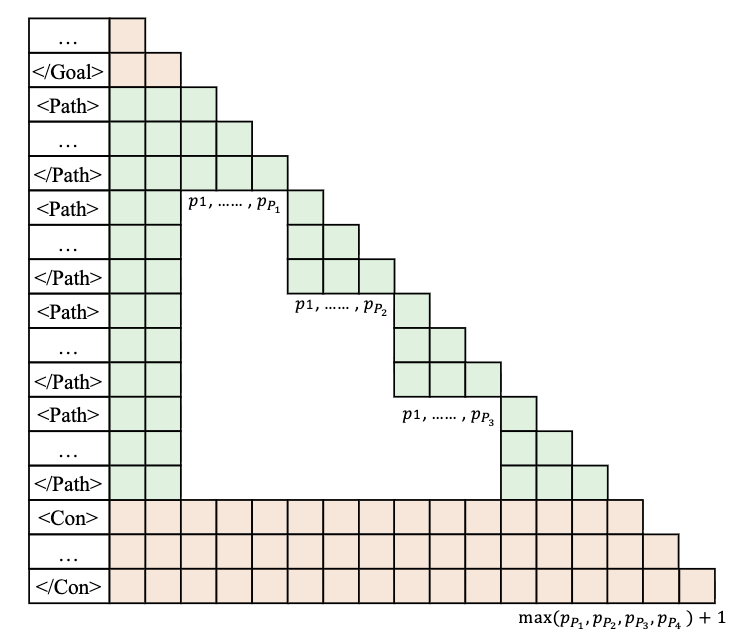
Stage three: trainable and concurrent variants. ParaThinker trains a model to run two fixed stages—generating parallel reasoning threads, then synthesizing them—using trainable control tokens (`<think_i>`) and thought-specific positional embeddings (Wen et al., 2025). GroupThink lets parallel threads see each other's partial progress at the token level mid-generation (Hsu et al., 2025). Hogwild! Inference goes further: threads share a KV cache and decompose tasks without an explicit coordination protocol, using RoPE to stitch individual KV blocks in different orders without recomputation (Rodionov et al., 2025).
The shared limitation across all three stages: when to parallelize, how many threads to use, and which search strategy to apply are imposed on the model. Applying one fixed structure to both "What's 25+42?" and a hard spatial puzzle wastes compute on the first and picks the wrong decomposition for the second.
What Adaptive Parallel Reasoning Changes
APR, introduced by Pan et al. (2025) as a paradigm rather than a single method, moves parallelization into the model's own control flow. The model is trained—typically via reinforcement learning—to emit special tokens that signal when to branch, how many threads to spawn, and when to join. In practice, that produces an adaptive allocation of compute between parallel and serial operations at inference time.
This shift matters for three concrete reasons. Against Tree-of-Thoughts-style methods, APR needs no hand-crafted decomposition heuristics; models discover useful patterns during RL, such as running a next step alongside self-verification of a previous one, or hedging a primary approach with a backup. Against BoN, APR avoids redundancy because it controls what each thread will do before branching, producing unique, non-overlapping subtasks (Pan et al., 2025; Yang et al., 2025). And against all non-adaptive approaches, APR can simply choose not to parallelize when a problem doesn't warrant it (Lian et al., 2025).
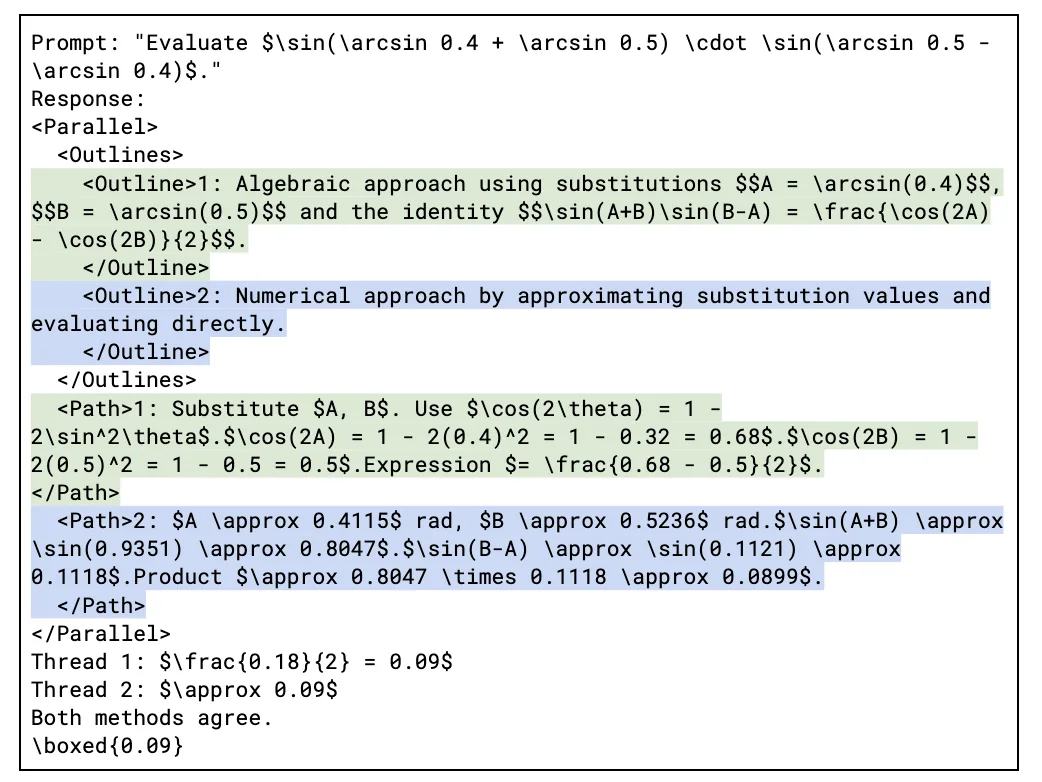
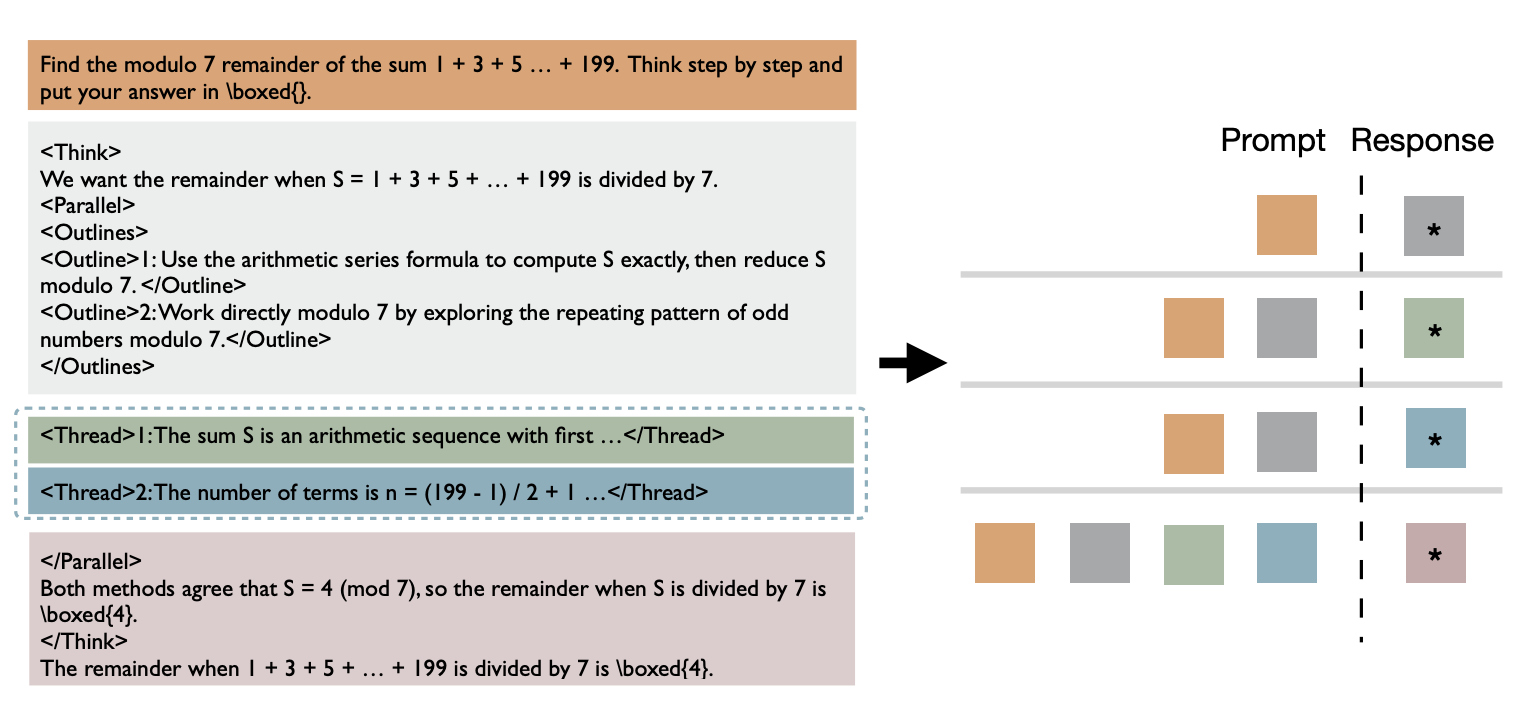
ThreadWeaver (Lian et al., 2025)—co-led by one of the survey's authors, Tony Lian—is one concrete instantiation: a condensed ThreadWeaver-style trace shows two outlines and two paths under a `<Parallel>` block, with the threads agreeing on a single boxed answer.
The Systems Problem: Fork, Join, and the KV Cache
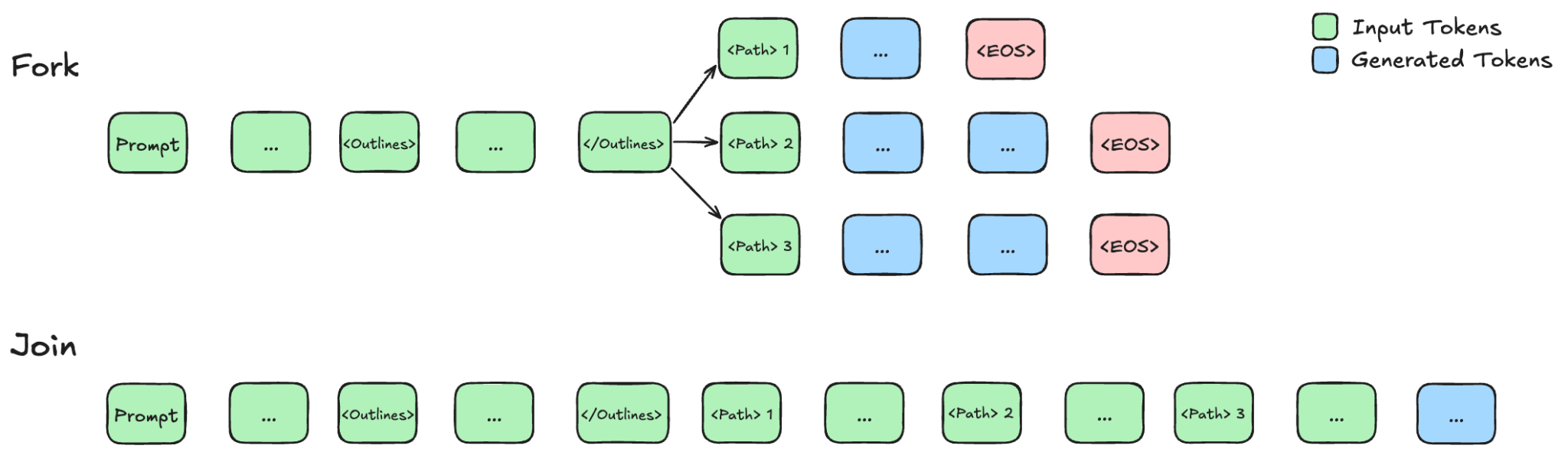
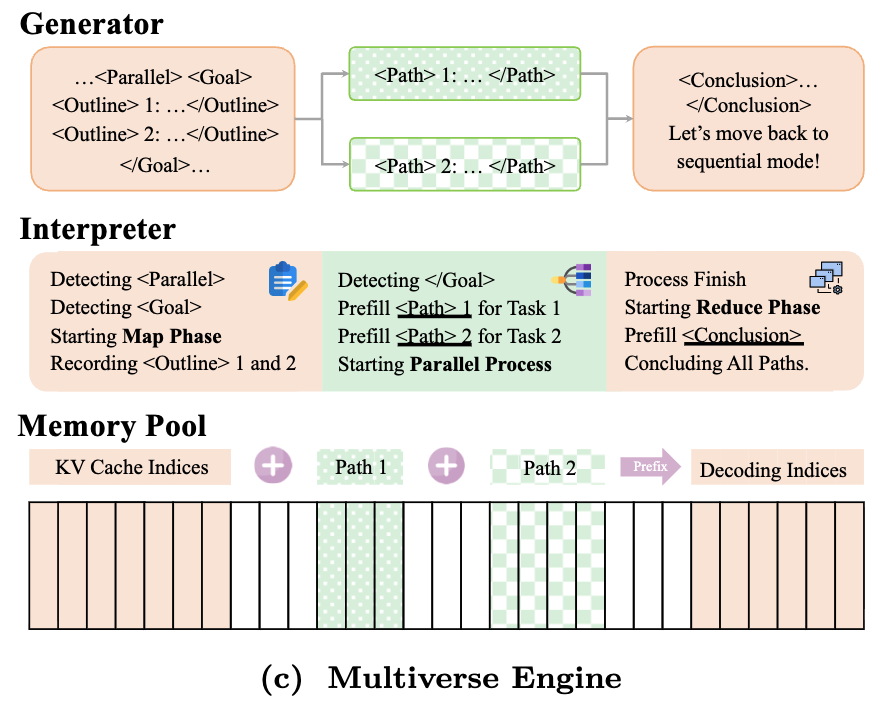
At inference time, APR performs what is effectively a map-reduce operation, borrowing from multithreading in classical computer systems: fork the problem into subtasks, process them concurrently, then join the results into a final answer. Subtasks are prefilled and dispatched as independent requests to the inference engine, decoded concurrently until an end token or max length, then aggregated.
Aggregation is the hard part. Tokens in independent threads start at identical position IDs, so merging KV caches produces encoding overlap and non-causal attention patterns the base model never saw in training.
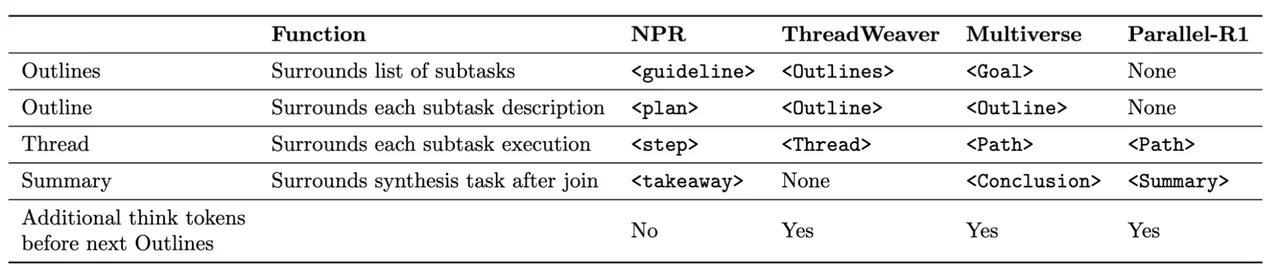
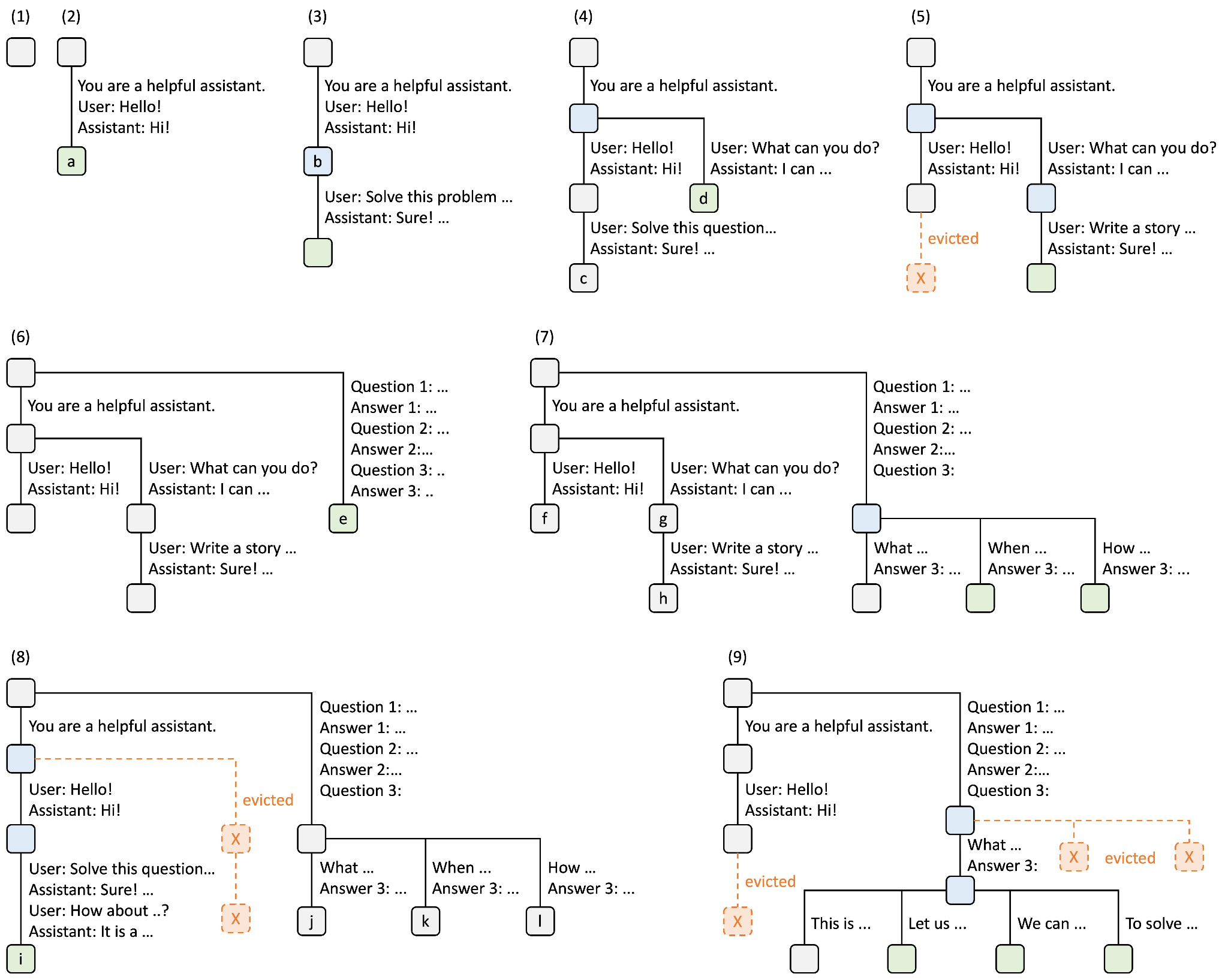
Two schools of thought have emerged. The engine-modification school, led by Multiverse (Yang et al., 2025), Parallel-R1 (Zheng et al., 2025), and NPR (Wu et al., 2025), reuses thread KV caches at the join: they copy each thread's cache and edit the page table to stitch non-contiguous memory blocks into one sequence, avoiding a costly second prefill. Upstream, SGLang's RadixAttention (Sheng et al., 2023) already eliminates redundant prefill of the shared prefix by organizing requests in a radix tree. The caveat: page-table surgery on the inference engine is non-standard memory handling that can produce unexpected behavior. The alternative school works around the engine rather than modifying it.
Where This Stands
The field is transitioning from fixed, externally orchestrated parallelism toward models that own their control flow, with inference systems engineering—KV cache reuse, fork-join scheduling—emerging as the next bottleneck. What to watch: whether engine-level modifications like Multiverse's prove stable enough for production serving, and whether emergent parallelization strategies from RL transfer reliably beyond benchmarks like Countdown.
Comments
No comments yet. Be the first to comment.