
Designing Imaging Systems Through an Information-Based Approach
Researchers introduced a NeurIPS 2025 framework that evaluates and designs imaging systems using a single metric: how much information measurements contain about the world. By estimating mutual information from noisy measurements and known noise physics, the method predicts decoder performance across color photography, radio astronomy, lensless imaging, and microscopy. The accompanying IDEAL tool optimizes system parameters via gradient ascent, matching state-of-the-art end-to-end optimization while using less memory, less compute, and no task-specific decoder.
Key Takeaways
- Researchers introduced a NeurIPS 2025 framework that evaluates imaging systems by a single metric: how much information their measurements contain about the world, using mutual information estimated from noisy measurements plus a noise model.
- The estimator exploits the physics of imaging noise (Poisson photon shot noise, Gaussian readout noise) to decompose information into total variation minus a computable noise term, yielding an upper bound that is reliable because modeling error can only overestimate, never underestimate.
- Across four domains — color photography, radio astronomy, lensless imaging, and microscopy — higher information estimates accurately predicted downstream reconstruction and classification performance without running any decoder.
- The team built IDEAL (Information-Driven Encoder Analysis Learning), which optimizes hardware parameters directly via gradient ascent on information estimates, matching end-to-end optimization while using less memory and compute and requiring no task-specific decoder.
- The approach offers an objective, unified metric needing no ground truth or subjective assessment, and could extend to any sensing system with deterministic encoding and known noise, including electronic, biological, and chemical sensors.
A team of researchers has introduced a framework that evaluates and designs imaging systems based on a single quantity: how much information their measurements contain about the world. Presented in a NeurIPS 2025 paper titled "Information-driven design of imaging systems," the method predicts downstream performance across four imaging domains and matches state-of-the-art end-to-end optimization while using less memory, less compute, and no task-specific decoder. Code is available on GitHub, and a video summary is on the project website.
Timeline: How the Problem Took Shape
Background. Modern imaging pipelines rarely deliver raw pictures to humans. Smartphones process raw sensor data through algorithms before a photo appears; MRI scanners collect frequency-space measurements that must be reconstructed before doctors can view them; self-driving cars feed camera and LiDAR data directly into neural networks. In all of these, what matters is not how the measurements look, but how much useful information they hold.
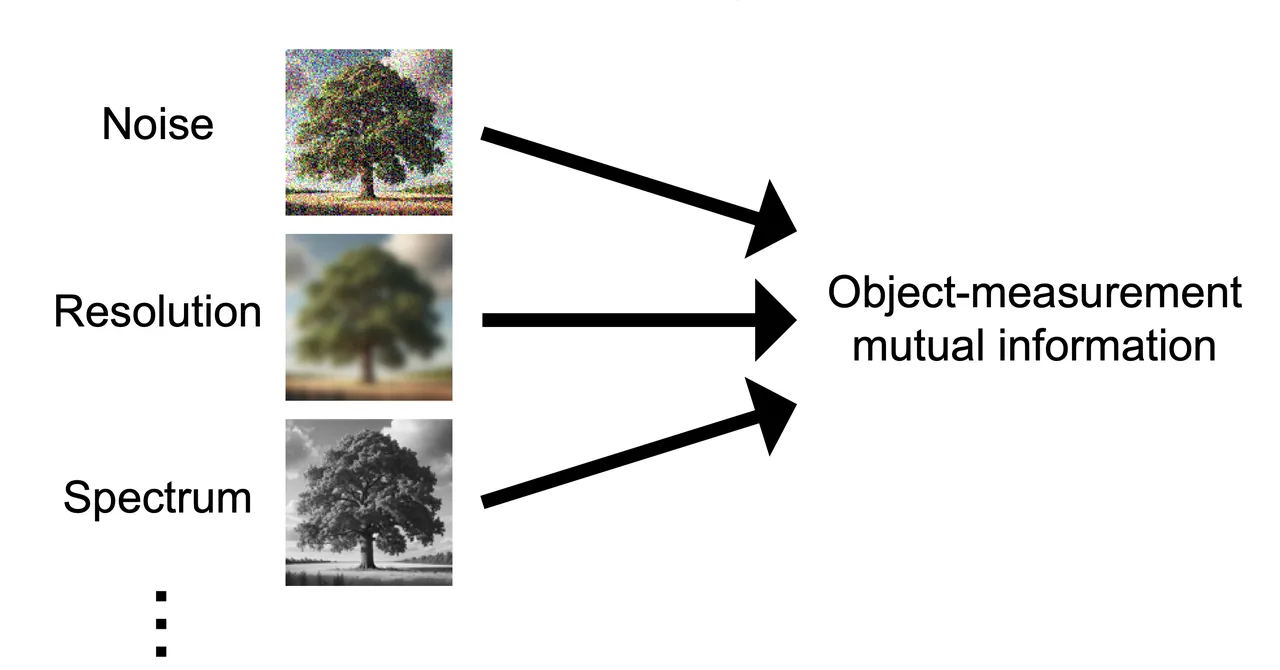
The gap. Traditional metrics such as resolution and signal-to-noise ratio assess individual quality aspects separately, making it hard to compare systems that trade one off against the other. Training neural networks to reconstruct or classify images, the common alternative, conflates hardware quality with algorithm quality. Earlier attempts to apply information theory to imaging either ignored the physical limits of lenses and sensors, producing wildly inaccurate estimates, or required explicit models of the objects being imaged, limiting generality.

How the Estimator Works
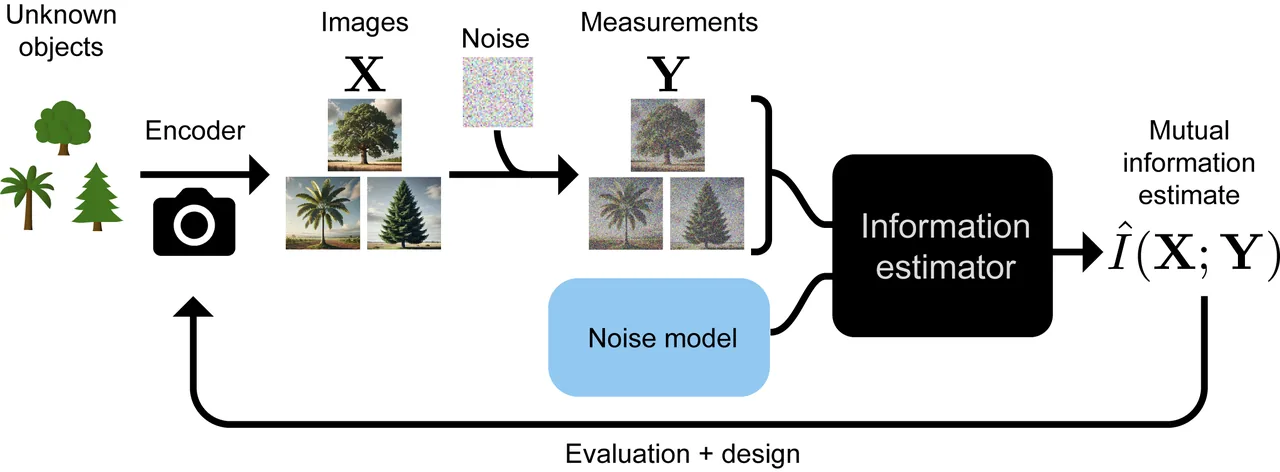
The framework treats an imaging system as an encoder (the optical system) mapping objects to noiseless images, which noise then corrupts into measurements. It estimates mutual information — how much a measurement reduces uncertainty about the object that produced it — using only the noisy measurements and a noise model.
Estimating mutual information between high-dimensional variables is notoriously difficult, but imaging systems allow a decomposition: information equals total measurement variation minus noise-only variation. Because imaging noise physics is well characterized — photon shot noise follows a Poisson distribution, electronic readout noise is Gaussian — the noise term can be computed directly, leaving only total variation to be learned. The authors fit a probabilistic model to measurement data, testing three options: a stationary Gaussian process (fastest), a full Gaussian (intermediate), and an autoregressive PixelCNN (most accurate). The result is an upper bound on true information; modeling error can only overestimate, never underestimate.
Validation Across Four Domains
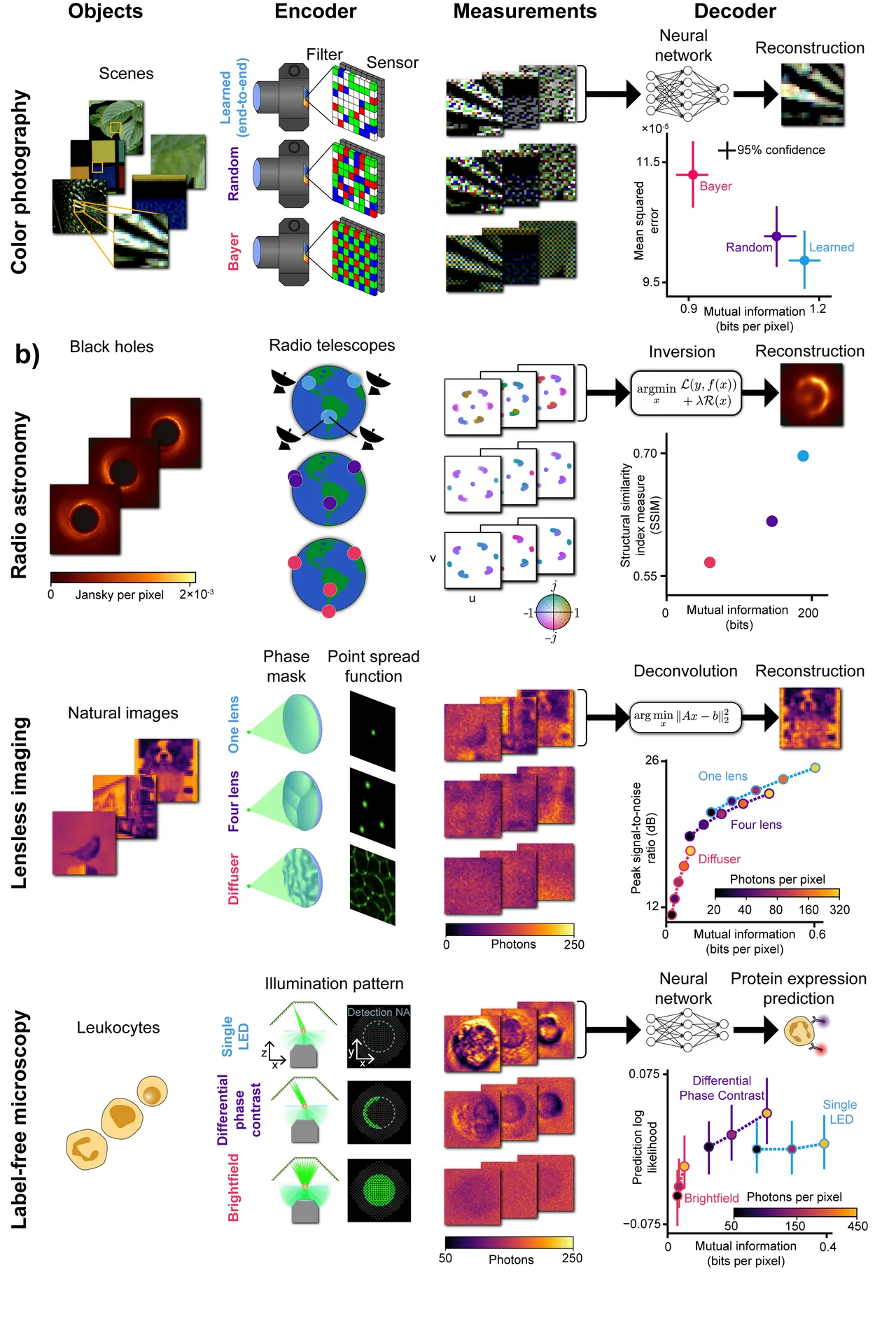
If information estimates capture what limits real systems, they should predict decoder performance. Tests confirmed this:
- Color photography. Comparing Bayer, random, and learned color filter arrays, the estimates correctly ranked designs by reconstruction quality, matching neural network demosaicing results without running any reconstruction.
- Radio astronomy. Telescope arrays combine signals from sites across the globe; selecting optimal locations is computationally intractable since each site's value depends on all others. The estimates predicted reconstruction quality across configurations, enabling site selection without expensive reconstruction.
- Lensless imaging. Estimates predicted reconstruction accuracy across a lens, a microlens array, and a diffuser design at various noise levels.
- Microscopy. For LED array microscopes, estimates correlated with neural network accuracy at predicting protein expression from cell images, avoiding costly protein labeling experiments.
In every case, higher information meant better downstream performance.
IDEAL: Designing Systems Without a Decoder
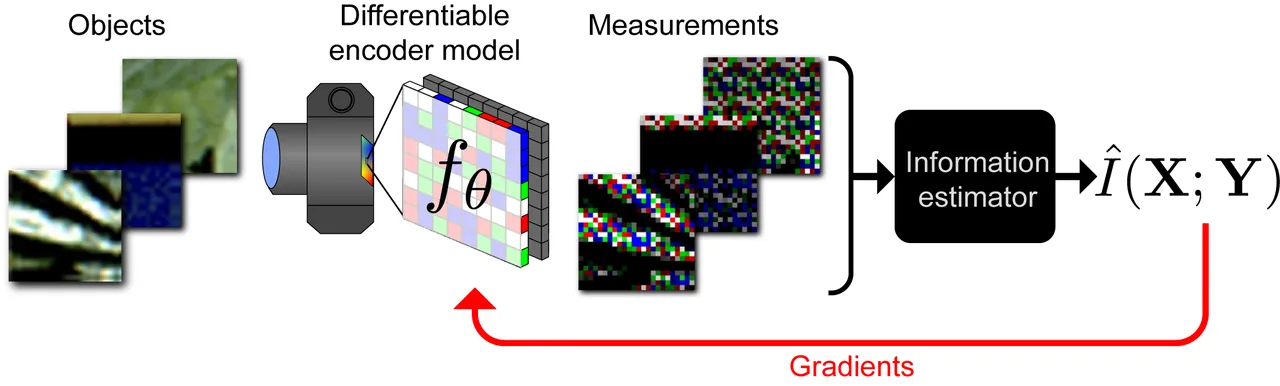
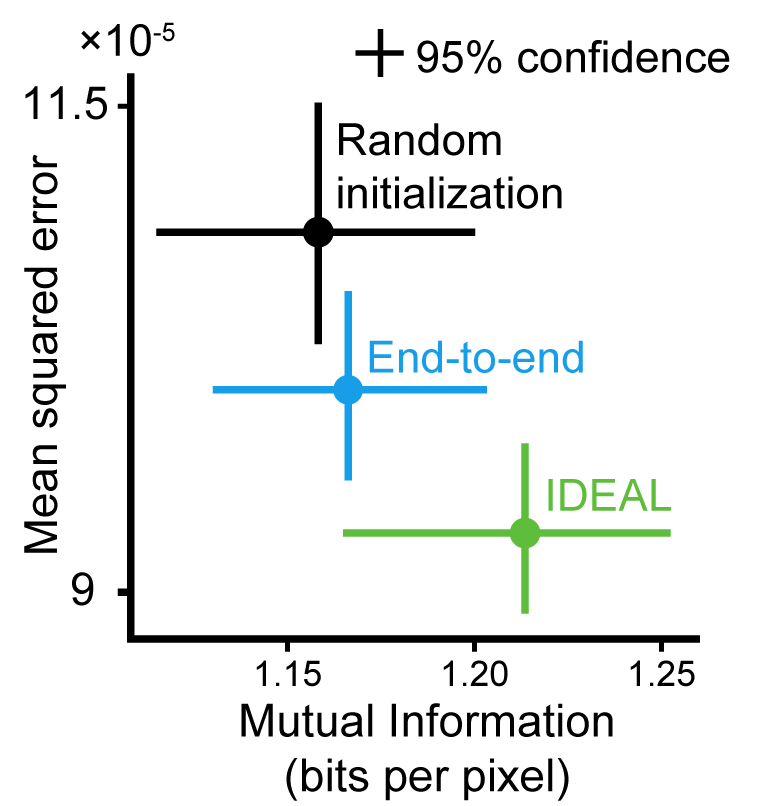
The researchers also built IDEAL (Information-Driven Encoder Analysis Learning), which uses gradient ascent on information estimates to optimize system parameters directly. End-to-end optimization, the standard approach, jointly trains hardware and a neural network decoder, requiring backpropagation through the entire decoder — with memory constraints and optimization difficulties. IDEAL optimizes the encoder alone. Starting from a random color filter arrangement, it progressively improved the design and matched end-to-end optimization in both information content and reconstruction quality.
Where This Is Headed
The work positions information content as an objective, unified metric that needs no subjective visual assessment, no ground-truth data, and no isolated quality checks — useful in real-world deployment where such inputs are unavailable. The authors note in follow-on work that any sensing system with deterministic encoding and known noise characteristics could adopt the approach, including electronic, biological, and chemical sensors. The next stage to watch: whether information-driven design moves from simulated benchmarks into the hardware of real cameras and sensor arrays.
Meta description: A NeurIPS 2025 framework estimates the information content of imaging measurements, predicting performance and enabling decoder-free system design.
Tags: NeurIPS 2025, computational imaging, mutual information, IDEAL, lensless imaging
Featured image: Abstract technology style — a grid of sensor pixels dissolving into flowing signal waves, cool blue tones, no people, no logos, no text.
Comments
No comments yet. Be the first to comment.