
RGBD20K: An Extensive Benchmark for RGB-D Semantic Segmentation
RGBD20K adds 20,000 RGB-D pairs and 160 fine categories, cleaner labels, and SPF fusion, enabling stronger RGB-D semantic segmentation benchmarks.
Key Takeaways
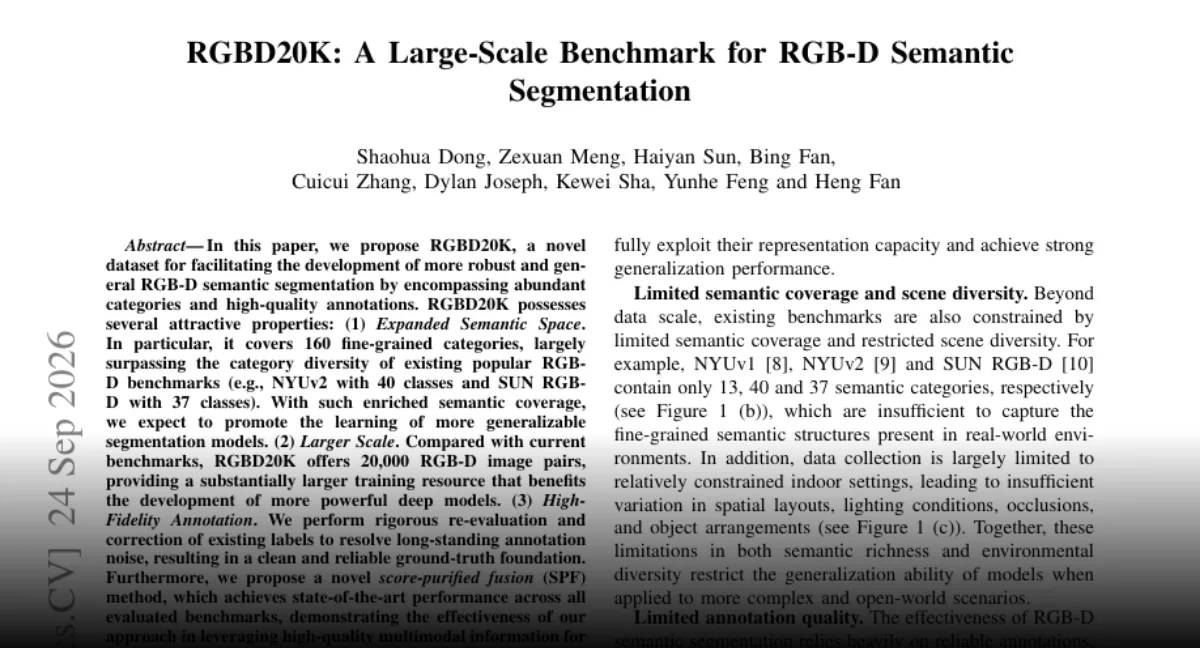
- RGBD20K is a large-scale RGB-D semantic segmentation benchmark containing 20,000 RGB-D image pairs and 160 fine-grained semantic categories.
- It tackles annotation noise by providing high-quality re-annotated ground truth, enabling cleaner supervision and fairer model evaluation.
- The paper introduces Score-Purified Fusion, a color-depth fusion method that achieves state-of-the-art performance across evaluated RGB-D benchmarks.
- The public release of the dataset, labels, and pretrained models offers researchers a concrete benchmark and reference baseline for RGB-D scene understanding.
Meta description: RGBD20K adds 20,000 RGB-D image pairs and 160 categories, plus re-annotated ground truth and Score-Purified Fusion for RGB-D semantic segmentation.
Tags: RGBD20K, RGB-D segmentation, Score-Purified Fusion, benchmark, computer vision
Featured image: abstract technology illustration of paired color and depth grids, no people, no logos, no text
RGBD20K has been introduced as a large-scale RGB-D semantic segmentation benchmark built from 20,000 RGB-D image pairs and 160 fine-grained semantic categories, while Score-Purified Fusion is presented as a method achieving state-of-the-art performance across evaluated RGB-D benchmarks. The release matters because cleaner ground-truth labels and stronger color-depth fusion are two practical bottlenecks in per-pixel scene understanding.
Background: The Need for Cleaner RGB-D Segmentation Data
RGB-D semantic segmentation pairs ordinary RGB images, which record color, with depth maps, which record distance information. A segmentation system must label each pixel with a semantic category, such as road, pedestrian, object, or background element. This task is useful for robotics, autonomous systems, and scene understanding, but it depends heavily on benchmark quality.
The benchmark problem is not only scale. If training or evaluation labels contain mistakes, models can learn incorrect boundaries, confuse nearby categories, or appear to improve because of noisy annotations rather than real generalization. The source identifies annotation noise in existing benchmarks as a specific issue that the new work aims to address.
Against that background, the project introduces RGBD20K, a large-scale benchmark for RGB-D semantic segmentation. It is designed to provide a more detailed evaluation environment for models that use both color and depth inputs. The fine-grained category structure also raises the stakes for label quality. When categories are narrow, a single ambiguous boundary or a mislabeled region can affect many adjacent pixels. Cleaner ground truth therefore supports fairer evaluation and more stable training.
Development Process: RGBD20K Expands Scale and Category Detail
The central numbers define the benchmark. RGBD20K contains 20,000 RGB-D image pairs. That scale is paired with 160 fine-grained semantic categories, which is more than a simple broad object list and allows evaluation of models that must distinguish closely related classes.
The second development step is re-annotation. The work provides high-quality re-annotated ground truth rather than relying only on existing labels. This addresses annotation noise by rebuilding the reference labels used for training or evaluation. For readers, the implication is direct: a benchmark becomes more useful when the label data itself is clearer, more consistent, and more granular.
The category count and image-pair count together indicate the intended role of RGBD20K. It is not just another dataset release; it is a testbed built around finer semantic distinction and cleaner supervision for RGB-D models.
Latest Progress: SPF Achieves Top Results Across Evaluated Benchmarks
Alongside the dataset, the work proposes Score-Purified Fusion, abbreviated as SPF. This is a fusion approach for RGB-D segmentation, meaning it combines information from color and depth modalities. The source states that SPF achieves state-of-the-art performance across evaluated RGB-D benchmarks.
That result matters because a new benchmark alone does not show whether models can use richer labels effectively. SPF is presented as the method that sets the current performance point on the evaluated benchmark suite. The public availability of both the dataset and pretrained models gives researchers a starting point for comparison, adaptation, or further evaluation.
For teams building RGB-D systems, the public dataset and pretrained models reduce the distance between idea and testing: they provide a concrete benchmark and a reference model to compare against.
The project now sits in a public research release stage. RGBD20K, its 20,000 image pairs, its 160 categories, its re-annotated ground truth, and the SPF model are positioned as available resources for RGB-D semantic segmentation work.
Comments
No comments yet. Be the first to comment.