
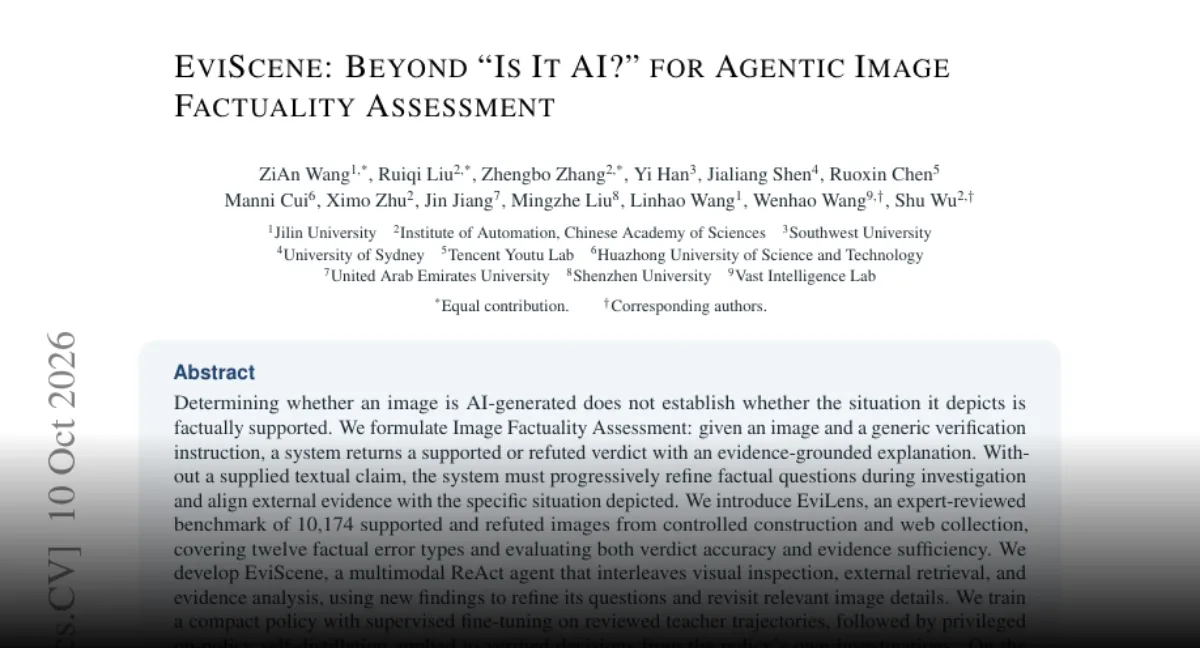
EviScene uses agents to assess image factuality rather than only asking whether an image is AI.
EviScene trains Qwen3.5-9B to inspect images, search evidence, compare findings, and verify facts, improving EviLens results.
Key Points
- EviScene verifies images directly: the AI agent receives only an image, identifies possible factual issues, and investigates them without being given a text claim.
- It builds an evidence chain using visual inspection, web search, image retrieval, and evidence comparison to support each conclusion.
- The Qwen3.5-9B agent is trained through Supervised Fine-Tuning and Privileged on-policy Self-Distillation, then evaluated on the EviLens benchmark of 10,174 images across 12 error categories.
- In tests on 1,527 images, the trained agent reached 79.05% BAcc and 52.26% SESR, improving over the baseline by 6.71 and 9.37 points and achieving the highest reported SESR among evaluated agents.
- The project is publicly available, including code, model weights, datasets, and documentation, making it a reusable pipeline for image-only fact-checking research.
Meta description: EviScene lets a Qwen3.5-9B AI verify images without text claims, using visual search, retrieval, and evidence comparison on the 10,174-image EviLens benchmark.
Tags: EviScene, EviLens, Qwen3.5-9B, Image Verification, Evidence Retrieval
Featured image: abstract technology style network linking a lens icon, search paths, and evidence nodes, with no real people, company logos, or text.
EviScene is an image-first verification approach for an AI agent. Instead of receiving a written claim to check, the agent is given only an image and must identify possible factual issues on its own. It then investigates through visual inspection, web searches, image retrieval, and evidence comparison. The method matters because it tests whether a model can build its own case, not just answer a pre-written question. For readers, the practical distinction is simple: the system is asked to look at a picture first, then decide what needs checking, rather than being handed a statement to support or refute.
Background: Starting From an Image, Not a Claim
The starting point of EviScene is deliberately narrow: the model receives only an image. There is no pre-provided textual assertion to verify. The agent must first identify issues from the visual input, then conduct investigations using four evidence activities: visual inspection, web searches, image retrieval, and evidence comparison.
This changes the verification task from matching a claim to evidence into a self-directed investigation. The capability is cultivated through two training stages named in the release: Supervised Fine-Tuning (SFT) and Privileged on-policy Self-Distillation (PSD).
Development: Building an Evidence Chain
The development process emphasizes the connection between judgment and evidence. An agent may spot a suspicious element in an image, but that observation is not enough by itself. It must gather supporting material through web searches or image retrieval, then compare that evidence with what it sees in the image.
The resulting workflow is a chain: identify a possible issue, inspect the visual details, search for related information, retrieve supporting images or pages, and compare the evidence before reaching a conclusion. The release frames this as the route used to train the Qwen3.5-9B agent.
Latest Progress: EviLens Results and Public Release
The accompanying benchmark is EviLens. It comprises 10,174 images and covers 12 categories of factual errors. Evaluation assesses both the correctness of the judgment and whether the evidence substantiates the conclusion. Success requires not only the right answer but also a solid evidentiary basis.
In the reported evaluation, the trained Qwen3.5-9B agent was tested on 1,527 images. It achieved 79.05% BAcc and 52.26% SESR. These figures are improvements of 6.71 points and 9.37 points, respectively, over the baseline agent. The release also states that the trained agent attained the highest SESR among all agents evaluated in the study.
The code, model weights, and datasets have all been made publicly available. The paper is linked at https://arxiv.org/abs/2610.14609, the code at https://github.com/wangzian828/EVISCENE, and the models and data at https://huggingface.co/ZiAnwang/EviScene. A project website is also available at https://wangzian828.github.io/EVISCENE/.
Current Stage: A Public Evidence Pipeline for Image Fact-Checking
EviScene now presents a concrete public setup for image-only fact-checking research. The trained Qwen3.5-9B agent, the EviLens benchmark, the code, the model weights, and the datasets are available, and the reported gains are tied to the 1,527-image evaluation. The next point to observe is how the released evidence-first workflow is used beyond the study's own benchmark categories and reported results.
Comments
No comments yet. Be the first to comment.