
Cloudflare's Clairic extracts data from documents more quickly and at a lower cost than LLMs
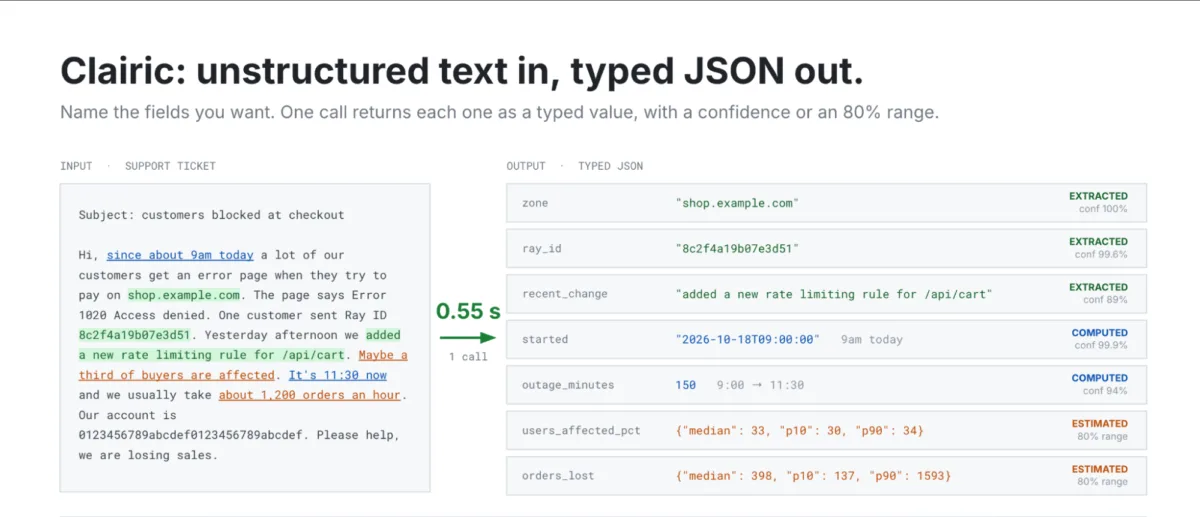
Cloudflare has previewed Clairic, a specialized AI extraction model on Workers AI. It pulls named fields from documents in a single pass, returning formatted values, confidence scores, and nulls. By focusing on structured extraction rather than chat, it can speed up agent workflows and lower costs compared with using a general LLM for every field.
Key Takeaways
- Cloudflare released Clairic, an AI model in Workers AI preview designed to extract named fields from documents faster and more cheaply than large language models, with open weights expected soon.
- Clairic works as a specialized extraction layer for agent workflows: it returns structured values, formats, confidence scores, and nulls in a single pass instead of generating text token by token.
- The model is intentionally limited: it handles unstructured text and simple calculations or forecasts, but it is not a general replacement for LLMs, and longer calculation chains should still be handled in code.
- Cloudflare shows that combining Clairic with decision and writing models can significantly reduce time and cost, using a complaint-email example that takes 19.3 seconds versus 61.7 seconds with GLM-5.3 alone.
Cloudflare has released Clairic, an AI model it says can pull named fields from documents faster and more cheaply than large language models. The model is available in preview on Workers AI, and Cloudflare says open weights are set to follow soon. For builders using AI agents, the pitch is narrow but practical: Clairic is not meant to chat. It is meant to turn messy document text into structured values that later models and code can act on.
Background: A document extraction gap in agent workflows
Agent workflows often begin with unstructured text: emails, invoices, support tickets, or scanned documents. A general large language model can read that text, but it usually produces output token by token, which can be slower and costlier when the task is mainly to locate fixed fields. Cloudflare positions Clairic as an extraction layer for these cases. Users name the fields they want, such as an order number or invoice total, and the model returns matching values in the right format along with a confidence score. If a value is missing, Clairic returns "null."
The design is deliberately limited. Clairic handles unstructured text and is intended to work as one piece of a larger agent chain. It can also perform simple calculations, estimates, and forecasts, but it is not presented as a general replacement for large language models.
Development: Single-pass field extraction in Workers AI
The key technical claim is that Clairic does not generate text token by token. Instead, it answers every requested field in a single pass. That approach matters for pipelines where speed and cost control are more important than free-form language generation. By returning values, formats, confidence scores, and nulls, Clairic gives downstream systems something machine-readable rather than prose that another model must parse.
Cloudflare says it wants Clairic to run alongside large language models and other "System One" models like Jev. In that framing, Clairic is a fast extractor, while other models or decision components handle judgment and communication.
Latest example: A complaint email chain
Cloudflare gives a concrete sequence to show how the pieces fit together. In a complaint email, Clairic first pulls out the order number, amount, and damage, then estimates the repair cost. A decision model, Clef, applies company rules to choose between a refund and a repair. GLM-5.3 then writes the reply to the customer.
The company says this chain takes 19.3 seconds. By comparison, it says GLM-5.3 alone needs 61.7 seconds for all three steps and costs almost twice as much. The example is not just about raw model speed. It is about specialization: a focused extraction model can do the repetitive field work, leaving larger language models for reasoning, policy, and natural language output.
Current limits and what to watch next
The preview still has boundaries. Cloudflare says Clairic cannot yet reliably handle longer chains of calculations. For now, developers should run those calculations in their own code. That caveat suggests the model is strongest when its role is limited: extract, format, score, and return nulls when data is absent.
The next milestone is open weights, which Cloudflare says are set to follow soon. Once available, those weights may allow closer evaluation of how Clairic behaves across document types, field schemas, and error cases. For now, the Workers AI preview gives developers a narrow extraction model aimed at a common agent bottleneck: turning unstructured documents into structured, actionable values without paying the full cost of a general large language model for every field.
Meta description: Cloudflare has released Clairic in Workers AI preview, an extraction model that returns named document fields in a single pass to speed agent workflows.
Tags: Cloudflare, Clairic, Workers AI, AI agents, document extraction
Featured image: Abstract technology graphic of a data pipeline with boxes, arrows, and confidence indicators, no real people, company logos, or text.
Comments
No comments yet. Be the first to comment.