
A miniature software layer built on lab-cultivated neurons could make AI video generation faster and more affordable
TBC, founded by two neurosurgeons, launched a commercial software adapter inspired by the behavior of lab-cultivated neurons, claiming generative video models run up to 5x faster and 80% cheaper. The neurons stay in the lab: their activity patterns are distilled into small adapters that plug into diffusion models like Oasis, improving quality and coherence without biological hardware. TBC raised $25 million and plans to serve via AWS Marketplace, though independent verification of its claims remains limited.
TBC, a startup founded by two neurosurgeons, has announced its first commercial product: a software adapter derived from the behavior of living nerve cells that it says makes generative video models up to five times faster and 80 percent cheaper to run. The company plans to run the model on AWS Trainium chips, serve it through Amazon SageMaker AI, and list it in the AWS Marketplace — though for now, only an early-access signup is available.
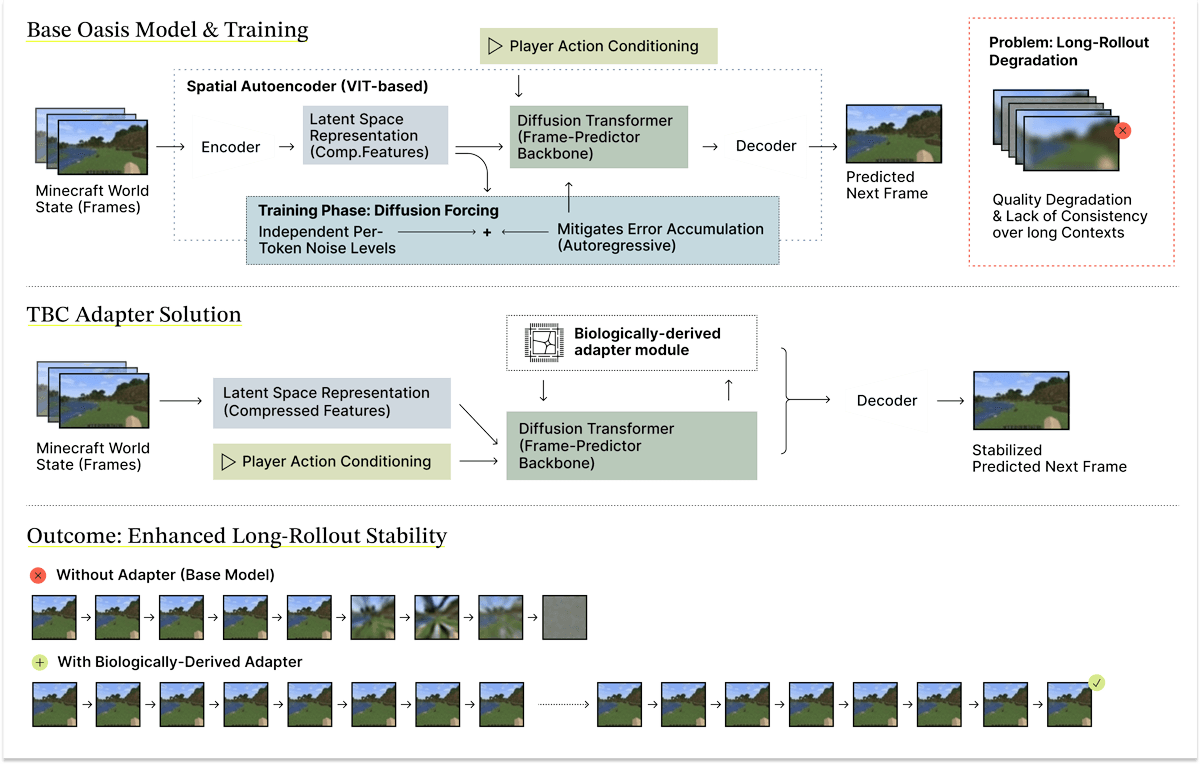
The neurons stay in the lab
Despite the company's biological branding, what TBC actually sells is ordinary software. The commercial adapter adds less than 0.1 percent to the size of the base model and runs entirely on standard AI infrastructure, requiring no biological hardware and no changes to customer workflows.
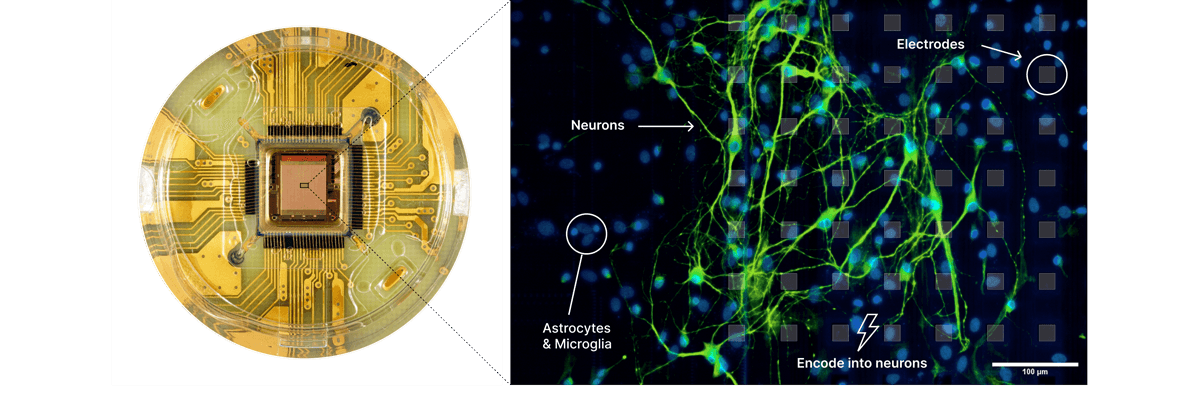
The biology lives in the development process instead. TBC grows cortical nerve cells on chips equipped with 4,096 electrodes, stimulates them electrically, and measures how activity spreads across the culture and fades over time. Those measured principles are distilled into small software modules, called adapters, that plug into existing diffusion models. The cells themselves never leave the lab.
TBC, originally called Biological Black Box, was founded by neurosurgeons Alex Ksendzovsky and Jon Pomeraniec and raised $25 million in February 2026. The company chose generative video as its entry point because that is where the hardest problems of AI inference — quality, speed, and cost — show up most clearly. Next, it aims to tackle world models and eventually let neurons compute alongside silicon.
From cell culture to software module
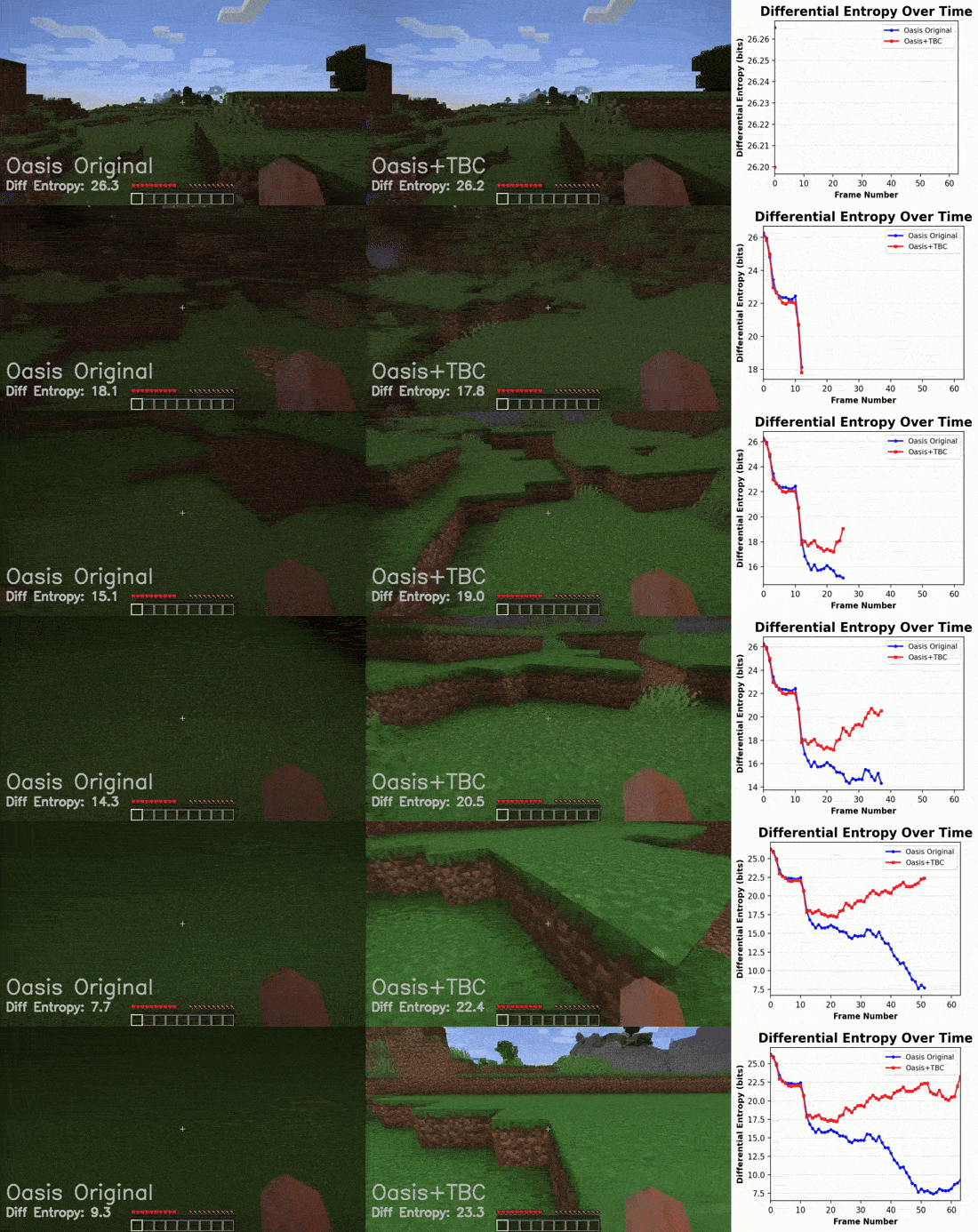
TBC detailed the path from cell chip to AI model in a blog post, using Oasis, the open Minecraft world model, as its example. Oasis is a diffusion model with roughly 600 million parameters that generates game scenes frame by frame. Because each new frame builds on the previous one, small errors accumulate until the scene dissolves into what TBC calls "washout."
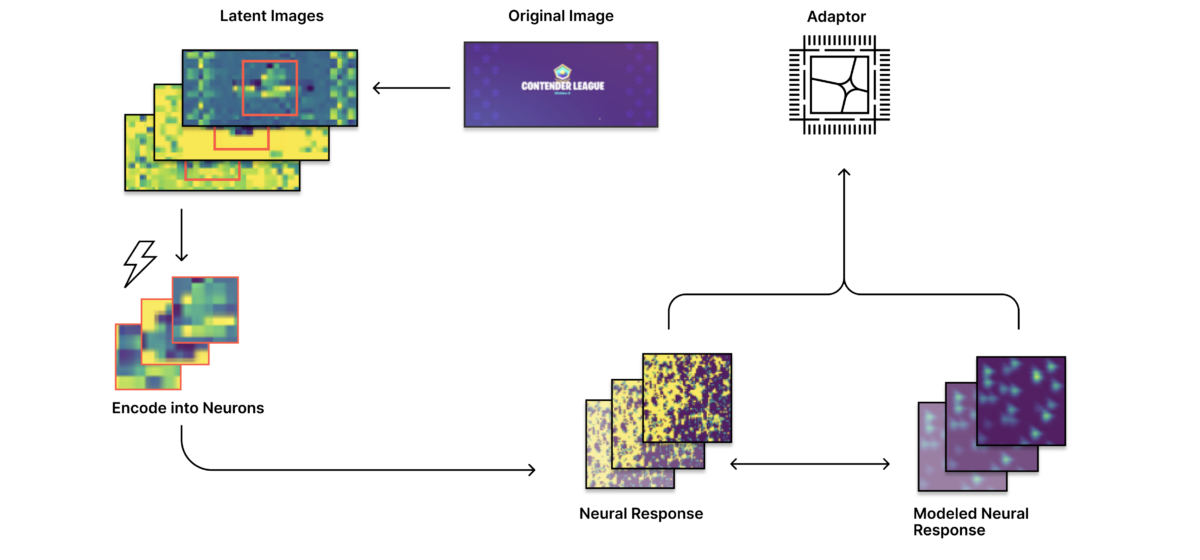
For the experiment, image data was translated into patterns of electrical pulses delivered to the nerve cell culture through specific electrodes. The neurons responded, with excitation spreading to neighboring cells before fading. TBC recorded where the network became active, how far the activity reached, and how long it lasted.
Those measurements were converted into a small module, the "Neural Dynamics Adapter," of roughly 156,000 parameters. It encodes one basic rule: activity acts mainly locally and then fades, working like a damper that holds neighboring image regions together and stops disturbances from spreading. A translation layer converts the biological pattern into the model's internal representations. The adapter was trained on Minecraft video sequences while the base model received a light fine-tuning with a low learning rate. At inference time, no cells are involved — the adapter is a fixed mathematical transformation that runs on any GPU.
The benchmark numbers
According to TBC, Oasis with the adapter retained sharp object edges and stable spatial relationships far longer than without it. Using differential entropy — roughly a measure of how much visual information a frame holds before blurring — the adapter variant scored about 19 percent better than the original across ten test videos, about 15 percent better than same-sized conventional fine-tuning, and about 5 percent better than a LoRA adaptation.
In a follow-up project, TBC built a larger adapter with roughly three percent extra parameters and pushed frame rates from about two to just under ten frames per second. The speed gain came not from the adapter itself but from cutting compute steps per frame without the usual quality collapse. An independent test by infrastructure provider Bluesky Compute in July found about 4.4 times lower inference costs and more than three times as much coherent video as the base model.
Plenty of numbers, little proof
Details for the commercial model remain scarce: TBC has not named the base model, hardware, resolution, clip length, or quality metric behind its headline claims. Notably, five times faster and 80 percent cheaper are mathematically the same statement — if you need a fifth of the GPU time, you save 80 percent — suggesting one effect expressed in two units rather than two breakthroughs.
It also remains untested whether the biological detour outperforms purely digital techniques like distillation or caching; no controlled comparison on the same base model has been published. TBC's deeper argument is not that neurons compute better than chips, but that they point to algorithms no one would have discovered at a desk. Whether that holds up can't yet be judged from the available data.
Comments
No comments yet. Be the first to comment.