
Meta Avoids Billions in U.S. Taxes by Labeling Its AI Data Centers as Experiments
Meta labels AI data centers and Nvidia chips as experimental, using a research tax credit to save $3.9 billion in 2025 amid legal risk.
Key Takeaways
- Meta used a U.S. federal research tax credit to save $3.9 billion in 2025 by classifying large AI data centers as pilot models and Nvidia chips as experimental materials.
- The tax savings grew rapidly alongside Meta’s AI expansion, from $700 million in 2023 to $2 billion in 2024 and $3.9 billion in 2025.
- The strategy conflicts with Meta’s public positioning of AI infrastructure as central to its business and superintelligence ambitions, not merely experimental projects.
- Meta’s own SEC filings acknowledge legal risk, and its uncertain tax position reserves rose 45 percent to $18.74 billion.
- The story highlights how a 1981-era research credit, intended for knowledge-based experimentation, is being applied to massive, business-critical AI infrastructure.
Meta’s use of a federal research tax credit has turned large AI data centers and Nvidia chips into tax-saving assets, according to the New York Times. The company saved $3.9 billion in 2025, making it the biggest beneficiary among publicly traded companies. That figure rose from $2 billion the year before and $700 million in 2023. The classification of facilities as "pilot models" and chips as experimental materials creates a widening gap between Meta’s SEC filings and its public promise to build superintelligence infrastructure.
Background: A 1981 Credit Meant for Experimentation
The federal research tax credit dates back to a 1981 law. James Shannon, the congressman who introduced it, told the New York Times that the credit was meant for "people power, knowledge, information." He said Meta's use has "gone way, way beyond what anybody could have imagined." The original purpose was tied to knowledge and information rather than the scale of Meta's current build-out. In Meta's filings, Nvidia chips are described as experimental materials and AI data centers as pilot models. Meta classifies these massive facilities as pilot models for tax purposes.
Development: From $700 Million to $3.9 Billion in Savings
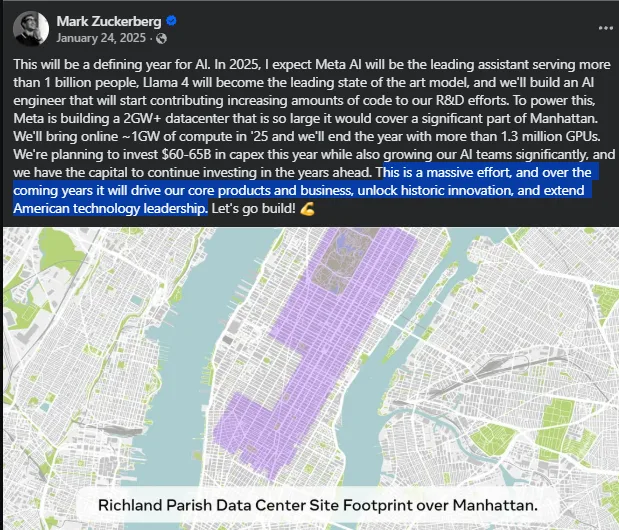
The savings moved in parallel with Meta's public AI build-out. In January 2025, Zuckerberg announced plans for a 2 GW+ data center so large it would cover a significant part of Manhattan, while also saying these data centers would "drive our core products and business." Later, in July 2025, he announced plans to "invest hundreds of billions of dollars into compute to build superintelligence," anchored by several multi-gigawatt clusters. The first, Prometheus, is already partly online, and a second, Hyperion, is supposed to scale to 5 GW over several years. "We have the capital from our business to do this," Zuckerberg wrote last summer.
During the same period, Meta's tax benefit grew from $700 million in 2023 to $2 billion the next year and $3.9 billion in 2025. The company defends the practice by pointing to $200 billion spent on R&D over the past five years.
Latest: Massive Compute Clusters and Legal Risk
By June 2026, Meta was openly detailing its massive compute infrastructure, including partnerships with Nvidia, AMD, AWS, Arm, and Broadcom, alongside its own custom MTIA chips. None of this sounds like an experiment. Meta's own accountants have flagged the strategy as legally risky. In SEC filings, the company warns the savings could be challenged, and reserves for uncertain tax positions jumped 45 percent to $18.74 billion.
EY, Meta's auditor, approved the strategy. The firm also helped Meta set up the strategy. Even if the IRS claws back the money, Meta likely still comes out ahead because the capital was put to work in the meantime, boosting its stock price. For readers, the story is less about a single credit than about how a 1981 law is being applied to infrastructure commitments that Meta has described as central to its business. The next test will be whether the pilot-model label can survive review when the facilities are described as powering core products and public AI plans.
Meta description: Meta saved $3.9 billion in 2025 by using a federal research tax credit for AI data centers and Nvidia chips, raising questions about legality and risk.
Tags: Meta, AI data centers, research tax credit, Nvidia, tax risk
Featured image: Abstract glowing server racks and fiber-optic light paths, no people, no company logos, no text.
Comments
No comments yet. Be the first to comment.