
This dashboard tracks how many jobs your state is losing to AI and the cost of those layoffs.
Center for AI Safety dashboard estimates 117,000 AI-linked layoffs and $8.5 billion annual wage losses, noting state impacts and limitations.
Key Takeaways
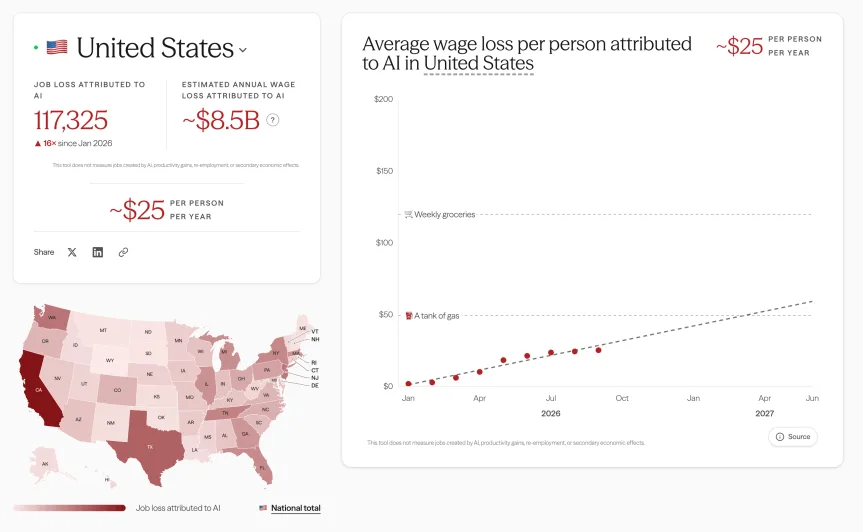
- The Center for AI Safety’s Wage Loss Dashboard estimates that AI-attributed layoffs have caused about $8.5 billion in annual wage losses nationwide, or roughly $25 per person, based on more than 117,000 AI-linked job cuts this year.
- The impact varies widely by state, with tech-heavy California showing about $56 in estimated annual wage loss per person, compared with about $14 in Alaska.
- The dashboard uses company-reported AI-attributed layoffs plus wage and population data to estimate losses, but it does not count jobs created by AI, productivity gains, re-employment, or broader economic effects.
- It also tracks rising AI agent capability on the Remote Labor Index, where the share of remote freelance tasks completed at professional quality rose from 2.5% to 15.8% in eight months.
- CAIS frames the tool as a way to make AI adoption costs visible to workers, communities, and policymakers, with the key signal being the trend rather than any single estimate.
The Center for AI Safety's Wage Loss Dashboard puts a dollar figure on AI-attributed job cuts for the first time, estimating $8.5 billion in annual wage losses and $25 per person nationwide.
Fears about AI's effect on employment have been building for years, fueled by steady layoffs at major companies and, in some cases, explicit statements tying job cuts to AI adoption. The Center for AI Safety (CAIS) has tried to move that conversation from anxiety to arithmetic with its Wage Loss Dashboard, which converts announced layoffs into estimated annual wage losses for households and communities.

From headlines to hard numbers
The dashboard combines several data sources: monthly layoff reporting from Challenger, Gray, and Christmas, which tracks US job cut announcements by state and flags cuts that companies themselves credit to AI; annual mean wage data from the Bureau of Labor Statistics; and population estimates from the US Census Bureau.

The core calculation is straightforward. CAIS multiplies the number of AI-attributed job cuts by the average annual salary to estimate annual wage loss. The dashboard also divides that figure by state population to produce an estimated loss per person, presented alongside everyday expenses such as a tank of gas.

As of the latest update, which added September data, the dashboard counts just over 117,000 AI-attributed job cuts nationally this year, translating to an estimated $8.5 billion in annual wage losses. For the country as a whole, that works out to $25 per person per year.

A state-by-state picture
The national average masks wide variation. California, with just over 27,000 layoffs attributed to AI, shows an estimated loss of $56 per person. Alaska, by contrast, records only 138 such job losses and $14 per person.

Those figures are estimates, not observed counts. CAIS explains its method directly: "The dashboard estimates AI-attributed cuts for each state, converts them to estimated annual wage loss, then divides by state population to estimate the average loss per person. State estimates are not observed AI layoffs. We apply each month's national share of cuts citing AI to that state's announced job cuts."

The per-person metric is intended to capture the ripple effect of layoffs beyond those directly affected. As CAIS researchers put it, "One person's layoff means less income for every business they support. Multiply that effect across thousands of workers in multiple industries, and you start to see the real economic weight of AI displacement." The dashboard's designers also note that AI-attributed cuts are not spread evenly, with states that have large tech and media sectors experiencing greater impact.

The limits of the data
CAIS is candid about what the dashboard does not capture. It excludes jobs created by AI, productivity gains, re-employment, and secondary economic effects. That omission reflects a genuine lack of consensus among experts on whether, or how much, AI will stimulate the economy or outpace job displacement.

The underlying layoff data are also murky. The dashboard counts only job cuts that companies themselves linked to AI, and without a shared definition of what that means, or full transparency from employers, it is not always possible to prove that a given layoff resulted directly from AI-driven obsolescence or replacement.
The Alliance for Secure AI, which runs a separate tracker called Jobloss.ai, describes its own standard as deliberately moderate: "We don't require an executive to say 'we replaced a team with AI.' This is a moderate standard, deliberately: it captures the broad pattern of AI-justified workforce reductions while excluding clearly unrelated cuts." Jobloss.ai logs only layoffs meeting certain criteria, such as at least 100 jobs cut at once alongside some mention of AI or proxy terms like "automation" and "productivity."
CAIS frames the project as a tool for visibility rather than blame. "AI is a technology being adopted by companies for many reasons," the organization wrote. "Our goal is to make the costs of that adoption visible, so workers, communities, and policymakers can respond with real information instead of guesses."
In 2025, Challenger, Gray, and Christmas reports identified over 54,000 job cuts that companies publicly linked to AI, equivalent to one in 20 layoffs that year.
Agents are getting better at remote work
The dashboard also tracks how capable AI agents have become at remote freelance tasks, using the Remote Labor Index (RLI), a benchmark CAIS co-developed that tests agents on real-world work such as web development and video production.
The trajectory is steep. "When RLI launched, the best AI agent completed just 2.5% of projects at professional quality. Eight months later, that number has risen to 15.8%," researchers wrote. That means AI can now fully automate almost 16% of remote tasks, a share that is doubling every 3.7 months. Claude Fable 5 ranks first, followed by OpenAI's GPT-5.5.
The RLI measures what models are capable of, not what they are actively taking on, so the figure does not mean AI is absorbing those projects from human freelancers. Still, CAIS says it remains alarmed by the convergence of AI-attributed job cuts and increasingly work-capable agents.
Legislation cannot outright stop companies from choosing AI systems over human hires in many cases, but recent laws in a few states, including the tech-heavy state of California, aim to ensure that firing and other disciplinary decisions are not left entirely to automated systems.
What to watch
The dashboard's value lies less in any single number than in the trend line. With AI-attributed cuts already numbering in the tens of thousands this year and agent capability doubling roughly every four months, the coming updates will show whether wage losses keep climbing and whether the states with the heaviest tech and media concentration continue to absorb the largest share. The open question CAIS cannot answer is the one that matters most: how many of these losses will be offset by jobs and productivity gains that no tracker is yet measuring.
Comments
No comments yet. Be the first to comment.