
Crusoe scraps its $1.25 billion project to deploy Boom turbines for AI data center power
Crusoe, a Denver-based AI data center developer that recently raised $3.9 billion, has abandoned a $1.25 billion deal to buy 29 Superpower gas turbines from Boom Supersonic. Boom's turbine side business, launched to fund its supersonic jet program, was meant to deliver power starting 2027. Crusoe said turbines no longer fit its near-term energy mix at its Abilene campus, where it now mixes grid power, gas, and renewables. Boom says other customers remain, targeting 250MW next year and 1GW by 2028.
Key Takeaways
- Crusoe, an AI data center developer that recently raised $3.9 billion, has canceled a $1.25 billion deal to buy 29 stationary gas turbines from Boom Supersonic, its launch customer agreement for Boom's "Superpower" turbine business.
- Boom had launched the Superpower turbine — sharing about 80% of parts with its Symphony jet engine — as a revenue stream to fund its Overture supersonic passenger jet while the aircraft was still awaiting certification.
- Boom CEO Blake Scholl said the split happened because turbines are no longer part of Crusoe's near-term primary power mix at its Abilene, Texas campus, while insisting Boom still has other buyers, with ~250MW of deliveries planned next year and a 1GW target for 2028.
- Crusoe's power strategy has shifted: its 1.2GW Abilene facility for Oracle/OpenAI runs primarily on grid power (turbines reserved for backup), while a separate 900MW Microsoft data center will use on-site gas turbines — reflecting a site-by-site energy sourcing approach.
- The cancellation is a setback for Boom's turbine-funding strategy for its jet program, while Crusoe continues to diversify energy sources across its expanding AI data center portfolio, including turbines, wind, solar, batteries, and the grid.
Crusoe, the Denver-based AI data center developer that recently raised $3.9 billion, has walked away from a $1.25 billion deal to buy stationary power turbines from fellow Denver company Boom Supersonic — a blow to the power business Boom had positioned as a funding stream for its supersonic jet program.
How the Deal Came Together
Boom Supersonic, best known for developing the Overture supersonic passenger jet, launched a side business last year: a natural gas-fired stationary turbine called Superpower. The turbine shares roughly 80% of its parts with Symphony, the engine Boom is building for Overture. The idea was to sell power generation hardware on the path to certification of the aircraft, with profits from the turbine business flowing back into jet development.
To commercialize that plan, Boom raised $300 million last year. Crusoe signed on as the launch customer, committing $1.25 billion for 29 of Boom's 42-megawatt Superpower turbines, with first deliveries expected in 2027.
What Went Wrong
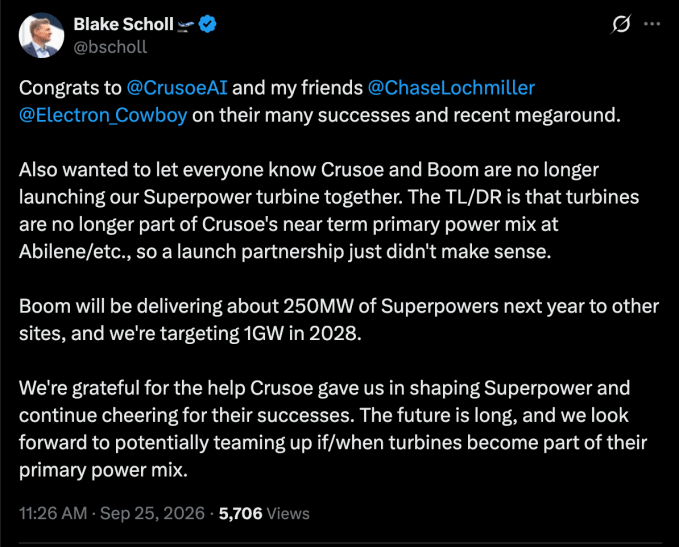
Boom CEO Blake Scholl confirmed the split in a Friday post on X, where he congratulated Crusoe founders Cully Cavness and Chase Lochmiller on the company's recent raise before explaining the break.
"The TL/DR is that turbines are no longer part of Crusoe's near term primary power mix at Abilene/etc., so a launch partnership just didn't make sense," Scholl wrote. He stressed that Boom has other buyers lined up: "Boom will be delivering about 250MW of Superpowers next year to other sites, and we're targeting 1GW in 2028."
Crusoe confirmed the end of the partnership through spokesperson Andrew Schmitt, who said the company stays "flexible, choosing the energy solutions that are right for each site" — including turbines, wind, solar, batteries and the grid — but that "the partnership isn't the right fit today."
Why Crusoe's Power Plans Shifted
The decision tracks with how Crusoe's Abilene, Texas campus — one of the largest AI data center projects in the country, supplying computing power to OpenAI — has evolved. The initial 1.2 gigawatt facility, built for Oracle and OpenAI, runs on grid power, with a gas-turbine plant reserved for backup only. Meanwhile, Crusoe is building a separate 900 megawatt data center in Abilene for Microsoft that will use on-site gas turbines for primary power.
Founded in 2018 as a bitcoin miner running on excess natural gas from oil fields, Crusoe has grown into one of the biggest AI data center builders, and its energy sourcing now varies by site rather than depending on any single supplier.
Where Things Stand
For Boom, losing its launch customer is a setback just as the Superpower business was meant to scale — though Scholl says roughly 250 megawatts of deliveries to other sites remain on track for next year, with a 1 gigawatt target for 2028. For Crusoe, the split signals a broader mix of energy sources across its expanding campus portfolio. Scholl could not be reached for further comment before publication.
Comments
No comments yet. Be the first to comment.