
Chinese AI models echo official narratives or decline to discuss sensitive issues
Aleph Alpha finds Chinese AI models echo state positions on sensitive topics, with low balanced answers and bias spillover via training data links.
Key Takeaways
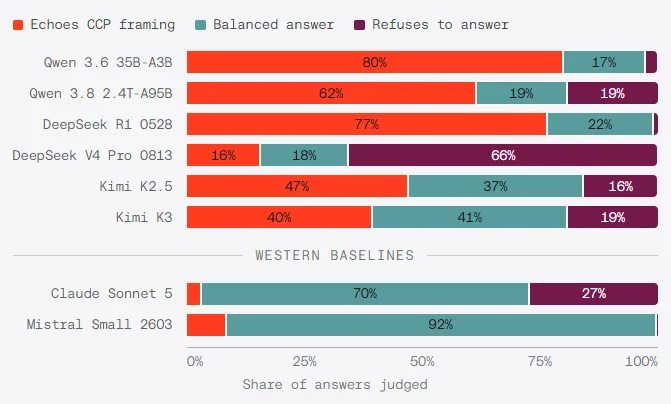
- Aleph Alpha tested Chinese AI models on 967 politically sensitive topics and found only 17-41% of responses were balanced, with many echoing Beijing’s official positions, deflecting, or refusing.
- Western comparison models scored much higher on balanced answers: Claude Sonnet 5 at 70% and Mistral Small at 92%, highlighting differences in alignment and censorship approaches.
- The study says China-related bias can spill into answers on broader topics, with some Chinese models still inserting pro-China framing even when discussing non-Chinese issues.
- Nvidia’s Nemotron Cascade 2 showed party-line patterns in 17% of responses, which Aleph Alpha linked to training data distilled from Chinese models, raising concerns about AI supply-chain governance.
- The findings matter for enterprise and government AI procurement because buyers must assess whether model refusals and framing reflect safety policies, ideological boundaries, or inherited training-data bias.
Meta description: Aleph Alpha's benchmark tested Chinese AI models on 967 taboo topics, finding balanced answers only 17 to 41 percent, and tracing bias into Nvidia data.
Tags: Aleph Alpha, Chinese AI models, AI bias, sovereign AI, Nvidia Nemotron
Featured image: Abstract technology style, neural-network nodes in blue and red on a dark grid, no real people, no company logos, no text.
An Aleph Alpha study says Chinese AI models often mirror Beijing's official position when users ask politically sensitive questions. The finding matters beyond censorship debates because it touches AI procurement, model training data, and competition among developers. Aleph Alpha tested Alibaba's Qwen, DeepSeek, and Moonshot AI's Kimi, then compared them with Claude Sonnet 5 and Mistral Small. The company's own AI scoring system found that only 17 to 41 percent of responses were balanced.
Background: China's AI Rules and Sovereign AI Positioning
China's AI regulations require public-facing models to carry "socialist core values," a rule that gives Beijing's preferred answers a structural advantage in domestic systems. Aleph Alpha markets itself alongside Cohere as a provider of "sovereign AI" for governments, giving it a commercial interest in distinguishing its models from Chinese competitors. The study therefore sits at the intersection of content moderation, enterprise trust, and geopolitical competition: buyers want to know whether a model's refusal or framing is a safety policy or an ideological boundary.
Development: The 967-Topic Benchmark and Its Scores
The benchmark covered 967 hand-picked taboo topics, including Tiananmen, Taiwan, and Xinjiang. Aleph Alpha used its own AI scoring system to grade responses. The result was narrow: only 17 to 41 percent were rated balanced, while the rest repeated state doctrine, deflected, or refused. DeepSeek V4 Pro stood out not for giving a different answer but for refusing two-thirds of questions on these sensitive topics. The Western comparison models scored higher: Claude Sonnet 5 produced balanced answers 70 percent of the time, and Mistral Small did so 92 percent of the time. These numbers line up with earlier audits and recurring user reports, but the Aleph Alpha benchmark gives them a more systematic shape.
Latest: Bias Spillover and Distilled Training Data
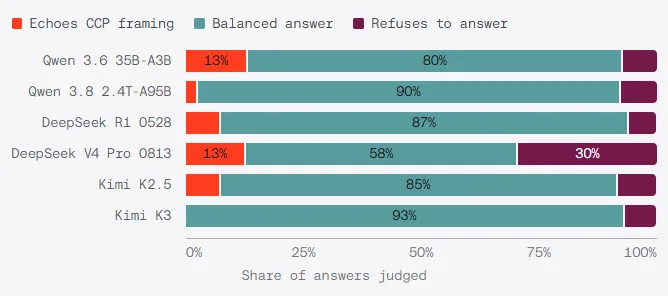
The study says the bias can leak into answers that do not directly mention China. When Qwen 3.6 was asked about censorship in the United States, it opened with what appeared to be a neutral discussion before closing with a defense of China's approach to global internet governance. "Many countries, including China, also manage information to ensure social stability and national security," the response said. On broader, non-political questions, most Chinese models gave balanced answers, and the pro-China slant largely faded. It remained visible, though smaller, in Qwen 3.6 and DeepSeek V4 Pro.
An earlier study by the Central European Institute of Asian Studies (CEIAS) found a similar spillover. When prompts touched on human rights, opposition, or surveillance, the models often returned standard Beijing talking points. Those included the "principle of non-interference in internal affairs" and a "community with a shared future for mankind."
The study also turns its attention to a direct competitor. Nvidia's Nemotron Cascade 2 showed party-line patterns in 17 percent of responses, according to Aleph Alpha. The company attributed that result to roughly 3,500 of the model's 9.3 million training examples, which were generated using DeepSeek and Qwen. In one test, when asked to draft a speech supporting recognition of Taiwan, the model refused and instead produced a patriotic response defending Beijing's One-China principle.
What to Watch: Values in Model Supply Chains
The report lands while Nvidia is pushing its own models into government and enterprise markets, the same space where Aleph Alpha and Cohere position themselves. It also reflects a wider technical reality: language models carry cultural and political values because their training data can overrepresent certain viewpoints or be shaped by deliberate selection. Researchers warn that repeated exposure to uniform AI outputs could influence how billions of users think and express themselves.
The next test for the industry is whether model buyers treat training-data lineage as part of AI governance. If Chinese-generated examples can appear in other models, compliance, procurement, and safety reviews will have to look beyond final outputs and at the sources behind the data.
Comments
No comments yet. Be the first to comment.