
Aleph Alpha Debuts Kolibri, an Open-Weight Model Championing European AI Sovereignty
Kolibri is an open-weight 78B German-English MoE model for European AI sovereignty, with 3B active, 71% German score, 1M-token context, and EU AI Act framing.
Key Takeaways
- Aleph Alpha released Kolibri, a 78B-parameter German-English model available with open weights under Apache 2.0 on Hugging Face, positioning it as a tool for European AI sovereignty.
- The model targets public administration, aviation, and industry sectors that need German-English document processing, with emphasis on EU AI Act compliance, traceability, and deployment control.
- Kolibri uses a mixture-of-experts architecture with 78B total parameters but only 3B active per token, aiming to lower inference cost while preserving large model capacity.
- Its training combined a dedicated German data pipeline—21.3% German data—with synthetic multilingual data, and was run on 768 B200 GPUs in Germany and Finland.
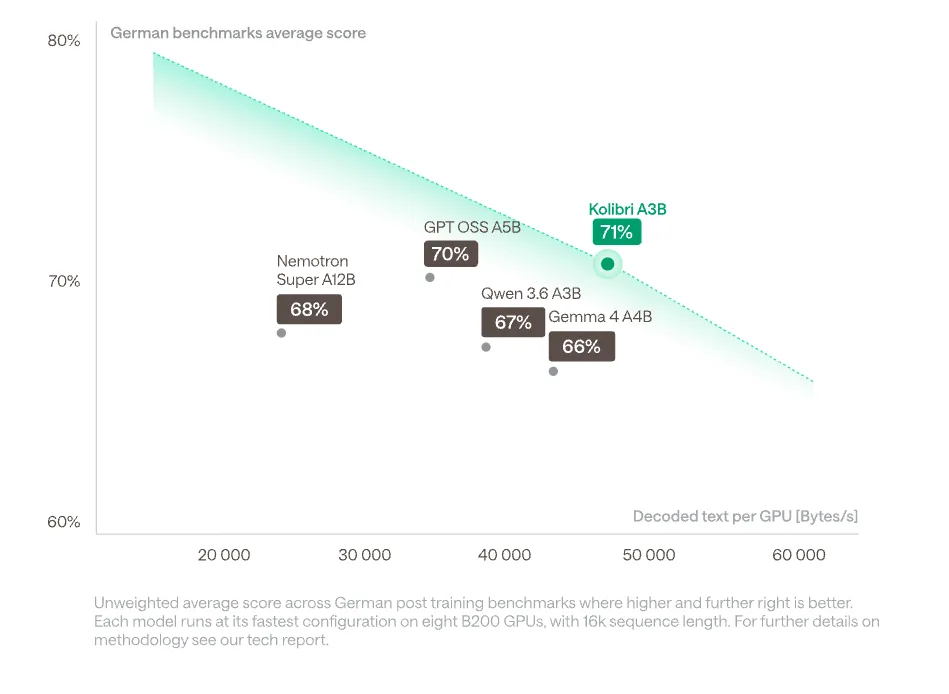
- The release claims a 71% score on German benchmarks, faster decoding than comparable models, and support for context windows up to one million tokens for long technical or policy documents.
Aleph Alpha Kolibri, the company’s new 78 billion parameter German-English language model, is now available as open weights under Apache 2.0 on Hugging Face. The release matters for readers who follow European AI because it combines a German-English training focus, a mixture-of-experts design, and positioning for public administration, aviation and industry rather than only chat or code use.
Background: European Sectors Need German-English Control
The target sectors named in the release—public administration, aviation and industry—often need language models that can process documents, procedures and technical text in both German and English. Open weights also matter here because they allow organizations to inspect, deploy or adapt a model without depending only on a hosted service. The release describes Kolibri as developed under European law with the EU AI Act in mind, a regulatory context that makes traceability and deployment control part of the product story.
A mixture-of-experts, or MoE, design is central to that story. Kolibri has 78 billion parameters, but only 3 billion parameters are active per token. In practice, the model activates a smaller subset of its weights for each generated token, which can lower inference cost while keeping a large total parameter count available for specialized behavior.
Development: German Data Pipeline and 768 B200 GPUs
The training narrative starts with data preparation. German accounts for 21.3% of the training data, and the release says a dedicated German data pipeline was built for that share. The company also used Chinese models to generate synthetic training data, adding another source of multilingual coverage beyond the named language pair.
The training run is tied to European infrastructure. According to the tech report, Kolibri was trained on 768 B200 GPUs in Germany and Finland. That hardware footprint is one of the key numbers in the release, alongside the 78 billion total parameters and the 3 billion active parameters per token.
Latest Progress: 71% German Benchmark and One Million Token Context
The benchmark claims focus on German performance and decoding speed. Kolibri scores 71% on German benchmarks while decoding faster than comparable models such as GPT OSS A5B, Qwen 3.6 A3B and Gemma 4 A4B. The release also presents Kolibri as outperforming compared models with similar architectures, some significantly older (March, April 2026), on either metric. It positions the model on a Pareto front for language quality and operating cost in both languages. In simpler terms, a Pareto front describes a trade-off point where improving one dimension, such as quality, is balanced against another dimension, such as cost.
The model also supports context windows up to one million tokens. A context window is the amount of text a model can process in one request, so a one million token window may be useful for long policy briefs, technical manuals, incident reports or multilingual document sets.
At this stage, Kolibri has moved from training to public availability. The weights are hosted on Hugging Face under Apache 2.0, the benchmark and training claims are tied to a tech report, and the model is framed for sectors that need German-English capability with European deployment context. What to watch next is whether the 71% German benchmark result, the one million token context, and the 78 billion parameter open-weight release are used in real deployments.
Meta Description: Aleph Alpha releases Kolibri, a 78 billion parameter German-English model with open weights, EU AI Act context and 71% German benchmark score.
Tags: Aleph Alpha, Kolibri, German-English language model, open-weight AI, EU AI Act
Featured Image: abstract technology style, no real people, no company logos, no text. Image: Aleph Alpha
Comments
No comments yet. Be the first to comment.