
Google Says EmbeddingGemma 2 Beats Rival Embedding Models Twice Its Size
EmbeddingGemma 2 compresses multimodal embedding into 740M parameters, delivering faster code retrieval and offline RAG with a tiny local footprint.
Key Takeaways
- Google’s EmbeddingGemma 2 is a 740-million-parameter multimodal embedding model that converts text, images, video, and code into vectors for semantic search, retrieval, and RAG.
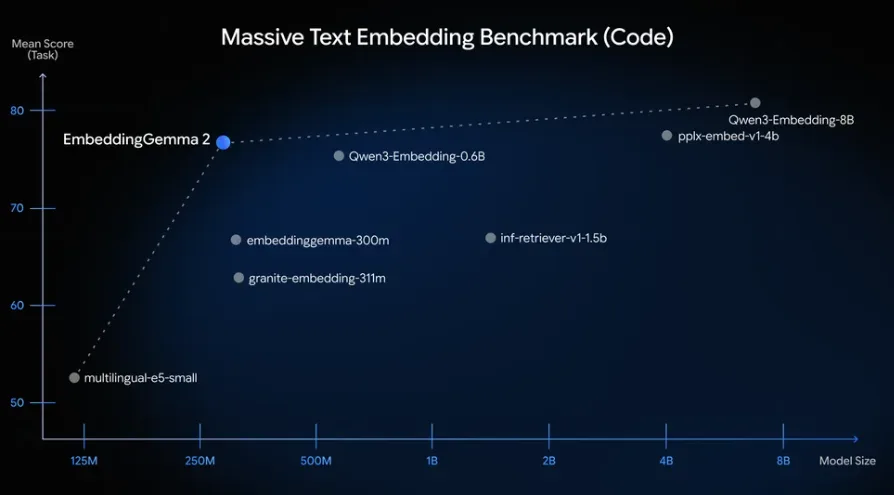
- The company says it outperforms rival embedding models up to twice its size on multimodal benchmarks, scoring 78.68 on the Massive Text Embedding Benchmark for code retrieval.
- It is designed for local and browser-based use, running without an API key, needing about 191 MB of RAM, and taking roughly 20 to 70 milliseconds per query through WebGPU.
- The model can support offline RAG pipelines with small open models such as Gemma 4, and Google says it can reduce local vector database storage by up to six times.
- It is currently at the developer-adoption stage, with weights available on Hugging Face and Kaggle, while a 270-million-parameter text-only version is suggested for lighter retrieval tasks.
Google EmbeddingGemma 2 Puts Multimodal Search Into 740 Million Parameters
Meta description: Google EmbeddingGemma 2 turns text, images, video, code into local vectors, with 740 million parameters, 191 MB RAM, and offline RAG support.
Tags: EmbeddingGemma 2, Google, local embeddings, multimodal search, offline RAG
Featured image: Abstract technology style with vector embeddings linking text, image, video, and code nodes, no real people, no company logos, no text
Background:
EmbeddingGemma 2 enters a retrieval stack where text, images, video, and code are first turned into numerical vectors, or embeddings, so machines can compare meaning rather than exact wording. Because embeddings represent content as coordinates, a query can be compared with stored items by distance, which is how semantic search finds relevant results even when wording differs. That comparison step sits beneath search, recommendation, duplicate detection, code assistance, and retrieval-augmented generation, or RAG, a pattern that fetches relevant context before a language model answers. Historically, stronger multimodal embedding models have demanded more storage, more memory, and server-side inference, which makes local deployment harder for browsers, laptops, and privacy-sensitive apps. Google's release targets that tradeoff: an open model that converts text, images, video, and code into numerical vectors while keeping the footprint small enough for local use.
Development:
The headline number is 740 million parameters. Google describes EmbeddingGemma 2 as the most compact model of its kind, and says it outperforms competing models up to twice its size on multimodal embedding benchmarks. The benchmark result gives the claim a concrete shape: EmbeddingGemma 2 scores 78.68 on the Massive Text Embedding Benchmark (Code), nearly 10 points above the predecessor's 68.76 score. The source says that places it on par with much larger models. For code-heavy retrieval, that benchmark category matters because developers often search across function definitions, documentation snippets, and project history. For developers, that combination matters because smaller embedding models reduce the cost of storing and querying vectors, while stronger code-related retrieval can support tools that search across repositories, documentation, and mixed media.
Latest progress:
The release is most notable for what it can do outside a cloud service. EmbeddingGemma 2 runs locally without an API key, and each query takes about 20 to 70 milliseconds through WebGPU in a browser. WebGPU is the browser interface that lets web applications use a device's graphics processing power for compute tasks. The model needs around 191 MB of RAM, and Google says it can cut local vector database storage by up to six times. For text-only tasks, the source says a 270-million-parameter version is sufficient. The model can also be paired with small open models such as Gemma 4 to run offline RAG apps, meaning retrieval and answer generation can stay on-device instead of sending data to external servers. The weights are available on Hugging Face and Kaggle, along with a developer guide and documentation.
Current stage:
EmbeddingGemma 2 is now at the developer-adoption stage rather than the consumer-product stage. It offers a compact open route for multimodal embeddings, local search, and offline RAG pipelines, especially where memory, storage, and privacy are constraints. The numbers that matter next are whether the 20 to 70 millisecond browser latency holds on varied hardware, whether the 191 MB memory figure and 6-times storage reduction translate into smoother local apps, and whether the 270-million-parameter text-only variant becomes a practical default for smaller retrieval tasks.
Comments
No comments yet. Be the first to comment.