
Google debuts Flash TTS models that let you create custom AI voices simply by describing them in text
Google has launched two new text-to-speech models, Gemini 3.8 Flash TTS and Flash-Lite TTS. Flash TTS creates custom voices from text descriptions, while both models support 100+ languages, per-line performance directions, and two-voice dialogue. Voice cloning requires just 30 seconds of audio plus consent, and all output carries SynthID watermarks. Available via Gemini API and Google AI Studio, pricing starts at $0.54 per hour of audio, with enterprise access and a Voice Remixing feature planned.
Google has unveiled two new text-to-speech models, Gemini 3.8 Flash TTS and Gemini 3.8 Flash-Lite TTS, expanding its lineup of speech generation tools. Flash TTS can synthesize entirely new voices from text descriptions, and both models handle over 100 languages while allowing users to insert performance directions into individual lines of dialogue. The launch signals Google's push to compete in the fast-growing market for expressive, controllable AI audio.
Design custom voices from a text description
Gemini 3.8 Flash TTS is aimed at creative work such as game characters, audiobooks, and podcasts, while Flash-Lite TTS targets inexpensive speech generation at scale for dubbing, audio content, and voice agents, according to Google.
With Flash TTS, users can build voices from scratch: a text prompt can specify a voice's role, accent, and vocal characteristics across many languages and dialects. For those who prefer not to start from zero, Google provides a library of more than 2,000 preset voices, including regional variants like Mexican Spanish, Quebec French, and Scottish English.
A voice cloning option can construct a voice profile from just 30 seconds of audio. To activate it, the person whose voice is cloned must record a spoken consent statement, and the voice in that recording must match the sample. Google also notes that every clip generated by its Gemini audio models carries an inaudible SynthID watermark to help identify AI-generated speech.
Google has additionally announced "Voice Remixing," which will let users modify the timbre, pitch, tempo, and accent of library voices, though the feature is not yet live.
Script directions shape dialogue and delivery
Both models accept per-line directions, or can interpret script cues on their own. Google says the models can produce hours of audio with minimal "speaker drift," meaning the voice stays consistent over long recordings. A two-voice mode generates dialogue from a single script while keeping the two speakers distinct. Users can also script laughter, sighs, and sounds like "mhm" to place reactions and pauses precisely.
In two hands-on tests using a preset voice with a style prompt describing an annoyed Berliner speaking English with a heavy German accent, the style controls produced a convincing accent and intonation. However, both tests showed a high-pitched whine in the background at points, and in one, the voice changed toward the end of the clip.
Rollout begins, enterprise API access to follow
Both models are now available through the Gemini API and Google AI Studio. Flash TTS also appears in Gemini Notebook, and Flash-Lite TTS in Google Vids. Access via the Gemini Enterprise API is expected soon for both. Developer platforms including Agora, LiveKit, Pipecat, and Vercel already support integration through the Gemini API, though Google has not yet listed regional endpoints for the new models; earlier TTS models offered EU data processing.
On pricing, data from the free tier is used to improve Google's products, while paid-tier data is not. Billing is in US dollars per million tokens, with text tokens charged for input and audio tokens for output. One second of generated audio equals 25 audio tokens, putting an hour of audio at 90,000 tokens. Through the end of 2026, an hour of audio output costs $0.81 with Flash TTS and $0.54 with Flash-Lite TTS. From January 1, 2027, those rates rise to $1.62 and $1.08 respectively, with text input billed separately.
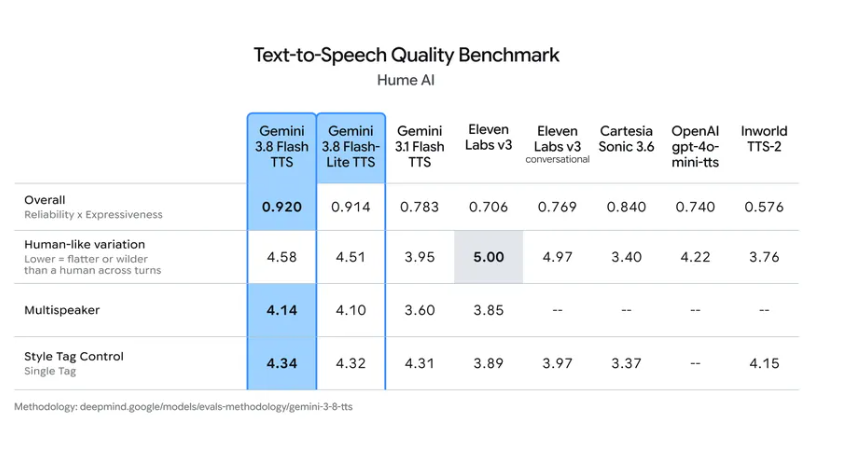
Google claims its new models lead most categories of Hume AI's text-to-speech benchmark. How they hold up against competitors' evolving models will be worth tracking as enterprise access opens up.
Meta description: Google launches Gemini 3.8 Flash TTS and Flash-Lite TTS, offering voice design from text prompts, 100+ languages, and per-hour audio pricing.
Tags: Google, Gemini, text-to-speech, AI audio, voice generation
Featured image: Abstract visualization of sound waves transforming into flowing digital gradients in blue and violet tones.
Comments
No comments yet. Be the first to comment.