
DreamTrue: A Robot World Model Faithful to Actions via Counterfactual Post-Training
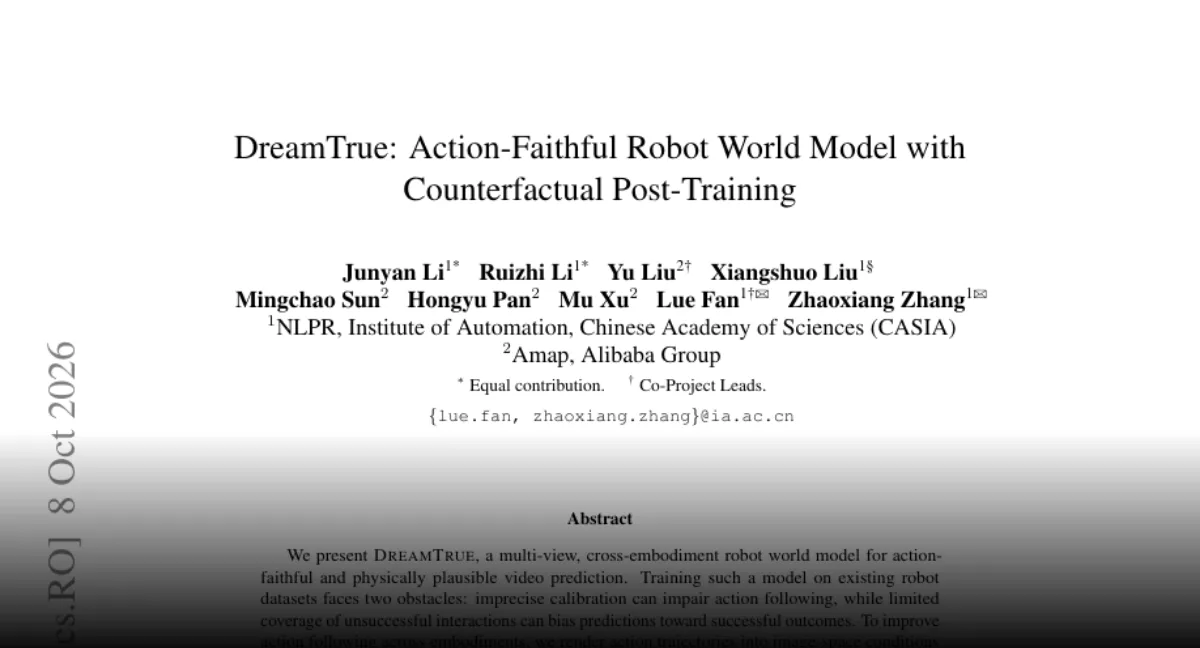
DreamTrue ranks first in AgiBot 2026 with multi-view, action-faithful robot video prediction, cutting interaction defects from 48.12% to 6.25%.
Key Takeaways
- DreamTrue is a multi-view, cross-embodiment robot world model focused on action-faithful video prediction rather than generic visual generation.
- It ranked first in the world model track of AgiBot World Challenge 2026, highlighting strong benchmark performance and relative standing among participating systems.
- Human-assessed interaction defects dropped from 48.12% to 6.25%, indicating much more behaviorally plausible predictions aligned with robot actions.
- The model matters because it can help robot planners, controllers, and evaluators compare candidate actions through more reliable simulated outcomes.
- Future evaluation will focus on how broadly these results transfer to different robot bodies, sensor setups, and long-horizon interaction scenarios.
Meta description: DreamTrue ranks first in AgiBot World Challenge 2026 world model track, cutting interaction defects from 48.12% to 6.25% with action-faithful video prediction.
Tags: DreamTrue, AgiBot World Challenge 2026, robot world models, video prediction, action following
Featured image: abstract multi-view robot simulation with glowing video frames and action paths, no people, logos, or text
Background: Robot Video Prediction Moves Toward Action Faithfulness
DreamTrue is a robot world model built to predict future video from actions, and its latest result places it at the front of AgiBot’s world model track. The model is described as multi-view and cross-embodiment, meaning it is designed around several visual perspectives and is intended to handle different robot forms or hardware configurations. For readers following robotics software, the relevant shift is from generic video generation to action-faithful, physically plausible video prediction: a future video is useful only if it stays consistent with what the robot is commanded to do and with the physical constraints of its environment.
This matters because robot learning systems often need to evaluate possible actions before executing them. A video model that can simulate those consequences gives planners, controllers, and evaluators a common ground for comparing candidate trajectories. When interaction defects remain high, the model may generate visually appealing but behaviorally wrong rollouts. DreamTrue’s reported result targets that failure mode directly.
Development: Multi-View and Cross-Embodiment Design
The presented development path centers on two technical constraints: multiple camera views and cross-embodiment generalization. A single view can miss object motion, contact states, or occluded robot components. Multi-view input gives the model a richer spatial record, which can improve consistency between predicted frames and real robot behavior. Cross-embodiment design broadens the model’s relevance by reducing dependence on one specific robot body, sensor layout, or action space.
In the AgiBot evaluation, the model achieved state-of-the-art action following. That phrase refers to the degree to which predicted video matches the executed or requested actions. The reported human-assessed interaction defect rate fell from 48.12% to 6.25%. The scale of that reduction is the most concrete signal in the source: it suggests that human evaluators identified far fewer interaction-related problems after the DreamTrue setup was applied, compared with the prior baseline.
Latest Progress: AgiBot Results and Competition Standing
The latest milestone is DreamTrue’s first-place finish in the world model track of AgiBot World Challenge 2026. The competition year anchors the event, while the track name identifies the specific category: world models rather than other robot intelligence tasks. The result combines benchmark performance with ranking, giving readers two complementary signals. The benchmark number, 48.12% to 6.25%, describes defect reduction. The competition placement describes relative standing among participating systems.
Together, these facts position DreamTrue as a current leader in action-aware robot video prediction within that challenge. The outcome is not simply a higher visual fidelity score; it is a reduction in interaction defects judged by humans, which is closer to what roboticists care about when a model is used to test or compare possible actions.
Current Stage
DreamTrue now sits in a validated competition stage: it has reported state-of-the-art action following on AgiBot, a large drop in human-assessed interaction defect rate, and first place in AgiBot World Challenge 2026’s world model track. The next question is how broadly these results transfer outside the challenge setting, especially across different robot bodies, sensor configurations, and long-horizon interaction scenarios.
Comments
No comments yet. Be the first to comment.