
Meta's Muse Spark Open Enters the Open-Weight Race as a Rival to Qwen, GLM, and Kimi
Meta launched Muse Spark Open, an 816B-parameter open-weight multimodal model with 42B active parameters, 1M token context, and weights on Hugging Face. It rivals Qwen, GLM, and Kimi on agentic and reasoning benchmarks but trails on coding and paid Muse Wonder Full models. Free use requires a 'Built with Muse Spark Open' label; API providers earning over $20M yearly need a separate Meta agreement.
Key Takeaways
- Meta has released Muse Spark Open as an open-weight AI model with 816 billion total parameters, 42 billion active parameters, multimodal support, and a 1 million token context window.
- The model is positioned as a strong US open-weight option for agentic, reasoning, and multimodal tasks, and Meta claims it outperforms several open rivals such as Qwen, GLM, and Kimi in selected benchmarks.
- Muse Spark Open weights are available on Hugging Face, can run locally on high-end Apple hardware, and are free to use under a license requiring the label “Built with Muse Spark Open.”
- The release is not a full replacement for Meta’s paid Muse Wonder models, as it still trails some competitors on coding benchmarks and remains behind higher-tier paid models.
- Large commercial API providers with more than $20 million in annual revenue need a separate agreement with Meta, creating a split between small-scale use and large-scale commercial resale.
Meta description: Meta's Muse Spark Open brings 816 billion parameters, 42 billion active, multimodal support, and Hugging Face weights under a labeled open-weight license.
Tags: Meta, Muse Spark Open, open-weight AI, Hugging Face, multimodal AI
Featured image: abstract blue-gray neural network nodes and parameter weights on dark background, no people, no logos, no text
Background: After Llama, Meta Reopens the Weight Path
Meta's move follows its Llama series and marks a return to open-weight territory with Muse Spark Open. The company describes the model as the most capable US open-weight model, positioning it for coding and agentic tasks. In an open-weight release, the model's weights are available for download and local execution rather than only through a hosted service; here, Meta places those weights on Hugging Face.
That structure gives developers a middle path. It offers more control than a paid API, but it still carries Meta's license terms, benchmark claims, and commercial usage conditions.
Development: A 816 Billion Parameter Multimodal Model
The core numbers define Muse Spark Open. It has 816 billion parameters, with 42 billion active parameters. It supports text, image, video, and audio, and accepts up to one million tokens of context. Context is the amount of input and output information the model can keep available while working; tokens are the units used to measure that information.
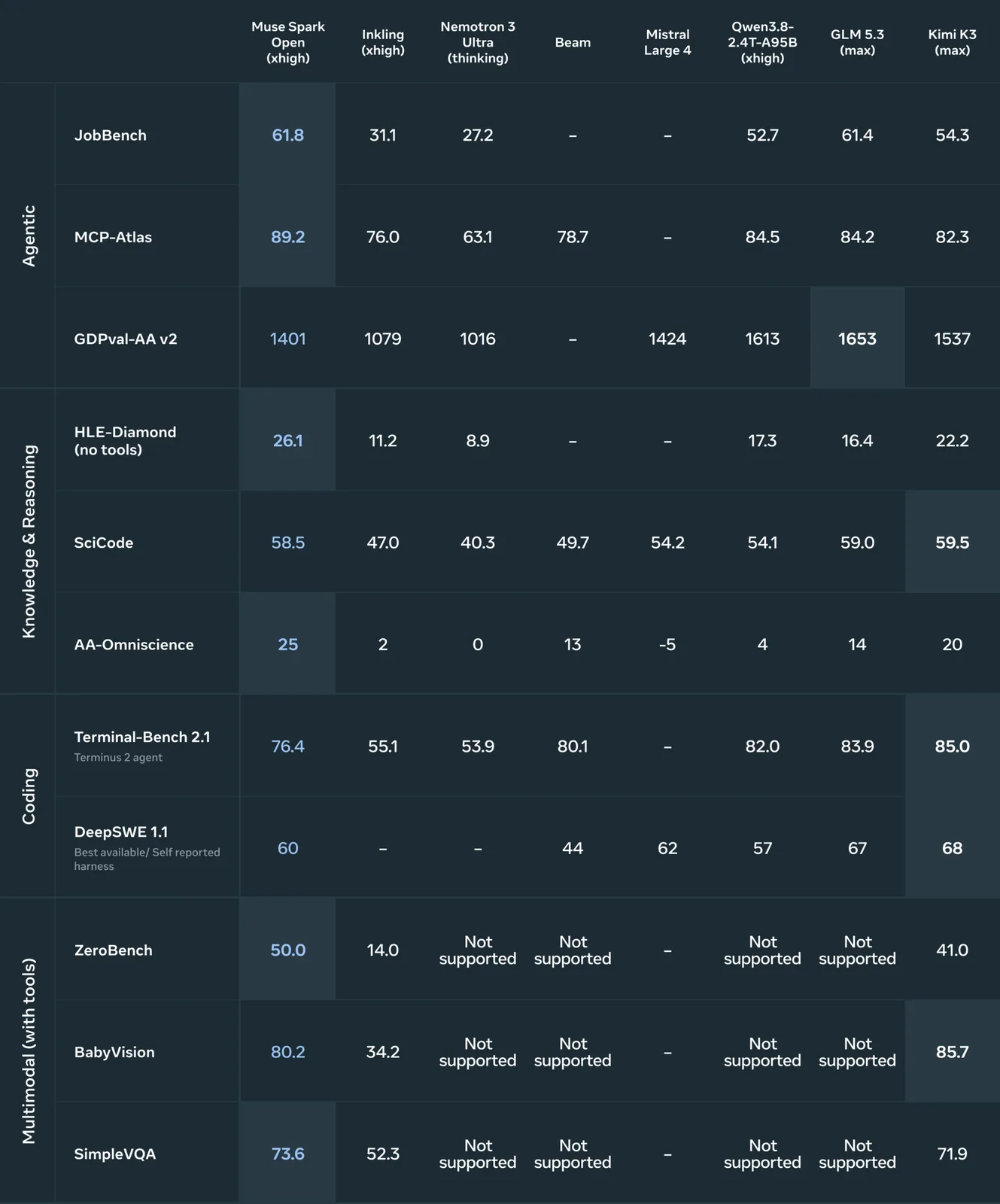
Meta says the model was benchmarked against other open models, including Inkling, Nemotron 3 Ultra, Qwen 3.8, GLM 5.3, and Kimi K3. In Meta's reported results, the model performs well on JobBench, MCP-Atlas, HLE-Diamond, and ZeroBench, scoring ahead of Qwen 3.8, GLM 5.3, and Kimi K3 in several categories. It leads in Agentic, Knowledge & Reasoning, and Multimodal categories.
At the same time, Meta acknowledges that it falls behind some competitors on coding benchmarks and still trails the paid Muse Wonder Full models. This split is important: the release is strongest as a broad open-weight multimodal option, not as a universal replacement for Meta's higher-tier paid models. The one million token context window and multimodal support expand the model's use case beyond text-only tasks, while the benchmark positioning shows a trade-off between open-weight accessibility and the strongest paid models.
Latest Stage: Local Runs, License Labels, and API Limits
Meta says the model is optimized for Apple's M5 Ultra and can run locally on two Mac Studios with 512 GB of unified memory each. The weights are on Hugging Face, and the license is free to use. It requires the label "Built with Muse Spark Open." For larger commercial API distribution, the rules change: providers pulling in more than $20 million a year who want to offer the model as an API service need a separate agreement with Meta. Additional details are in Meta's research blog.
The current stage is a controlled open-weight launch. For developers, the practical value is local multimodal inference, a large context window, and benchmark claims against open models, especially in agentic and reasoning workloads. For API sellers, the free use is conditional, and the $20 million annual revenue threshold creates a clear separation between smaller experimentation and large-scale commercial reselling.
What remains to watch is how coding performance compares with the named open competitors in hands-on use, how the label requirement and API agreement shape commercial adoption, and how far Muse Spark Open closes the gap with the paid Muse Wonder Full models in later evaluations.
Comments
No comments yet. Be the first to comment.