
DeepSeek V4.1 Flash 1017 outperforms larger competitors in agentic tasks while once again dramatically lowering cost per task.
DeepSeek V4.1-Flash-1017 improves agentic coding, opens weights, and adds Search/Fetch APIs while cutting cost per task below larger rivals.
Key Takeaways
- DeepSeek V4.1 Flash 1017 improves agentic coding and task performance while reducing cost per task through faster, shorter outputs.
- The model is available via DeepSeek’s website, app, and API, and its weights are open-sourced on Hugging Face and ModelScope.
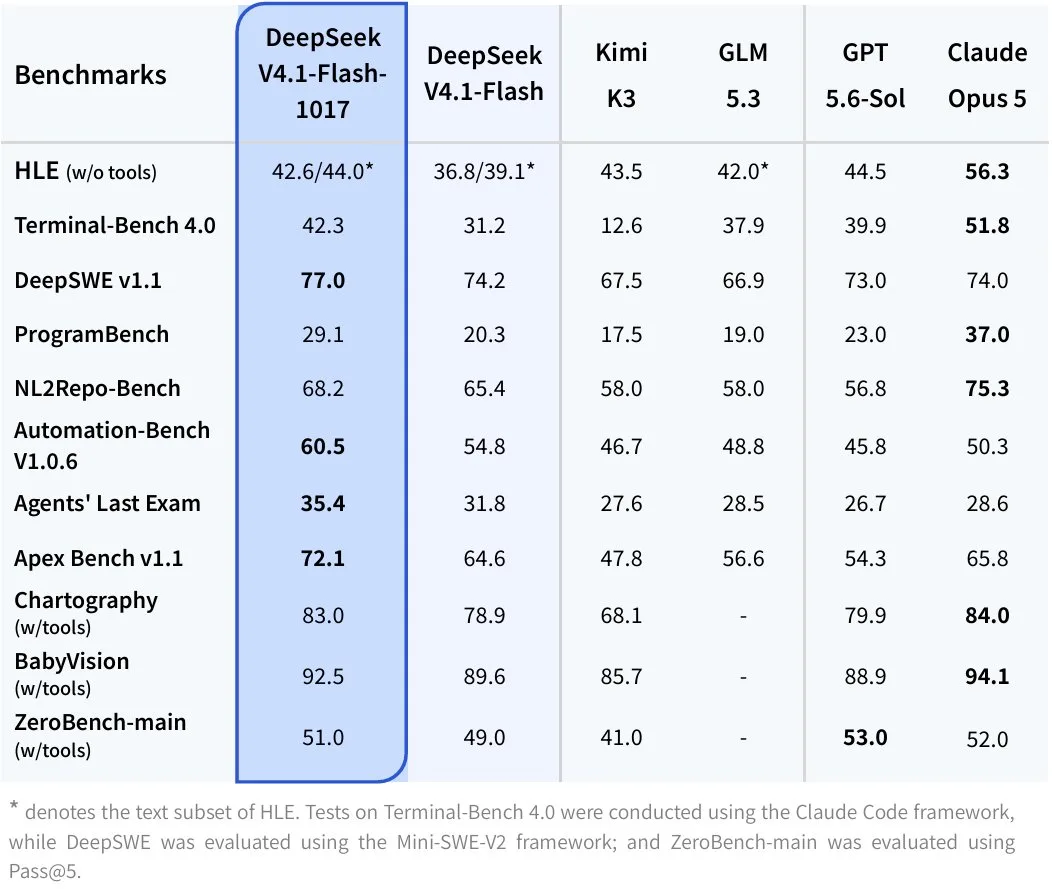
- In DeepSeek’s benchmarks, it outperforms its predecessor and several larger competitors on coding and AI agent tasks, with much lower average cost.
- DeepSeek also opens its internal Search & Fetch APIs to developers, priced at $0.75 per 1,000 calls, with temporary free access through selected tools.
- Wider open-weight availability may face regulatory uncertainty in China, though this release is currently a developer-facing step.
Meta description: Deepseek releases V4.1-Flash-1017 with better agentic coding scores, lower cost, open weights, and Search & Fetch APIs, available via website, app, and API.
Tags: Deepseek V4.1-Flash-1017, agentic coding, Search & Fetch APIs, open-weight models, AI benchmarks
Featured image: Abstract technology illustration with neural pathways and code-like light trails, no real people, no company logos, no text.
Background: A Cheaper Flash Model With Open Weights
Chinese AI company Deepseek has shipped an updated version of its Flash model, and the release carries two changes that matter for developers: stronger agentic and coding behavior, and the first external opening of its in-house search engine. The new model is named Deepseek-V4.1-Flash-1017, and it is now available through the company's website, app, and API. Deepseek also published the model weights as open source on Hugging Face and ModelScope.
The company describes the update as a Pareto improvement in the tradeoff between performance and cost. In practice, that means Deepseek says the model gets better benchmark scores than its direct predecessor, finishes tasks faster, and produces shorter outputs. Shorter outputs can reduce token use, which may lower the cost of repeated coding or agent runs.
Development Process: Self-Feedback Training, Harness Tuning, And Benchmark Gains
To build complete software projects from scratch, Deepseek uses reinforcement learning with self-feedback. This post-training method lets the model use its own internal confidence scores or self-generated critiques as a reward signal, removing the need for human evaluators or external reward models. The company says the approach improves end-to-end project development across tasks ranging from game programming to 3D modeling and design work. The model can also animate compact explainer videos, similar to the recently released Opus 5.5. A demonstration video is credited to FeiZ.
Deepseek tuned the model for development environments including Deepseek Harness, Tencent CodeBuddy, and WorkBuddy. For Deepseek Harness, version v0.2.1-rc.1 or later is recommended.
In Deepseek's own benchmarks, V4.1-Flash-1017 outperforms its predecessor V4.1-Flash. It also beats larger competing models such as Claude Opus 5, GPT 5.6-Sol, Kimi K3, and GLM 5.3 in several coding and AI agent categories. The company's charts show the model improving on the predecessor in every tested category.
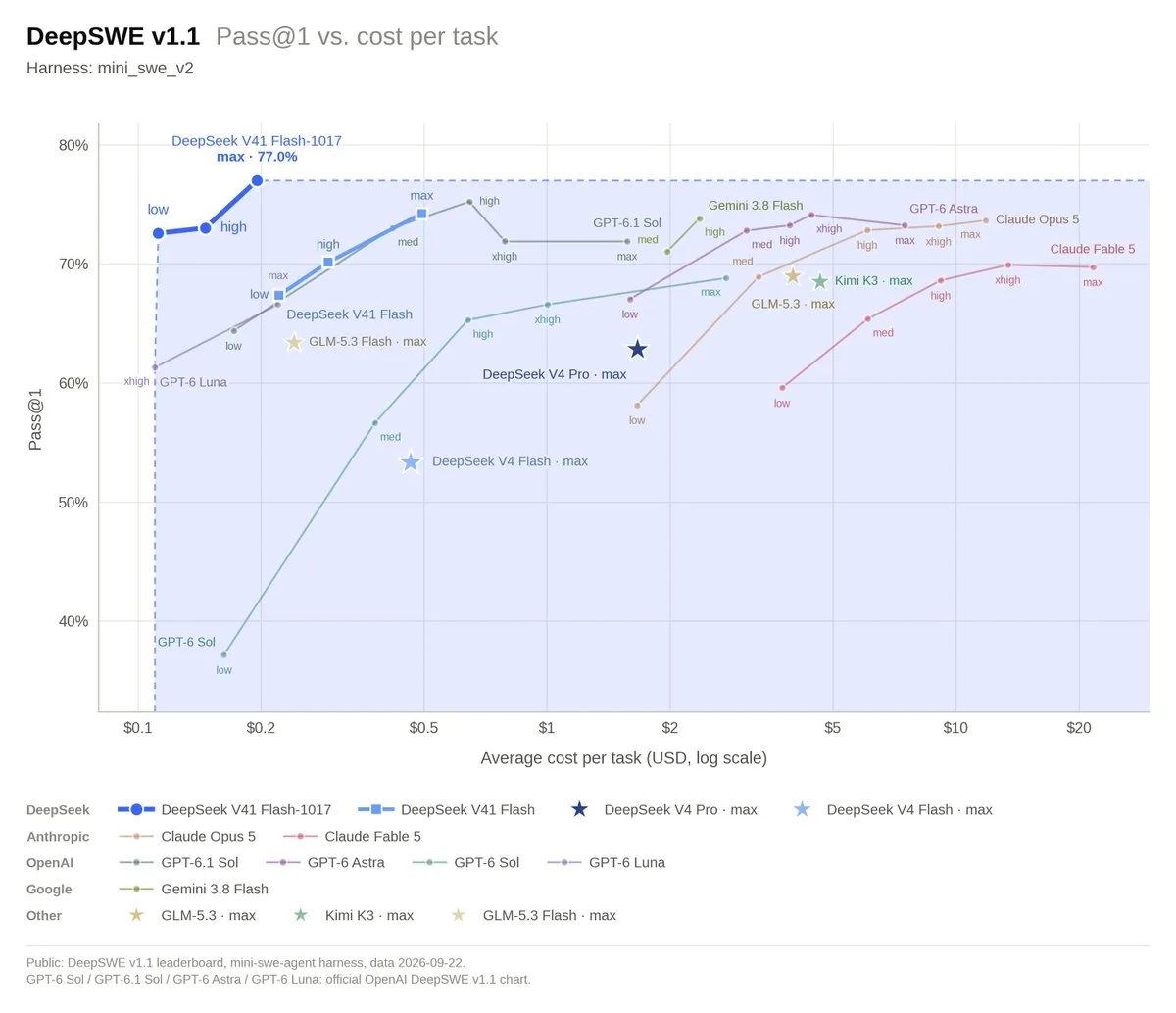
A cost chart for the DeepSWE benchmark highlights the effect of shorter outputs. V4.1-Flash-1017 reaches a top score of 77.0 percent at an average cost of just under $0.20 per task. In its low setting, it still clears 72 percent for about $0.10. The predecessor scored 74.2 percent but cost around $0.50 per run. The chart shows the Flash model undercutting larger rivals by a wide margin on average cost per agentic coding task.
Rival models including GPT-6 Astra, Gemini 3.8 Flash, and Claude Opus 5 fall between $2 and over $10 per task in the chart, and none match the smaller Deepseek model's accuracy. Deepseek notes that independent benchmarks have not yet come out, and that benchmark scores only tell part of the story. Developer impressions on code quality can differ widely from published results.
Latest Progress: Search APIs, Pricing, And Regulatory Uncertainty
Alongside the language model, Deepseek is making its web search tools, called Search & Fetch APIs, available to all developers. The company says these services run on a search engine it built internally that already handles hundreds of millions of queries per day worldwide. Setup details are in the API documentation.
Pricing is $0.75 per 1,000 calls for each endpoint. Deepseek API users can access the features for free through server-side tools in Deepseek Harness, Claude Code, and Codex until October 31, 2026 at 4:00 PM Coordinated Universal Time.
The broader context has become less straightforward. Reports from the previous day suggested that the Chinese government plans to tighten rules on publishing open-weight models, or even block their release entirely. One deciding factor is whether a given system ranks among the top 10 most capable models. For now, the current stage of this release is a developer-facing step: Deepseek has put a lower-cost Flash model and its search tools into public use, while open-weight distribution and model availability remain subject to possible policy change.
Comments
No comments yet. Be the first to comment.