
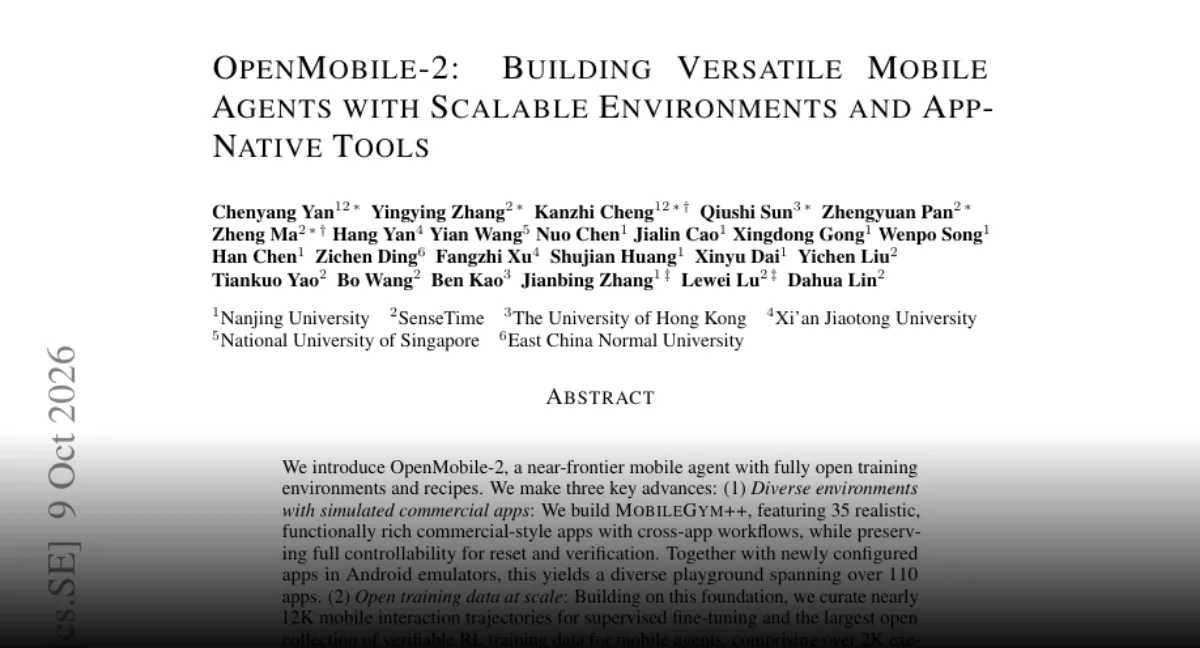
OpenMobile-2 builds versatile mobile agents by leveraging scalable environments and app-native tools.
OpenMobile-2 open-sources MobileGym++, 35 apps, a 110-app playground, hybrid screen and tool actions, and real-device gains.
Key Takeaways
- OpenMobile-2 releases a fully open-source mobile-agent stack covering environments, data, benchmarks, and models.
- MobileGym++ provides 35 controllable commercial-style apps, expanding to 110+ apps for scalable training and testing.
- It introduces hybrid GUI and CLI interaction, allowing agents to combine screen actions with app-native tool calls.
- The project reports competitive benchmark results and nearly 2x performance on real-device mobile tasks.
- All resources are publicly available for research, including app trials, papers, code, and benchmark repositories.
Meta description: OpenMobile-2 introduces MobileGym++ with 35 commercial-style apps, 110+ total apps, app-native tools, and nearly 2x performance on real-device mobile tasks.
Tags: OpenMobile-2, MobileGym++, mobile agents, GUI and CLI, app-native tools
Featured image: 
OpenMobile-2 introduces a fully open-source mobile-agent stack built around environments, data, benchmarks, and models. The release matters because mobile-agent progress has been limited by two constraints: training spaces that are too heavy and too narrow, and agents that mostly interact through screens rather than app-provided functions. The announcement positions the work as infrastructure for future mobile-agent experiments, not just a single model demo.
Background: emulator limits and a 110+ app playground
Existing emulator-based environments are heavyweight and cover limited apps, especially commercial ones. To reduce that gap, OpenMobile-2 introduces MobileGym++, a set of 35 high-fidelity, fully controllable commercial-style apps with cross-app workflow. The apps were built through human-coding agent collaboration.
Together with emulator-based apps, MobileGym++ forms an open playground of 110+ diverse apps. That playground is intended for scalable data synthesis and agentic RL, or reinforcement learning for agents, and users can try the apps directly on the project website. Commercial apps are often difficult to reproduce inside emulator-only setups, so the 35-app set is presented as a controllable training layer.
Development: hybrid GUI and CLI
The second direction is hybrid GUI and CLI. While hybrid computer use is gaining traction, mobile agents remain largely limited to GUI interactions. OpenMobile-2 explores a setting in which mobile apps expose app-native tools. In that setup, an agent can interleave GUI actions and tool calls within a single task.
GUI interactions refer to actions taken through visible app screens, while CLI-style tool calls refer to direct commands or functions exposed by the app itself. This hybrid mode is closer to real workflows because some steps may require seeing the screen, while others can use app capabilities directly.
Latest progress: benchmark, real-device results, and open resources
MobileGym++ Bench supports both GUI-only and hybrid evaluation on challenging commercial-app tasks. The project reports that OpenMobile-2 achieves competitive results on established benchmarks and nearly 2× performance on real-device mobile tasks. The benchmark covers two modes, so readers can see whether the agent still works when it must move from visual control to app-native tool use and back. Real-device results are especially notable because they move evaluation beyond simulated tasks.
Everything is open-sourced. The available links include the project site for online app trials, the HF Paper entry, the main GitHub repository, and the MobileGym++ repository. The project also asks for support with an HF Paper upvote and a GitHub star.
- Project: https://os-copilot.github.io/OpenMobile2-Home/
- HF Paper: https://huggingface.co/papers/2610.14157
- GitHub: https://github.com/OpenMobile2/OpenMobile2-Code
- MobileGym++: https://github.com/OpenMobile2/MobileGym-plusplus
Current stage
The current stage is a public open-source release rather than a closed product launch. It gives researchers a larger app playground, a hybrid interaction model, and a benchmark for commercial-app tasks. The next thing to watch is whether app-native tools change mobile-agent evaluation and whether the 110+ app environment supports more scalable training work.
Comments
No comments yet. Be the first to comment.