
Recursive presents the first result of its AI-driven research process with Flint.
Recursive introduced Flint, its first publicly released model built through the Eureka Machine automated research process. The mixture-of-experts coding model has 40 billion total parameters and 2.5 billion active parameters per token. It is optimized for local agentic coding, with open Apache 2.0 weights, support for common runtimes, and custom kernels for Apple Silicon and Nvidia GPUs. Flint tests whether AI-driven research can improve future model development.
Key Takeaways
- Recursive released Flint, a 40B-parameter mixture-of-experts local coding model with 2.5B active parameters per token, presented as the first result of its Eureka Machine automated research process.
- Eureka Machine reportedly shaped major technical choices, including the model architecture, 4-bit quantization with distillation, and custom inference kernels for Apple Silicon and Nvidia RTX Spark.
- Flint is designed for fast, private on-device agentic coding, with open weights under Apache 2.0 and support for common local runtimes such as llama.cpp, Ollama, LM Studio, vLLM, and SGLang.
- Recursive claims strong speed and coding benchmark results against similar sparse models, but the findings are not independently verified, and complex tasks may still require more guidance than large proprietary models.
Meta description: Recursive released Flint, a 40 billion parameter mixture-of-experts coding model with 2.5 billion active parameters, built in four months using Eureka Machine.
Tags: Recursive, Flint, Eureka Machine, local coding model, mixture-of-experts
Featured image: Abstract technology style with glowing circuit patterns and neural network nodes, no real people, no company logos, no text.
Recursive's first language model, Flint, arrived after four months of automated research, and the release is notable because the startup says its Eureka Machine took part in nearly every step of development: suggesting ideas on its own, building them out, testing them, and planning follow-up experiments from the results. Flint is a mixture-of-experts model designed for agentic coding, meaning coding tasks where a model plans and executes steps, on local hardware. It has 40 billion total parameters, with 2.5 billion active parameters per token. For readers, the immediate question is whether local coding assistance can become faster and more private, while the larger question is whether an AI research system can genuinely improve its next model.
Before the release: stealth, funding, and a research bet
The AI startup Recursive, founded by Richard Socher and others including former DeepMind researcher Tim Rocktäschel, came out of stealth in May 2026 and raised $650 million at a $4.65 billion valuation. At that point, it had no concrete technical results to show. Recursive is making a bet: it wants to build AI systems that keep making better AI systems. Its long-term goal is a superintelligence that keeps improving itself, and each new model is supposed to make the Eureka Machine a better researcher so later models can be built faster and more efficiently. Eventually, the company wants to apply the same approach to automate research in other scientific fields. Flint is the company's first publicly available model from its automated research process.
Inside the four-month build: Eureka Machine shaped architecture, quantization, and kernels
According to Recursive, Eureka Machine handles the whole research loop and explores several approaches at the same time. In the Flint project, it worked on training data, optimizers, architecture design, and inference tuning. Recursive credits the system with selecting the architecture, quantization, and compute kernels independently, and it points to three examples.
The starting architecture used 35 billion total parameters and 3 billion active parameters. It then tried different expert configurations, and Recursive says the final design, 40 billion total parameters with 2.5 billion active parameters, gave the best balance of speed and coding performance across the tested variants.
In quantization, the process of using lower-precision weights, the system broke with usual practice by lowering the output layer to four bits too. A distillation step was added to restore accuracy lost by the lower precision, and Recursive says it required roughly half as many training steps as the previous method. According to Recursive, the completed NVFP4 model is only 0.7 points behind the 16-bit version across benchmarks.
The system also created specialized compute kernels for Apple Silicon and Nvidia RTX Spark. On Apple's M4 and M5 chips, a Metal megakernel merges the full forward pass during token generation into one operation. Recursive attributes the high inference speed to optimizations made across several development stages.
Release details: local coding speed, open weights, and limits
The context window, the amount of text processed at once, can reach 512,000 tokens, but Recursive recommends a 256,000-token limit. The weights are published on Hugging Face under an Apache 2.0 license, and the supported runtimes include llama.cpp, Ollama, LM Studio, vLLM, and SGLang. The company also introduced rec, an inference engine built for Apple Silicon.
The practical consequence is that code can be processed on-device instead of being sent to external servers. Recursive acknowledges that complex tasks may need more guidance than with large proprietary coding models, and it suggests splitting bigger jobs into smaller steps.
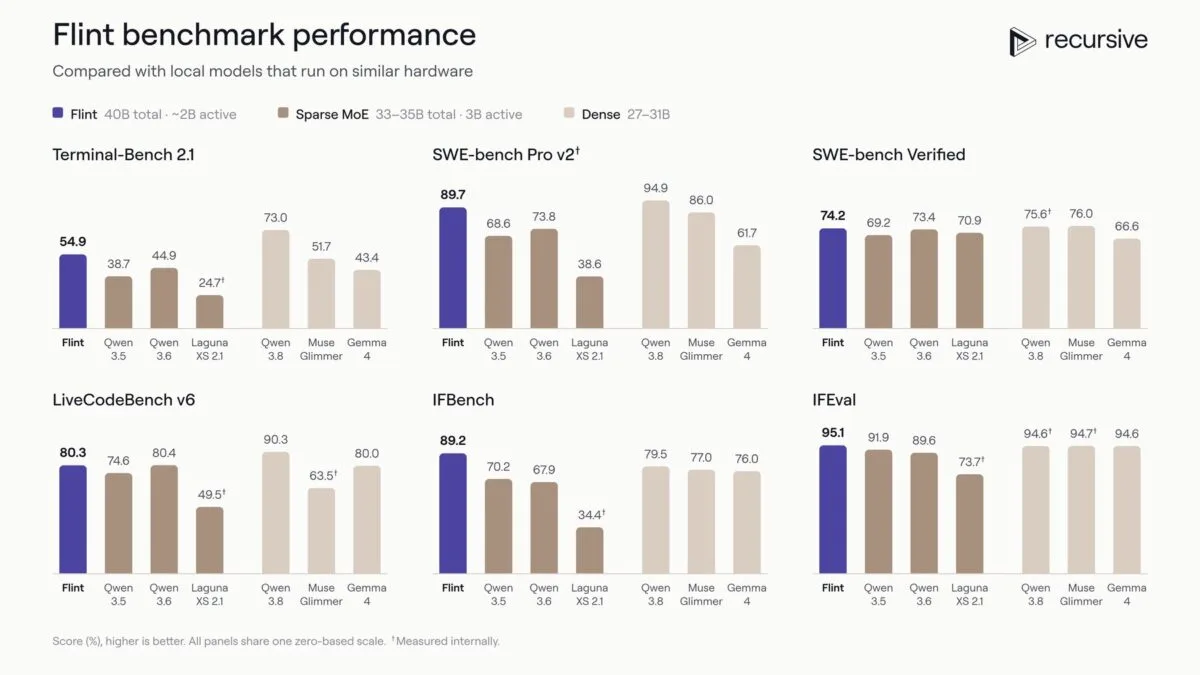
In benchmark claims, Recursive says Flint is ahead of other mixture-of-experts models with fewer than 50 billion parameters, such as Qwen3.6-35B-A3B and Laguna S 2.1, on SWE-Bench Pro v2, Terminal-Bench 2.1, and SWE-Bench Verified. The results have not been independently verified yet.
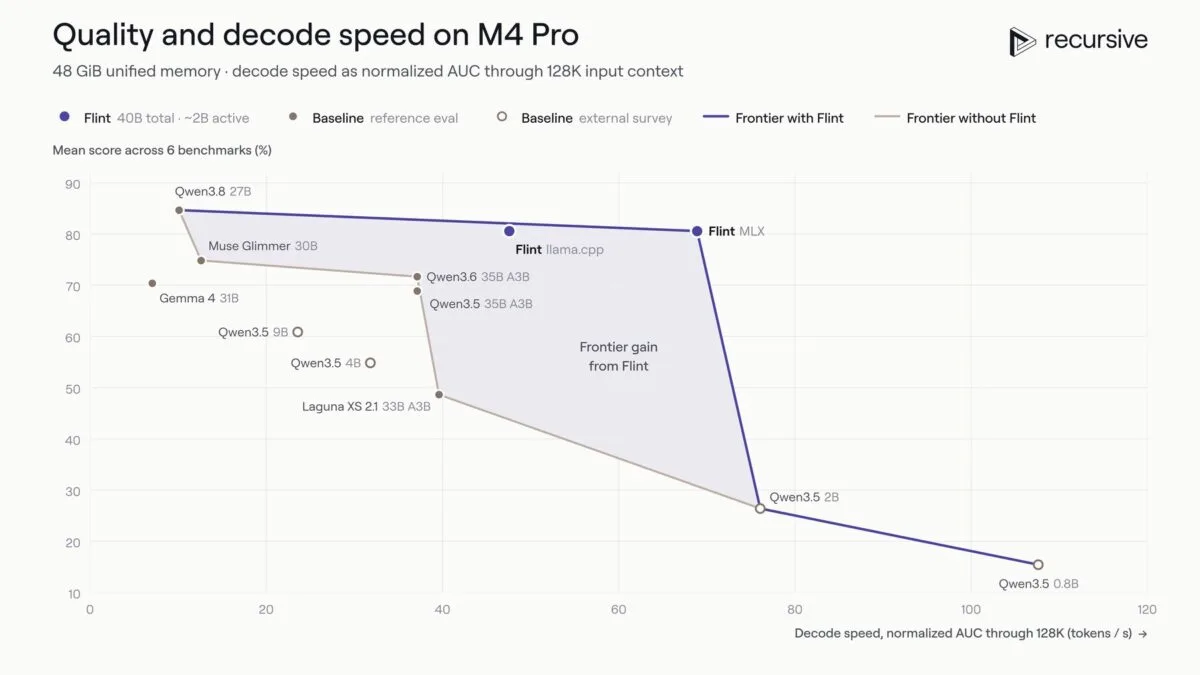
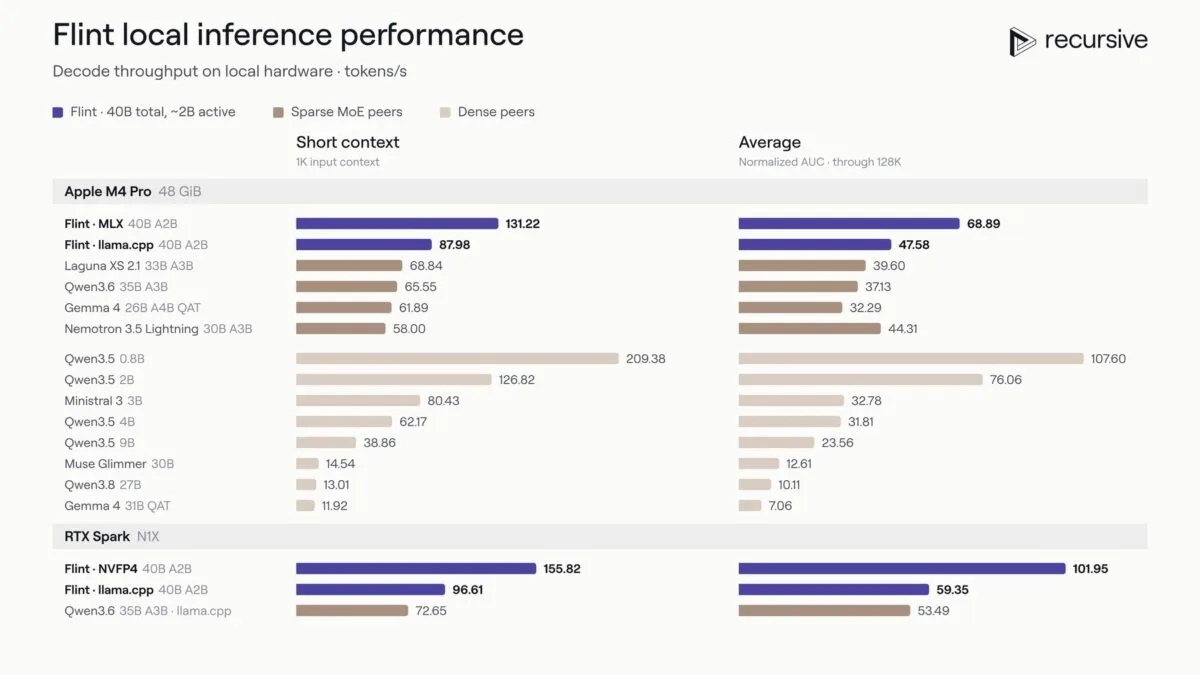
Recursive says a 48 GB M4 Pro can reach benchmark scores similar to much slower dense models, which activate all parameters for each token, in the 27 to 31 billion parameter range. Recursive positions Flint against dense models in the 25 to 40 billion parameter range while running more than five times faster. For a MacBook Pro with M4 Pro, Recursive reports more than 125 tokens per second at short contexts; on an Nvidia RTX Spark with 64 GB of memory, it tops 150 tokens per second. Against similar models, Recursive says inference can be up to twice as fast. Charts published by Recursive show roughly twice the tokens per second of comparable mixture-of-experts models at short context lengths on both M4 Pro and RTX Spark. The company says Flint is ahead on all six coding and instruction-following benchmarks among sparse mixture-of-experts models of similar size, although dense models such as Qwen 3.8 score higher in some tests.
Where the claim stands now
It remains unclear whether this path will produce accelerating self-improvement. Other AI labs are also using AI in model development. Anthropic reports that Claude now carries out a large share of its own development work, while OpenAI deploys AI agents across its full research pipeline. How far that automation actually goes is still debated. A study covering more than 700 task logs found that AI agents perform large portions of the work, but humans still make most of the critical research calls.
Oriol Vinyals, a former Google DeepMind research lead, sees AI-assisted self-improvement as realistic but considers an intelligence explosion unlikely. Generating good research ideas and reliably judging results remain especially difficult for AI systems. Those are the steps Recursive wants to automate with the Eureka Machine.
Flint is the first concrete result, but it does not yet prove full recursive self-improvement. That would require showing that a model produced by the Eureka Machine makes the Eureka Machine itself a better researcher. The current stage is therefore an early signal: local agentic coding may become more practical through automated architecture search, quantization, and hardware-specific kernels, while the benchmark claims still await independent verification.
Comments
No comments yet. Be the first to comment.