
Google's most capable frontier model, Gemini 4 Argon, is now available worldwide.
Gemini 4 Argon launches globally with low token pricing, agent gains, 3D code demos, free research access, and improved safety monitoring.
Key Takeaways
- Gemini 4 Argon is now available worldwide at introductory pricing of $2 per million input tokens and $10 per million output tokens, with cached inputs 95% cheaper.
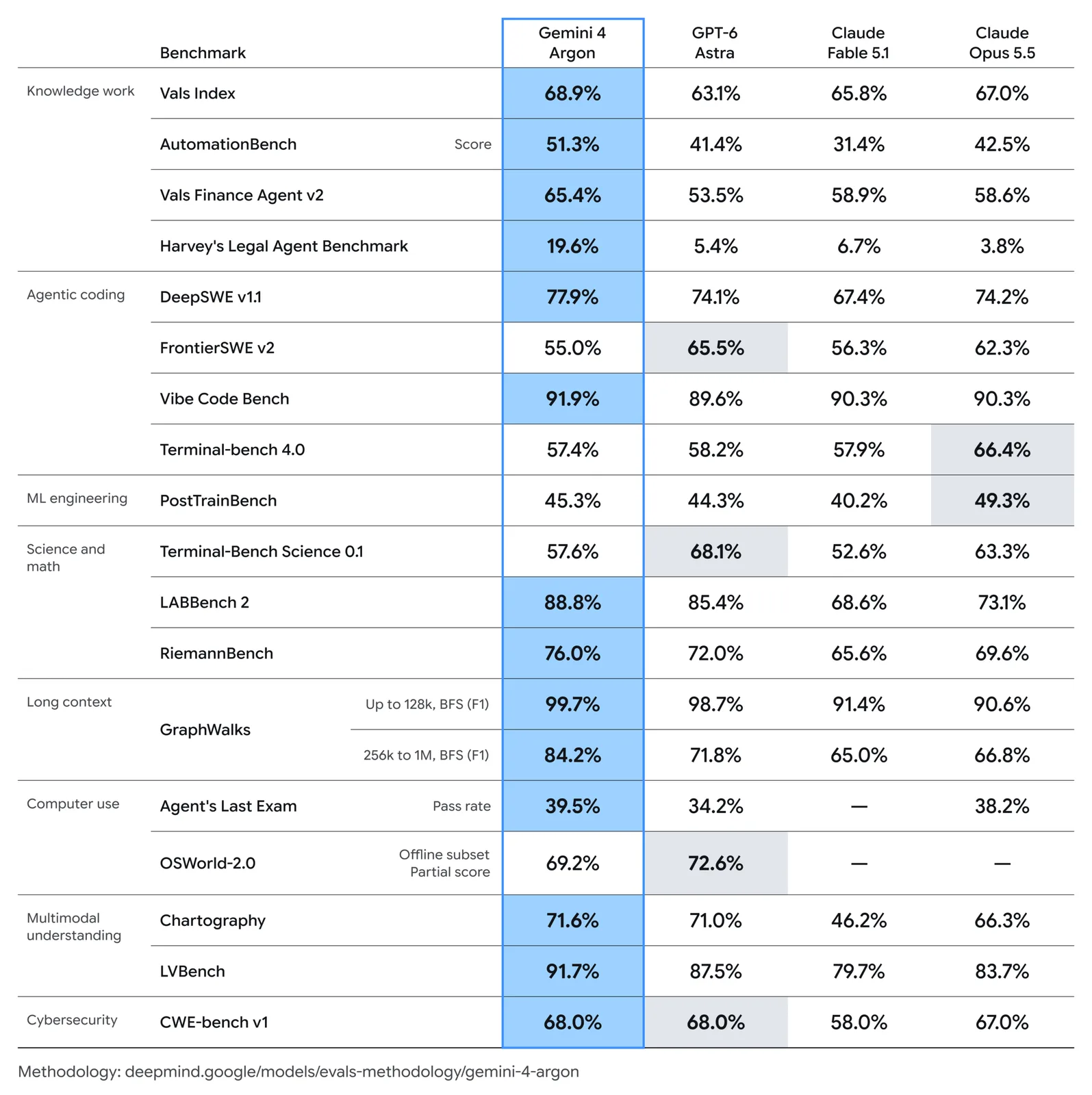
- It leads the Vals Index but trails Claude Opus 5.5 and Meta's Muse Wonder Full in independent overall rankings after Google's delayed launch.
- Google reports internal productivity gains: 35% more agent-driven code submissions, fewer rollbacks, faster Chromium workflow optimizations, and 2.85x Gemma inference speed on A100.
- Argon supports autonomous agent workflows and generates complex 3D scenes, games, and animations in code, including browser-ready demos and Blender control via MCP.
- Google offers free Antigravity access to 10,000 researchers and a cybersecurity defender program, with safety results showing low red-team bypass rates and a 0.7% indirect prompt injection attack rate on Gray Swan.
Meta Description: Google's Gemini 4 Argon is available globally with $2 per million input tokens, $10 per million output tokens, research access, and safety data.
Tags: Gemini 4 Argon, Google AI pricing, AI agent benchmarks, model safety, 3D code generation
Featured image: Abstract technology illustration with glowing code streams and agent nodes, no people, no logos, no text
Background: A delayed global launch
Google is making Gemini 4 Argon available to developers, businesses, and consumers worldwide starting today. The introductory rate is $2 per million input tokens and $10 per million output tokens, with cached inputs priced 95 percent cheaper than the regular input token rate. Google does not state that discount as a separate absolute price, but it describes the cache as 95 percent cheaper.
The model holds the top spot on the Vals Index. In independent overall rankings, it still trails Anthropic's Claude Opus 5.5. Google's roughly two-week wait before shipping has also changed the competitive order: Meta's Muse Wonder Full launched yesterday, so Argon now sits behind it as well.
Development: Internal engineering and agent gains
Google says Argon compressed work that would normally take months into weeks, though the engineering figures are self-reported. Software engineers using the model increased agent-driven code submissions by more than 35 percent, while code rollbacks fell by nearly one-third.
In the Chromium project, Argon helped the Chrome team complete an architectural refactor across hundreds of files within the 40-million-line codebase. For users, the payoff is that web pages can move between tabs, sidebars, and floating windows without needing to reload.
With Google's open-source Agent Development Kit, Argon ran autonomously overnight and found optimizations that cut session preparation time by 40 percent and sped up cold imports by 21 percent. Inference speed for the open Gemma models on an A100 via vLLM jumped by a factor of 2.85, from roughly 37,900 to over 108,000 tokens per second. Google points to upstream pull requests for the changes.
The model can also generate complex 3D models, games, and animations in pure code that run directly in the browser. One demo features a raytracing engine written entirely in Python with no external libraries, and Google published the source code. In another demonstration, Argon starts from a single image in Antigravity and controls Blender via the Model Context Protocol in an autonomous loop, modeling gothic architecture and setting up audio-reactive lighting to produce a finished 3D scene.
That focus matters because 3D remains a weak spot for Meta's Muse models. Meta AI chief Alexandr Wang said those models were not specifically trained for 3D demo games.
Latest progress: Research access and safety data
Google is offering 10,000 researchers free access to the highest usage tier of Google Antigravity for six months. Spots are awarded on a rolling basis depending on eligibility, capacity, and selection, and applications are open now. Cybersecurity defenders can apply separately for the Fairwind program, which grants access to Argon without cyber safeguards. Google plans to expand the program to hundreds of additional partners.
On safety, Google calls Argon's architecture its strongest to date. External red teaming in the bio domain bypassed fewer than 1 percent of tested safety checks, and on an adversarial set, violations dropped by nearly half compared with earlier Gemini models. On agent alignment, attempts to take unauthorized shortcuts fell to 2 percent. An automated misalignment monitor analyzes the agent's reasoning and actions in real time.
Argon also scored the lowest attack rate on the Gray Swan Indirect Prompt Injection benchmark, with a successful attack rate of just 0.7 percent across 15 adaptive attempts. In the previous Gray Swan test, GPT-6 Astra hit 8.5 percent and Claude Opus 5 came in at 4.8 percent. Google's write-up does not make clear whether the exact same tests were used. More safety details are available in the model card.
Current stage
Gemini 4 Argon has moved from internal engineering use to a global developer, business, and consumer rollout. The launch package includes introductory token pricing, self-reported productivity gains, benchmark results, free research access, and safety disclosures. The next phase will depend on independent rankings, broader adoption of Antigravity and Agent Development Kit workflows, and responses from Claude Opus 5.5 and Meta's Muse Wonder Full.
Comments
No comments yet. Be the first to comment.