
AI Outpaces Licensed Accountants in Speed and Accuracy, Yet Still Needs Supervision to Close the Books
AI models now surpass CPAs on simplified bookkeeping speed, accuracy, and cost, but still fail many full APEX tasks and need human oversight.
Key Takeaways
- Mercor's APEX study finds AI models now outperform licensed CPAs on simplified bookkeeping tasks in speed, accuracy, and cost, reversing a gap from 18 months ago.
- On the full APEX Accounting benchmark, leading models still meet only about 58%-62% of grading criteria, and nearly 60% of tasks are not fully solved.
- AI is strongest at structured, rule-based detail work but lacks the human judgment, client communication, and experience needed for broader accounting tasks.
- Accountants are not yet replaceable, but AI is expected to deliver major productivity gains while requiring human oversight for full accounting workflows.

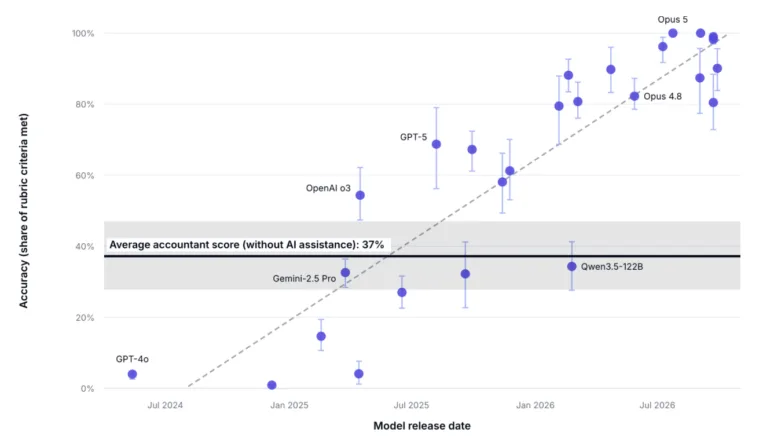
A Mercor study on an AI accounting benchmark finds that AI models are faster, more accurate, and far cheaper than accountants at structured bookkeeping tasks. 12 licensed CPAs, each with an average of five and a half years of experience, worked through simplified tasks from the APEX Accounting Benchmark. The results show a sharp change: Eighteen months ago, the best models scored below the accountants' average of about 37 percent. Today, the same tasks are solved almost flawlessly.
Background: The Human Baseline and the APEX Tasks
The comparison rests on a benchmark designed to capture real accounting work. The full APEX Accounting benchmark contains 160 tasks across 10 simulated companies. It was built by more than 40 professionals who average 11 years of experience, making the task set broader than the simplified tasks used in the model-versus-accountant comparison.
Mercor's study focused first on simplified tasks and compared AI model accuracy on those tasks with accountants working without AI assistance, broken down by model release date. That design makes the timeline clear: model releases are not just becoming better in general; they are improving against a fixed accounting task set.
Development: From Below 37 Percent to Near Flawlessness
The most striking change is the gap between model capability and the human baseline. The accountants' average on the simplified tasks was about 37 percent. Eighteen months ago, the best models remained below that level. The study presents the current state as a reversal: models now complete the same simplified tasks almost flawlessly.
This shift is not only about raw accuracy. The study frames the models as faster, more accurate, and far cheaper than accountants on structured bookkeeping tasks. Those are the attributes that matter for adoption: faster output, higher accuracy, and lower cost.
Latest: Leaders on the Full APEX Benchmark
When the comparison moves from simplified tasks to the full APEX Accounting benchmark, the picture becomes more nuanced. Claude Opus 5.5 currently leads with 61.8 percent of grading criteria met. Fable 5.1 follows at 61.0 percent, and GPT-6 Astra is at 57.9 percent.
Even with those leads, no model fully solved almost 60 percent of the tasks. That detail matters because it separates high scores on individual grading criteria from end-to-end accounting completion. The remaining failure rate shows that the top systems still cannot close the books without oversight.
Current Stage: Strong at Structured Detail Work, Not Yet Autonomous
Mercor acknowledges that the study's tasks test exactly what AI does best: hunting down details and following instructions precisely. That is a natural fit for model strengths, especially when the work is constrained by explicit rules and checkable outputs.
The study also leaves out the parts of accounting that depend on human judgment and relationship work. It does not test talking with clients, checking with colleagues, or drawing on context built over years. Those omissions define the remaining gap between a high-scoring model and a CPA who can manage ambiguous, client-facing, or judgment-heavy accounting work.
The study's conclusion is that accountants can't be replaced, while Mercor expects major productivity gains across the industry. The current stage, then, is a period in which AI models can outperform accountants on selected structured bookkeeping tasks while still requiring human oversight for the broader accounting workflow. The next signal to watch is whether future model releases can raise the share of fully solved tasks on the full APEX benchmark, not just improve scores on simplified tasks.
Meta description: Mercor APEX study shows AI models outperform licensed CPAs on simplified bookkeeping, but full accounting tasks still need oversight for now.
Tags: Mercor, APEX Accounting Benchmark, CPA, AI accounting
Comments
No comments yet. Be the first to comment.