
SAGE: Reducing Long-Horizon Reasoning Biases through Topological Guidance
SAGE addresses long-horizon LLM reasoning failures caused by sparse rewards, where plausible local steps can accumulate into unstable trajectories. It introduces symbolic closure analysis to explain exploration and compounding biases, then guides search with algebraic sparsification and hyperbolic geometry. Reported results span 12 benchmarks and 7 model families, including major gains on the Andrews-Curtis problem.
Key Takeaways
- SAGE is a Structural Admissibility-Guided Exploration framework designed to reduce long-horizon reasoning failures in large language models, especially in sparse-reward tasks where locally plausible steps can lead to globally unstable trajectories.
- It targets two core biases: exploration bias, which pulls models toward structurally unstable branches, and compounding bias, where small errors accumulate over long reasoning chains.
- SAGE combines algebraic sparsification to suppress spurious branching and hyperbolic structural guidance to provide denser depth-wise feedback, making long search paths easier to navigate.
- The framework was evaluated across 12 benchmarks and 7 model families, with a reported up to 8-fold improvement on the Andrews-Curtis problem, and its code is publicly available for inspection.
SAGE Framework Improves Long-Horizon Reasoning for Large Language Models
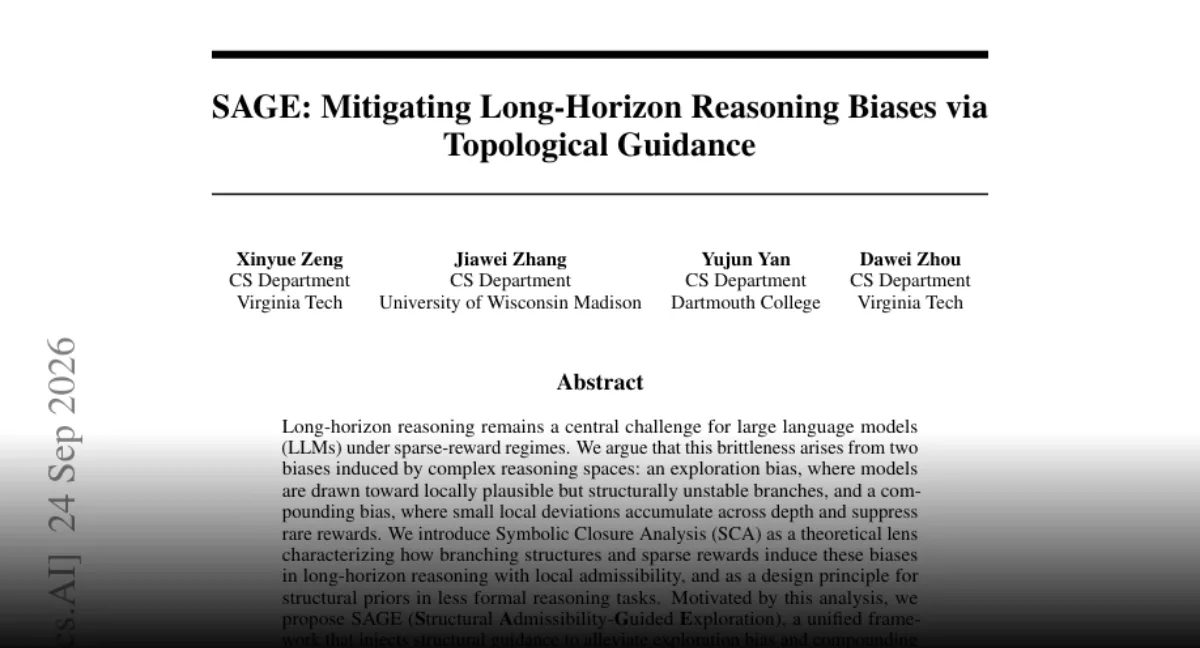
Meta description: SAGE uses symbolic closure analysis, algebraic sparsification, and hyperbolic guidance to cut exploration and compounding bias in long-horizon LLM reasoning.
Tags: SAGE, large language models, long-horizon reasoning, symbolic closure analysis, Andrews-Curtis problem
Featured image: Abstract technology style illustration of branching reasoning paths curving through a negatively curved geometric space; no real people, no company logos, no text.
SAGE, a framework called Structural Admissibility-Guided Exploration, is presented as a way to reduce long-horizon reasoning failures in large language models. The reported results cover 12 benchmarks and 7 model families, including up to an 8-fold improvement on the Andrews-Curtis problem. The work matters because sparse-reward tasks can make locally reasonable model steps accumulate into globally unstable trajectories.
Background: Why long-horizon reasoning breaks
Large language models often perform well when feedback is frequent, but they become brittle when the answer is only validated after many dependent steps. This setting is known as sparse-reward long-horizon reasoning. It matters because complex tasks can contain long chains where each local step seems acceptable, yet the whole trajectory fails.
For readers, the issue is not that a model cannot produce a plausible intermediate move. The issue is that plausible local moves can still lead to a globally failed path. Sparse rewards make that problem harder because the model receives little signal until the final outcome is known.
The material identifies two recurring failure modes. The first is exploration bias: a model is pulled toward branches that appear locally plausible but are structurally unstable. The second is compounding bias: tiny deviations accumulate as depth increases, making rare successful paths harder to reach. These biases are not simply mistakes in individual steps. They are properties of the reasoning space itself, where branching structures and sparse rewards interact.
Development Process: From SCA to SAGE
The proposed response begins with Symbolic Closure Analysis, abbreviated SCA. SCA is presented as a theoretical lens for understanding how local admissibility, branching structure, and sparse rewards create the two biases. It is also framed as a design principle for adding structural priors when reasoning tasks are less formal and do not provide dense intermediate feedback.
This framing matters because it separates ordinary reasoning errors from structural errors created by the search geometry. Local admissibility means a step can satisfy a limited check, while the final reward may still depend on a long sequence of later choices. That gap makes the search space difficult to navigate.
Building on that analysis, the work introduces SAGE, which stands for Structural Admissibility-Guided Exploration. SAGE is described as a unified framework that injects structural guidance into long-horizon reasoning. Its purpose is to reduce both exploration bias and compounding bias without relying only on reward signals.
SAGE uses two complementary mechanisms. The first is algebraic sparsification. It takes candidates that are locally admissible and projects them onto operator-indexed algebraic subspaces. The goal is to suppress spurious branching, which directly targets the problem of models drifting into unstable local choices.
The second is hyperbolic structural guidance. It embeds reasoning states into a negatively curved space. This provides denser depth-wise signals, helping the model see progress across many steps and reducing the accumulation of small errors. Together, the two guidance signals aim to make the search space easier to navigate: one trims unstable branches, while the other supplies more depth-sensitive feedback.
Latest Progress: Benchmarks and public code
Across the reported evaluation, SAGE was tested on 12 benchmarks and across 7 model families. The material states that SAGE outperforms competitive baselines on this breadth of settings. The use of 12 benchmarks and 7 model families is significant because it tests the method beyond one task format and one model scale.
The most notable reported result is an up to an 8-fold improvement on the Andrews-Curtis problem, described as an open real-world long-horizon task. The public code is available at https://github.com/Susan571/SAGE-NeurIPS2026. The repository path includes the label SAGE-NeurIPS2026.
Current stage
SAGE is now a research framework with a defined method, benchmark evidence, and accessible implementation. Its contribution is a structural explanation for why sparse-reward reasoning fails and a pair of guidance mechanisms that address those failure modes. The public code path allows readers to inspect implementation details.
The next evidence readers can watch for is whether the same structural priors continue to hold as tasks, model families, and evaluation conditions become broader and more difficult.
Comments
No comments yet. Be the first to comment.